Chile’s Military Strength: Tanks, Jets and Ships in the Inventory (2026)

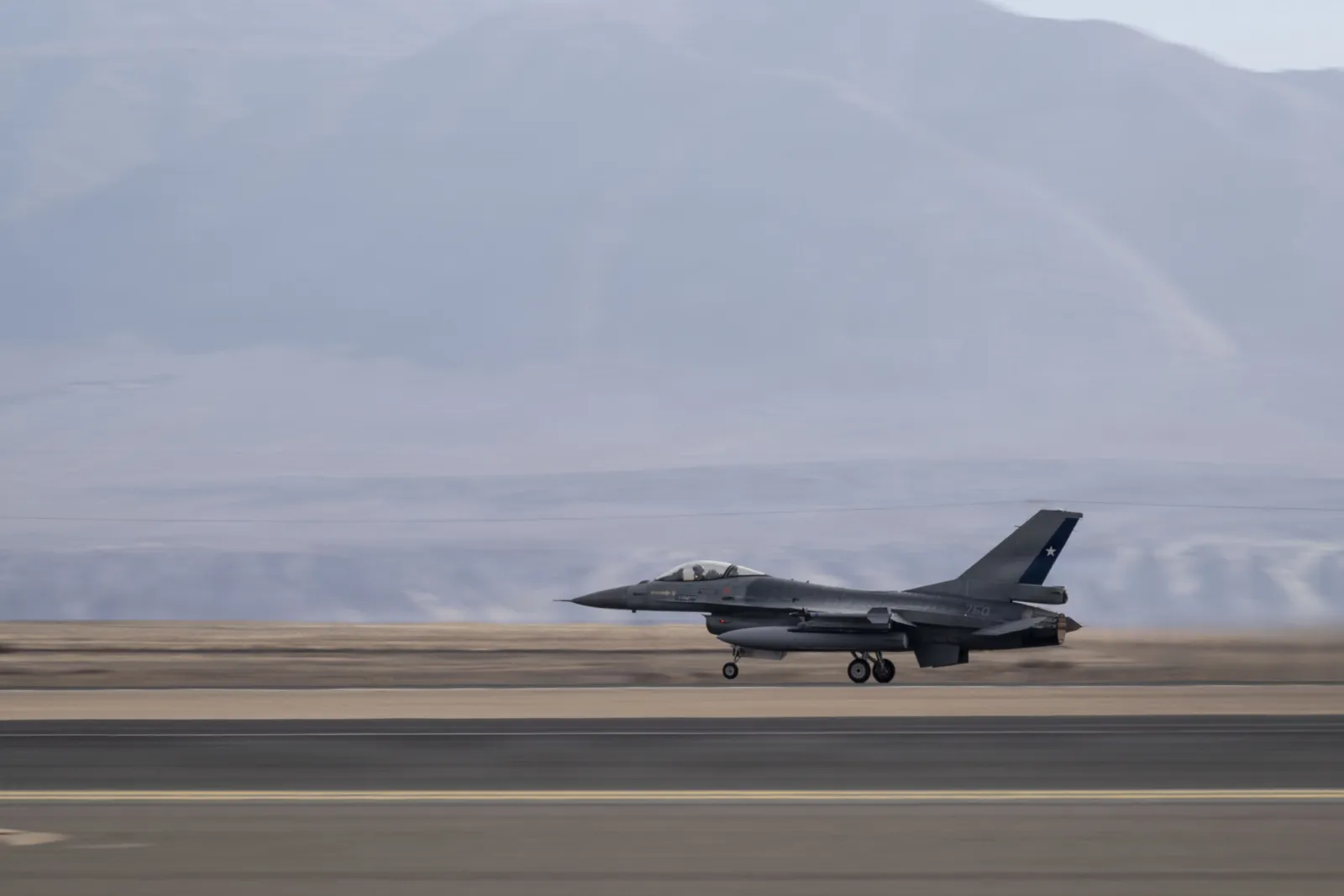
Chile’s military inventory is one of the rare Latin American cases built on quality rather than quantity. With 80,000 active personnel the country does not field the region’s largest army; yet with German-sourced Leopard 2A4CHL tanks, a 46-aircraft F-16 fleet, eight frigates and four submarines it operates the most technologically advanced force structure in South America. Since 2023 two critical strands of that inventory — the fire-control systems of its main battle tanks and the combat management software of two frigates — have been entrusted to the Turkish defence industry.
At a Glance
- Active personnel: ≈ 80,000 active, 40,000 reserve and 50,000 paramilitary (Carabineros); the Navy employs 25,000 and the Air Force 10,600
- Main battle tanks: 386 (GFP 2026); the core is 186 German-sourced Leopard 2A4CHL, the heaviest armoured force in South America
- Military aircraft (total): ≈ 274 (178 ready); the combat core is 46 F-16s and 11 F-5E/F Tigre IIIs, and the attack-helicopter column is zero
- Air defence: Three NASAMS II batteries acquired in 2010 (2 static + 1 mobile) with AMRAAM rounds, complemented by Mistral 1/Mygale and 35 mm Oerlikon and VADS anti-aircraft guns
- Navy: 8 frigates, 4 submarines and 130 platforms in total; one of the largest frigate fleets in the region
- GFP ranking: 49th among 145 militaries (PwrIndx 0.8704); defence budget $6.8 billion (GFP) versus roughly $2.4 billion for 2026 (≈ 1.6% of GDP)
Note: The inventory figures below are approximate values drawn from open sources such as Global Firepower, the IISS Military Balance and SIPRI.
About the Chile Armed Forces
The Chilean Armed Forces comprise the Army (Ejército de Chile), the Navy (Armada de Chile) and the Air Force (Fuerza Aérea de Chile), alongside the Carabineros, a roughly 50,000-strong gendarmerie-type force. In Global Firepower’s 2026 data the country ranks 49th among 145 militaries with a PwrIndx score of 0.8704.
Geography dictates the shape of the force. The Atacama Desert in the north, Patagonia and an Antarctic claim in the south, a coastline of more than 6,400 kilometres to the west and an area of responsibility reaching Easter Island in the Pacific turn the defence of a country 4,300 kilometres long but on average 180 kilometres wide into a problem of range and mobility. That is why the armoured weight is concentrated in the north and why tanker aircraft and an icebreaker occupy such a prominent place in the inventory.
The funding model changed from 2019. The Ley Reservada del Cobre, which channelled part of copper export revenue directly to the armed forces, was abolished and replaced by a Strategic Capabilities Fund based on multi-year planning. The 2026 defence budget stands at roughly $2.4 billion, about 1.6 percent of gross domestic product, while Global Firepower — counting purchasing power and indirect items — gives a figure of $6.8 billion. The gap between the two reflects a methodological difference common in budget readings.
Land Forces Inventory
| System type | Est. quantity |
|---|---|
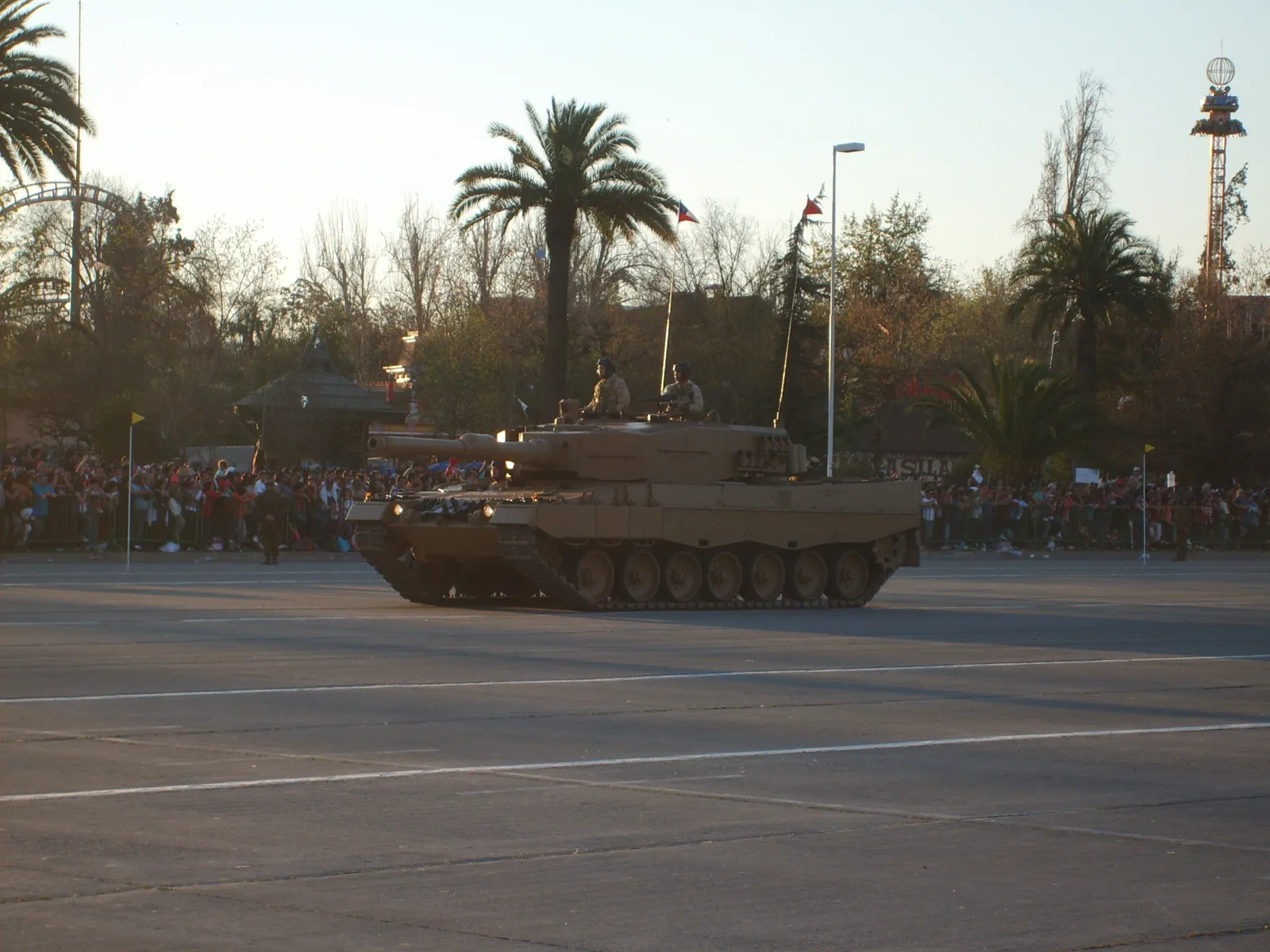
| Main battle tanks (Leopard 2A4CHL) | 186; sourced from Germany and being modernised under the PROACO programme by the ASELSAN-FAMAE partnership |
| Main battle tanks (Leopard 1V) | Fewer than 200; the previous generation, largely in training and secondary roles |
| Infantry fighting vehicles (Marder 1A3) | 180-270; armed with a 20 mm cannon, the mechanised infantry component of the Leopard 2 battalions |
| Armoured personnel carriers (M113A1/A2) | ≈ 408; the numerical backbone of the inventory, part of it refurbished in Chile |
| Armoured personnel carriers (AIFV-B / YPR-765) | 169; Dutch-sourced, including turreted 25 mm variants |
| Wheeled armour (Mowag Piranha 6×6/8×8) | ≈ 177; Swiss design, a substantial share licence-built at FAMAE facilities |
| Self-propelled howitzers (M109A3/A5 CL) | 48; 155 mm, upgraded in Chile |
| Towed howitzers (M101, OTO Melara M-56, Soltam M-71) | ≈ 249 (136 M101 + fewer than 53 M-56 + fewer than 60 M-71); numerous but largely of an older generation |
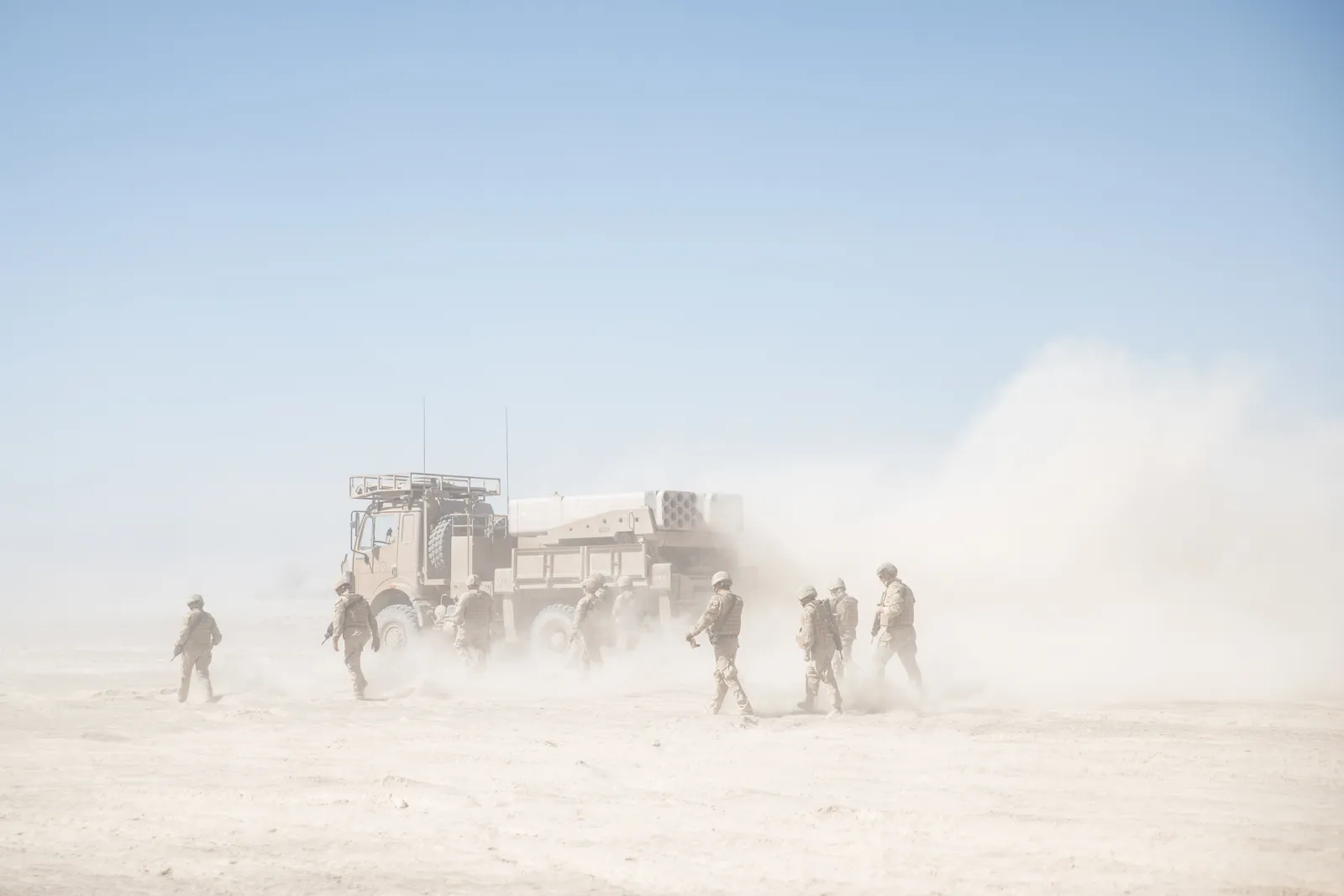
| Rocket artillery (LAR-160) | 8; the Israeli-built 160 mm system, the land forces’ only salvo-fire capability |
| Anti-tank missiles (Spike LR/ER) | ≈ 2,200 rounds; Israeli-sourced, the main anti-tank layer of the land forces |
| Army helicopters (AS532 Cougar, MD530F) | 10 Cougars + 9 MD530F Nightfox; the attack-helicopter column is entirely empty |
| Armoured vehicles (broad definition) | ≈ 7,480 (4,862 ready); GFP’s broad count, which also covers logistics and support vehicles |
Air Force Inventory
| Platform | Est. quantity |
|---|---|
| Total military aircraft | ≈ 274; 178 of them ready |
| Fighters (F-16C/D Block 50) | 10; the only batch bought new, the most capable end of the fleet |
| Fighters (F-16AM/BM Block 15 MLU) | 36; bought second-hand from the Netherlands, the numerical weight of the fleet |
| Fighters (F-5E/F Tigre III) | 11 (8 E + 3 F); still flying with Grupo 12 at Iquique while retirement planning continues |
| Airborne early warning (E-3 Sentry) | 2; one of very few air forces in Latin America operating this class |
| Tankers (KC-135, KC-130) | 3 + 3; the element that solves the range problem across a 4,300 km-long country |
| Transport (C-130H, Boeing 767, Boeing 737) | 4 + 1 + 2; the carrier of Antarctic and Pacific island logistics |
| Light attack / training (A-29 Super Tucano, T-35 Pillán) | 22 + 30; the T-35 is built domestically by ENAER and is due for replacement in 2027-2028 |
| Helicopters (UH-60, Bell 412, UH-1) | 7 + 16 + 13; the total helicopter inventory is 86 and there is no attack helicopter |
| Unmanned aerial vehicles (Hermes 900, Mantis) | 3 + 2; all in the surveillance role, with no armed UAV in the inventory |
Missile and Air-Defence Systems
| System | Type / Note |
|---|---|
| NASAMS II | Three batteries (2 static + 1 mobile) acquired in 2010; with AMRAAM rounds it is the backbone of medium-range air defence |
| Mistral 1 / Mygale | A French-sourced very short-range system; Mygale is the base-defence variant paired with a Thales radar |
| Anti-aircraft guns (Oerlikon GDF, M163/M167 VADS) | 35 mm and 20 mm; the gun-based layer beneath the missile belt |
| Anti-tank missiles (Spike LR/ER) | ≈ 2,200 rounds, used in both vehicle-mounted and dismounted configurations |
| Rocket system (LAR-160) | 8 launchers; 160 mm, fired alongside US HIMARS during the Southern Fenix exercises |
| Air-to-air missiles (AMRAAM, Python IV/V, Derby, Sidewinder) | Carried by the F-16 and F-5 fleets; a mixed US and Israeli stock |
| Anti-ship missiles (Harpoon, Exocet) | Aboard frigates, submarines and fast attack craft; the main element of naval strike power |
| Ballistic and cruise missiles | None; Chile holds no ground-launched ballistic or cruise missile |
Naval Power
| Class / Type | Est. quantity |
|---|---|
| Total naval platforms | ≈ 130; operated by 25,000 personnel including a 5,200-strong marine corps |
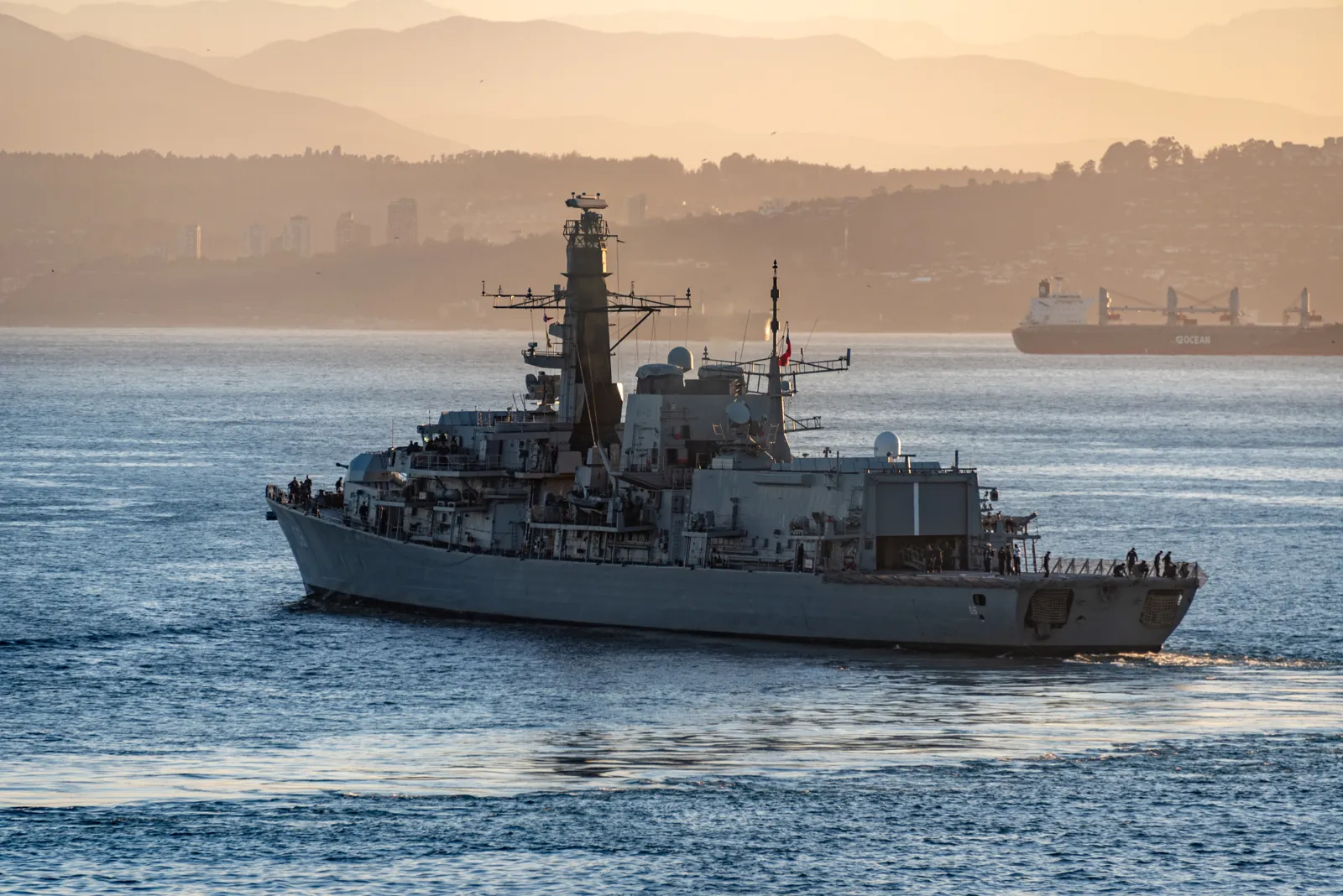
| Frigates (Type 23 / Cochrane class) | 3 (Almirante Cochrane, Condell, Lynch); being modernised with CMS 330, TRS-4D radar and Sea Ceptor |
| Frigates (M class / Karel Doorman) | 2 (Almirante Blanco Encalada, Almirante Riveros); bought from the Netherlands in 2005 and 2007, their combat management system will be HAVELSAN’s ADVENT |
| Frigates (Adelaide class) | 2 (Almirante Latorre, Capitán Prat); transferred from Australia and commissioned in 2020 |
| Frigates (Type 22 Batch 2) | 1 (Almirante Williams); British-sourced, the largest-hulled frigate in the fleet |
| Submarines (Scorpène class) | 2 (O’Higgins 2005, Carrera 2006); a French-Spanish design and among the most modern boats in the region |
| Submarines (Type 209/1400L) | 2 (Thomson, Simpson); German-designed and in service since 1984 |
| Amphibious (Sargento Aldea LSDH, Rancagua, Chacabuco) | 1 + 2; the Foudre-class Sargento Aldea was bought from France in 2011 and is the fleet’s largest landing platform |
| Patrol vessels (OPV-80 Piloto Pardo class) | 4; built domestically at the ASMAR yard, the backbone of exclusive economic zone and Antarctic patrol |
| Fast attack craft (Sa’ar 4 / Casma class) | 3 (Casma, Chipana, Angamos); Israeli-sourced and armed with anti-ship missiles |
| Patrol craft and auxiliaries | ≈ 40 patrol craft (16 of them Protector class) plus replenishment tankers, tugs and the training ship Esmeralda |
| Icebreaker and polar vessel (Almirante Viel) | 1; commissioned in 2024 and built at ASMAR, the most visible instrument of Chile’s Antarctic claim |
The Turkey Angle: Turkish Defence Industry
Chile is the Turkish defence industry’s most concrete reference market in Latin America, and at the centre of that stands ASELSAN’s contract to modernise the Chilean Army’s Leopard 2A4CHL tanks. The company won the tender in July 2023, beating German competitors; on 17 July 2023 ASELSAN announced a $123.5 million contract with an international customer, and industry sources linked that figure to the Chile programme. The local partner is FAMAE, the Chilean Army’s own production organisation, and the contract covers not merely a product sale but technology transfer in tank modernisation and an increase in FAMAE’s capacity. Under the programme, known as PROACO, the tanks receive the Volkan-II fire-control system, the ATS-65D electro-optical system, the Kartalgozu gunner’s sight, the Yamgoz short-range surveillance system, the Goren low-light driver vision system and an internal communications suite; the package also includes commander optics, a battle management system, 360-degree situational awareness, electric turret drives and identification friend-or-foe and laser warning systems.
The programme has not stayed on paper. 2024 was devoted to system design and to defining the architecture against Chilean Army requirements; the 2025-2026 period moved into series integration. The first modernised tanks were delivered in 2025 and completed validation testing. Images published in FAMAE’s 2025 annual report showed modernised Leopard 2A4CHLs passing live-fire trials with in-service Chilean ammunition under the extreme conditions of the Atacama Desert. At the FIDAE 2026 exhibition in Santiago the programme was confirmed to be advancing into its mass production phase. Following the contract, ASELSAN opened its Latin America regional office in Santiago — meaning Chile is not merely a customer but the company’s base on the continent.
The second strand is at sea. On 27 March 2025 HAVELSAN signed an agreement with the Chilean Navy to supply the ADVENT combat management system. It will be integrated into the two M-class frigates bought from the Netherlands in 2005 and 2007 — Almirante Blanco Encalada and Almirante Riveros. The four-year project covers ADVENT’s interoperability with the sensors and weapons already aboard, bringing threat evaluation, decision support, target detection and weapon and sensor control under a single architecture. With this agreement Chile became the ninth country to integrate ADVENT into its naval platforms. A third strand is taking shape in the air: at the FIDAE exhibition in April 2026 Turkish Aerospace signed a memorandum of understanding on unmanned aerial vehicles with ENAER, Chile’s national aerospace company, and its subsidiary DTS. The non-binding document envisages a UAV project proposal based on existing systems such as ANKA or Aksungur and adapted to Chilean Air Force requirements, the participation of ENAER and DTS engineers in training and joint design work at Turkish Aerospace, and the possibility of manufacturing selected components at ENAER’s facilities. There is no Turkish-built unmanned aircraft in Chile’s inventory today; this memorandum is a co-development framework, not a procurement contract.
A long diplomatic foundation underpins this military proximity. Chile was the first Latin American country to recognise the Republic of Türkiye, in 1926, and 2026 marks the centenary of diplomatic relations between the two countries. Chile is also the only Latin American country with which Türkiye has signed a Free Trade Agreement: it was signed in Santiago on 14 July 2009 and entered into force on 1 March 2011. Mutual high-level visits began with President Süleyman Demirel’s trip to Chile in 1995; Ricardo Lagos came to Türkiye in 2004 and Sebastián Piñera in 2012, and the Turkish President visited Chile in February 2016. The most recent political consultations were held in Santiago on 20 February 2024, and the second-term meeting of the Joint Economic Commission took place in Ankara on 9 April 2025. Bilateral trade reached $483 million in 2024 and around $604 million in 2025. The presence of a broad Turkish delegation — Turkish Aerospace, ASELSAN, Otokar, Baykar and Dasal among them — at the biennial FIDAE exhibition in Santiago is the clearest sign of that commercial base extending into defence.
Frequently Asked Questions
How many tanks does Chile have? Global Firepower’s 2026 data lists 386 main battle tanks for Chile, 251 of them ready. The core is 186 Leopard 2A4CHLs acquired from Germany, joined by fewer than 200 Leopard 1Vs. The rest of the armoured force consists of 180-270 Marder 1A3 infantry fighting vehicles, roughly 408 M113s, 169 AIFV-B/YPR-765s and 177 Mowag Piranhas. The Leopard 2A4CHL fleet is currently being modernised by ASELSAN in partnership with FAMAE.
What combat aircraft does the Chilean Air Force fly? The combat fleet consists of two types. The main element is 46 F-16s: 10 F-16C/D Block 50s bought new and 36 F-16AM/BM Block 15 MLUs acquired second-hand from the Netherlands. To these are added 11 F-5E/F Tigre IIIs still flying with Grupo 12 at Los Condores air base in Iquique; their retirement is being planned but they continue to train alongside the F-16s. The fleet is completed by 22 A-29 Super Tucano light attack aircraft, two E-3 Sentry early warning aircraft and six tankers.
How strong is the Chilean Navy? With 25,000 personnel and a 5,200-strong marine corps, the Chilean Navy operates one of the most capable fleets in South America. Its eight frigates come from four different classes: three Type 23s (the Cochrane class), two M-class, two Adelaide-class and one Type 22. The submarine arm holds two Scorpene and two Type 209 boats. At the centre of amphibious capability is the landing ship Sargento Aldea, bought from France, while four OPV-80 patrol vessels built at the ASMAR yard and the icebreaker Almirante Viel, commissioned in 2024, carry out Antarctic and exclusive economic zone patrol.
What is Chile’s air defence like? Layered but limited. The medium-range layer consists of three NASAMS II batteries acquired in 2010 — two static and one mobile, firing AMRAAM rounds. At short range the French-sourced Mistral 1 and the Mygale base-defence variant are in service. Beneath them sit 35 mm Oerlikon GDF and 20 mm M163/M167 VADS anti-aircraft guns. There is no long-range surface-to-air missile system and no ground-launched ballistic or cruise missile in the inventory.
What has Chile bought from the Turkish defence industry? Chile’s relationship with Türkiye is built on systems and modernisation rather than platform purchases. Under the tender it won in July 2023, ASELSAN is modernising the Chilean Army’s Leopard 2A4CHL tanks in partnership with FAMAE; the Volkan-II fire-control system, the ATS-65D electro-optical system and the Kartalgozu gunner’s sight are the main items of that package, and the first modernised tanks were delivered in 2025. Under an agreement signed on 27 March 2025, HAVELSAN will integrate the ADVENT combat management system into two M-class frigates. Turkish Aerospace signed a non-binding memorandum of understanding with ENAER on unmanned aerial vehicles in 2026. There is no Turkish-built unmanned aircraft or armoured vehicle in Chile’s inventory today.
Bottom Line
Chile’s inventory is an exception in Latin America: the country has neither the region’s largest army nor its highest defence budget, yet in platform quality and maintenance discipline it runs the continent’s most consistent force structure. With 186 Leopard 2A4CHLs it fields South America’s only genuine heavy armoured force; with two E-3 Sentries and six tankers it holds an air-control and reach capability with few regional parallels; with eight frigates and four submarines it maintains a serious naval presence in the Pacific. The gaps are just as visible: the attack-helicopter column is entirely empty, there is no armed unmanned aircraft, no long-range air-defence layer has been built and much of the towed artillery belongs to an older generation. Chile’s answer is taking shape around renewing what it already has rather than buying new platforms — the Type 23s’ combat system is being replaced, the Leopard 2A4s’ fire control is being changed, and indigenous multipurpose ships are under construction at ASMAR under Escotillon IV. The Turkish defence industry entered this picture precisely through that preference: ASELSAN beat German competitors to take on the sights and fire control of the continent’s most prestigious tank fleet and then moved its Latin America base to Santiago; HAVELSAN will write the brain of two frigates; Turkish Aerospace has sat down with ENAER at the unmanned-aircraft development table. That a customer as technically demanding as Chile — one that operates German, American, French and Israeli systems side by side — chose Turkish solutions in all three areas is among the clearest indicators of how far Türkiye has come in defence exports. Diplomatic relations entering their hundredth year, and the only Free Trade Agreement in Latin America, offer ready ground for that cooperation to widen further.
Related Reading
Sources
- Global Firepower — Chile
- IISS — The Military Balance
- SIPRI — Arms Transfers Database
- Wikipedia — Chilean Army
- Wikipedia — Chilean Air Force
- Wikipedia — Chilean Navy
- Turkish MFA — Relations between Türkiye and Chile
- Naval News — HAVELSAN ADVENT agreement
- Infodefensa — FAMAE and ASELSAN Leopard 2A4 firing trials
- Defensa.com — ENAER and Turkish Aerospace UAV cooperation