Laser Weapons Explained: What Turkey’s GÖKBERK, ALKA and NAZAR Systems Can Actually Do


The drone war is rewriting the economics of air defense. As cheap FPV quadcopters, mini-UAVs and Shahed-class kamikaze platforms saturate modern battlefields, militaries are no longer asking whether to deploy laser weapons — they are asking how fast. With per-shot costs measured in dollars rather than millions, directed-energy systems are quickly becoming the only economically sustainable answer to massed low-cost air threats.
Turkey has positioned itself among the leading actors in this race, with three distinct systems — ALKA, GÖKBERK and NAZAR — already either in service or in advanced trials. Together they form a layered laser-defense concept that complements rather than replaces traditional missile-based air defense.
How a laser weapon actually works
A laser weapon focuses a beam of coherent light energy onto a precise point on the target, generating intense heat. Depending on power and dwell time, that energy can blind optical sensors, fry electronics, or burn through structural components. Unlike conventional weapons, no ammunition is consumed — only electrical power.
According to defense analysts, the most compelling use-case is not exotic. It is the simple problem of how to engage cheap targets cheaply:
“You cannot stop a $10,000 drone with a $1 million interceptor missile. The math doesn’t work. Lasers solve that math problem.”
Why the drone era changed everything
Battlefields in Ukraine, the Red Sea and the South Caucasus have all underscored a brutal new reality: low-cost flying threats now arrive in swarms, often dozens at a time. Defense planners can no longer assume that every incoming threat will be a high-end ballistic or cruise missile worth a high-end interceptor.
Laser systems offer:
- Engagement at the speed of light — effectively zero flight time
- Per-shot cost measured in single-digit dollars of electricity
- Silent, low-signature operation with no muzzle flash
- Magazine depth limited only by power generation
Turkey’s three-system laser arsenal
Within roughly five years, Turkey has built up a portfolio that addresses three different battlefield problems: short-range UAV defeat, mobile point defense, and electronic disruption of missile seekers.
| System | Manufacturer | Power Output | Primary Targets | Status |
|---|---|---|---|---|
| ALKA | ROKETSAN | 2.5 / 5 kW | Mini/Micro UAVs, asymmetric threats | In service |
| GÖKBERK | ASELSAN + TÜBİTAK BİLGEM | Mobile HEL | FPV drones (1,550 m), fixed-wing UAVs (1,000 m) | Operational tests successful |
| NAZAR | Meteksan Defense | Directional EW laser | EO/IR missile seekers | Naval & land variants planned |
ALKA — Turkey’s first deployed laser shield
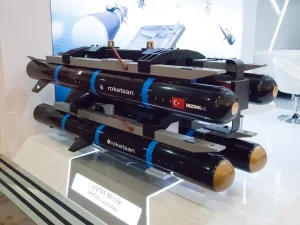
Developed by ROKETSAN, ALKA is the most mature of Turkey’s directed-energy systems. It combines electromagnetic jamming and a laser kill chain into a single platform. Variants at 2.5 kW and 5 kW levels are positioned to defend critical infrastructure, military bases and high-value point targets against mini and micro UAVs.
GÖKBERK — Mobile laser, layered defense
A joint ASELSAN/TÜBİTAK BİLGEM program, GÖKBERK is mounted on a 6×6 mobile platform combining radar, electro-optical sensors and a high-energy laser in one integrated stack. Field trials have demonstrated engagement of FPV drones at 1,550 meters and fixed-wing UAVs at 1,000 meters — important benchmarks for short-range air defense in urban and forward-deployed environments.
NAZAR — Different game, same technology
Unlike ALKA and GÖKBERK, NAZAR from Meteksan Defense is not designed to physically destroy targets. Instead, it directs laser energy at the electro-optical and infrared seeker heads of incoming missiles, blinding or confusing them. Naval and land variants are planned for protecting key bases and warships — a critical capability as anti-ship missile threats proliferate.
The limitations no one talks about
Despite the hype, lasers are not a silver bullet. Three constraints define the realistic envelope:
- Power generation: a multi-hundred-kW system needs serious onboard power and cooling
- Atmospheric attenuation: fog, heavy rain, dust and turbulence degrade beam coherence
- Dwell time: kill effects require beam-on-target for seconds, not milliseconds
For now, lasers are best understood as a complementary layer sitting beneath missile-based air defense — not a replacement for it.
The global race accelerates
Israel’s Iron Beam, the U.S. Army’s DE M-SHORAD and the Navy’s HELIOS, the United Kingdom’s DragonFire, and China’s Silent Hunter all signal that directed-energy weapons have crossed from laboratory to the operational edge. Turkey’s ALKA, GÖKBERK and NAZAR place Ankara not as a follower but as a solution-developer in this new tier.
Bottom line
Gunpowder is not going away. But in an era defined by cheap drones and saturation attacks, the laser is becoming the most efficient way to defend critical points and forward units. Turkey’s three-system approach — area defense (ALKA), mobile defense (GÖKBERK) and missile-seeker disruption (NAZAR) — looks increasingly like a template others may follow.
Sources
- ASELSAN — aselsan.com.tr
- ROKETSAN — roketsan.com.tr
- Meteksan Defense — meteksan.com
- Open-source compiled defense reporting