Keel Laid for India’s First Next Generation Missile Vessel

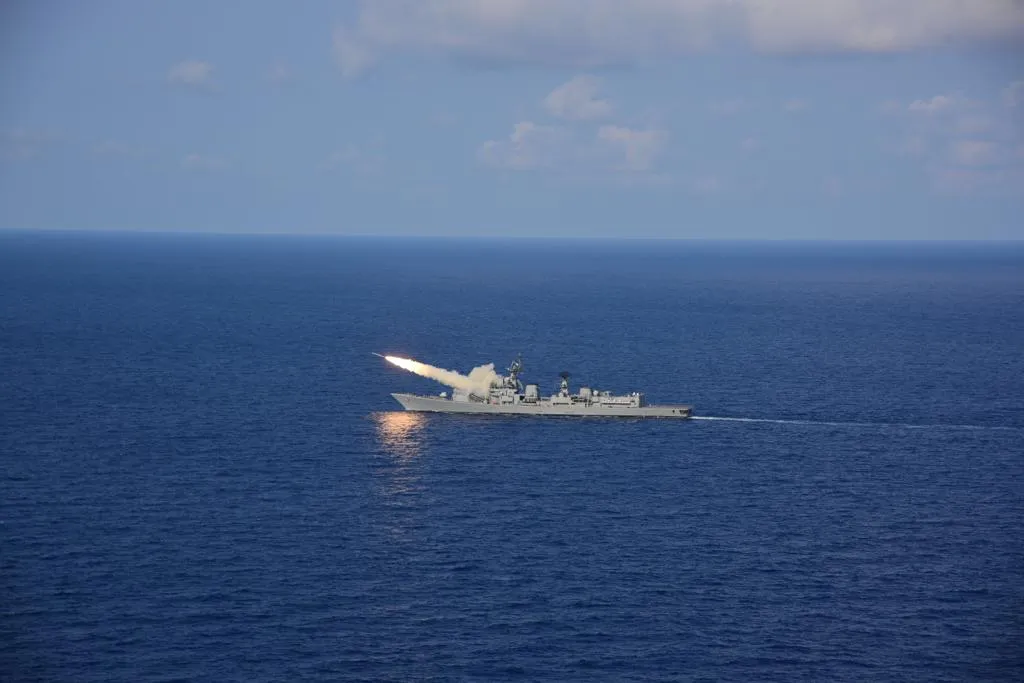
Cochin Shipyard has laid the keel for the first of six Next Generation Missile Vessels ordered by the Indian Navy. The programme centres on a small, heavily armed strike platform built around the BrahMos supersonic missile.
Keel laid on 18 September
The keel of yard number BY 531, the lead Next Generation Missile Vessel (NGMV), was laid at Cochin Shipyard Limited (CSL) in Kerala on 18 September 2026. Vice Admiral Sanjay Sadhu, Controller of Warship Production and Acquisition at Integrated Headquarters of the Indian Navy, officiated.
Keel laying is the first substantial physical milestone after steel cutting, which for the lead ship took place in December 2024. The ceremony came a day after steel was cut for the second vessel on 17 September, attended by Rear Admiral Kapil Mehta, Assistant Controller of Warship Production and Acquisition. Running the two events back to back signals CSL’s intention to build the class in overlapping batches rather than sequentially.
Contract and schedule
CSL signed a ₹9,804 crore contract — comfortably over $1 billion — with India’s Ministry of Defence in March 2023 for the design and construction of six NGMVs. Delivery of the lead ship was originally slated for early 2027. With the keel only now on the slipway, that date has clearly moved to the right.
A corvette built to hit things, not to escort
The NGMV sits outside the usual multi-role corvette definition. The Indian Navy describes its primary role as providing offensive capability against enemy warships, merchant shipping and land targets — a strike platform first, with self-defence fitted around it rather than the other way round.
The weapons fit matches that description:
- BrahMos: four supersonic anti-ship/land-attack missiles in two bow-mounted inclined launchers
- VLSRSAM: vertically launched short-range air defence
- 76 mm SRGM super rapid gun mount
- Stern-mounted CIWS with its own fire control radar
- Bharat Electronics MFR: multi-function air surveillance and fire control radar, roughly 200 km range
The ship carries a crew of 80 and reaches 33 knots on three Kamewa waterjets driven by a single GE Aerospace LM2500 gas turbine. Waterjets buy acceleration and shallow-water handling at the cost of long-range cruise efficiency — the propulsion choice of a littoral strike ship, not a blue-water escort.
The supply chain
The programme reflects India’s indigenisation push without pretending to be fully domestic. LM2500 engines are assembled by Hindustan Aeronautics Limited. Bharat Electronics received an ₹850 crore order for the X-band MFR in September 2024. Kongsberg Maritime is supplying 18 large Kamewa waterjets under an April 2026 contract.
Where the NGMV fits
The class replaces the Veer and Prabal missile boats that have served since the 1990s, and the difference is not merely one of tonnage. The older boats were built around Soviet-derived Kh-35 variants and a short engagement envelope bounded by their own radar horizon. The NGMV pairs BrahMos range with targeting data drawn from maritime patrol aircraft, unmanned systems and satellite links — the shooter at the end of a sensor network rather than a self-contained hunter.
That places it in the same conceptual family as several contemporary programmes, including Türkiye’s integration of the ATMACA anti-ship missile onto ADA-class corvettes and İSTİF-class frigates: concentrated strike power on a modest hull. The design divergence lies in the missile itself — BrahMos trades a large signature and high cost for supersonic terminal speed, while ATMACA follows a subsonic, sea-skimming profile optimised for late detection.
Sources
- Cochin Shipyard Limited — keel laying and steel cutting announcements, 17–18 September 2026
- Indian Ministry of Defence — NGMV contract announcement, March 2023
- Naval News, “Cochin Shipyard Lays Keel for Indian Navy’s First NGMV”, 20 September 2026
- Bharat Electronics Limited — MFR radar order announcement, September 2024