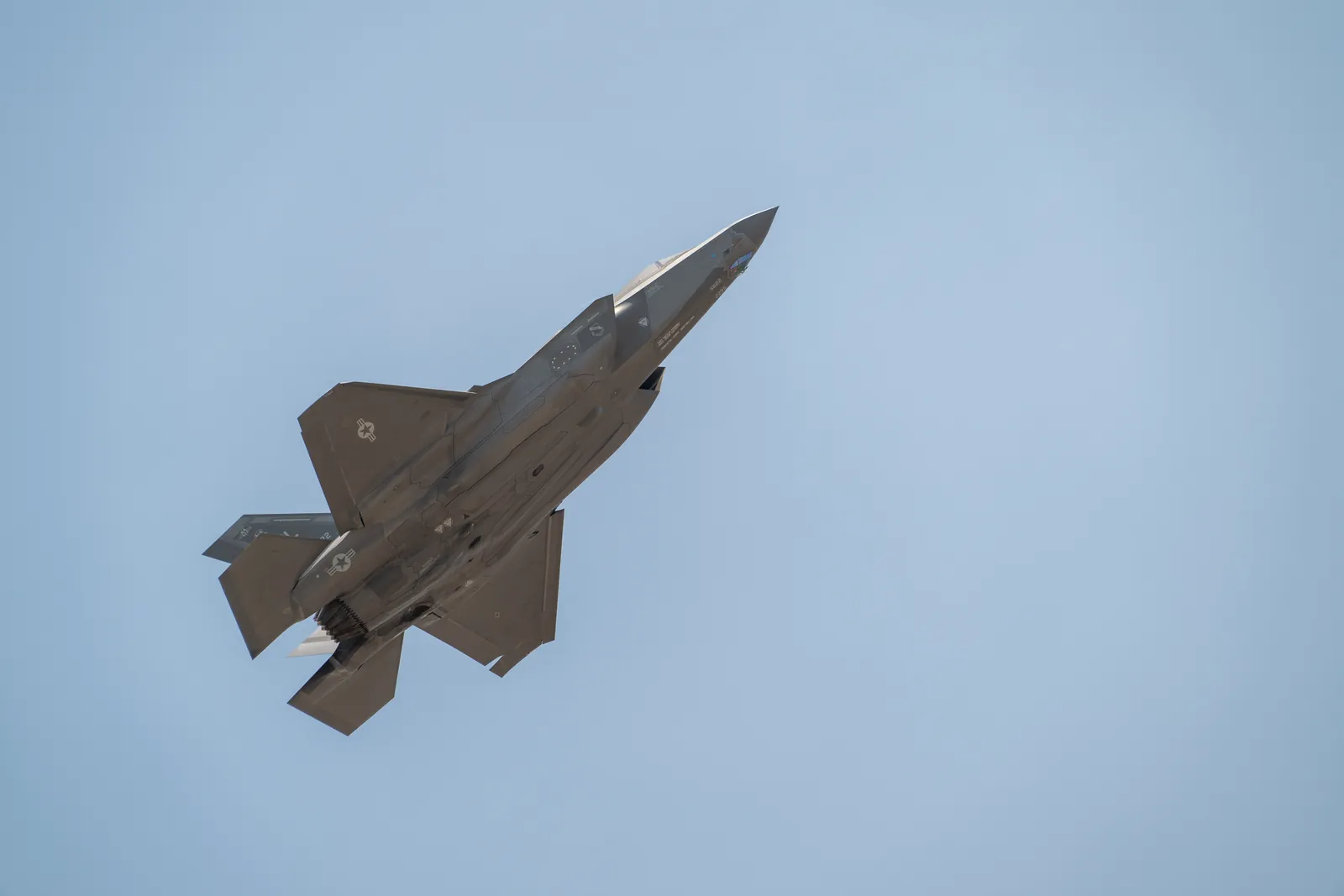
Lockheed Martin F-35 Lightning II. Source: Wikimedia Commons (CC BY-SA 4.0).
The F-35 Lightning II is a fifth-generation, single-engine, stealth multirole fighter built by the U.S. company Lockheed Martin. It is the most widely fielded stealth fighter in the world: by the end of 2025 roughly 1,300 aircraft had been delivered and more than 19 nations operate or have ordered the jet. This reference page explains what the F-35 is, its technical specifications, unit cost, operator countries, how it compares with the Russian Su-57 and Chinese J-20/J-35, and why Turkey was removed from the program.
On this page: what the F-35 is, technical specifications, variants (A/B/C), operator countries, orders & deliveries, cost and contracts, Su-57 / J-20 / J-35 / KAAN comparison, the Turkey story, strengths and criticism, FAQ and sources.
What is the F-35 Lightning II?
The F-35 is a fifth-generation multirole fighter that combines air superiority, strike against land and sea targets, reconnaissance and electronic warfare in a single platform. It is defined by low observability (stealth), advanced sensor fusion and network-centric operation alongside allied forces.
It is produced in three variants: the conventional take-off and landing F-35A, the short take-off / vertical landing F-35B, and the carrier-based F-35C. This versatility has made the F-35 the common backbone of NATO and allied air forces.
Technical specifications
Feature
Value
Role
5th-gen single-engine stealth multirole fighter
Manufacturer
Lockheed Martin (US)
First flight / service
2006 / 2015
Engine
1 × Pratt & Whitney F135 (~43,000 lbf with afterburner)
Max speed
~Mach 1.6 (~1,930 km/h)
Combat radius
~1,100–1,240 km (F-35A, internal fuel)
Length / wingspan
~15.7 m / ~10.7 m (F-35A)
Crew
1
Radar
AN/APG-81 AESA
Internal weapons
Air-to-air & air-to-ground; external stations for non-stealth loadouts
Variants
F-35A (CTOL), F-35B (STOVL), F-35C (carrier)
Variants: A, B and C
Variant
Type
Primary users
F-35A
Conventional take-off & landing (CTOL)
Air forces — the most-produced variant (e.g. US, Norway, Israel, Japan, Poland)
F-35B
Short take-off / vertical landing (STOVL)
US Marines, UK, Italy — operates from short decks and amphibious ships
F-35C
Carrier variant (larger wing, tailhook)
US Navy — catapult launch / arrested recovery from aircraft carriers
Which countries operate the F-35?
The F-35 has become the common fighter of the Western world. The table below summarises the main operators and their status according to open sources.
Lockheed Martin delivered a record 191 F-35s in 2025, bringing the cumulative total to roughly 1,300 aircraft. The stable production rate is about 156+ jets per year. The Lot 18–19 contract alone covers 296 aircraft. Major order books include the United Kingdom (138), Japan (147), Italy (90) and Canada (88).
Cost and contract values
Important: dividing a package contract by the number of aircraft does not give the true unit price. Contracts can also cover engines, training, spares, maintenance, simulators and logistics. The figures below are approximate, open-source values; year and scope are stated separately.
Cost type
Approx. value
Year / scope
Note
F-35A fully equipped flyaway
~$101.5M
2025 (Lot 18)
Airframe ~$81.1M + F135 engine ~$20.4M
F-35B (STOVL)
~$109M
Recent lots
Short take-off / vertical landing
F-35C (carrier)
~$102M
Recent lots
Carrier variant
F135 engine (unit)
~$20M
2025
Up from ~$14–15M in Lot 17
Lot 18–19 package
~$24.29B / 296 aircraft
2025
Avg ~$82.4M (bare airframe, all variants); not a unit price
Program lifetime cost
>$2 trillion
Through 2088 (US)
Acquisition + sustainment (GAO)
US sustainment cost
~$1.58 trillion
2023 estimate (GAO)
US fleet only; +44% vs 2018
F-35 unit cost varies by variant, production lot and contract scope. With Lot 18 (2025) the fully equipped F-35A passed $100 million for the first time, driven by inflation, raw-material costs and rising engine prices. The program’s lifetime cost exceeds $2 trillion through 2088, making the F-35 the most expensive weapon system in U.S. history.
Rivals and equivalents: Su-57, J-20, J-35, KAAN
The F-35’s closest global counterparts are the fifth-generation Su-57 (Russia), J-20 and J-35 (China), and Turkey’s in-development KAAN. These are not identical in mission, however: the F-35 is designed as a networked multirole system, the J-20 emphasises long-range air superiority, and the Su-57 prioritises manoeuvrability. Read the table below as a near-class comparison, not direct equivalence.
Criterion
F-35 (US)
Su-57 (Russia)
J-20 (China)
J-35/J-35A (China)
KAAN (Turkey)
Manufacturer
Lockheed Martin
Sukhoi (Rostec)
Chengdu (AVIC)
Shenyang (AVIC)
TUSAŞ
First flight
2006
2010
2011
2011 (FC-31 demo)
2024
In service
2015
~2020
2017
J-35A: 2025
Target ~2028
Max speed
~Mach 1.6
~Mach 2
~Mach 2
~Mach 1.8 (est.)
Target ~Mach 1.8
Combat radius
~1,100–1,240 km
Longer on paper (~1,500 km+)
~1,500 km+ (long range)
Not disclosed
Not disclosed (in dev.)
Stealth approach
Full-design + sensor fusion
Partial (mainly frontal)
Mainly frontal
Close to F-35 class
Targeted 5th-gen
Numbers built
~1,300 delivered (2025)
<30 in service
~300+ (2025)
>57 built
Prototype / development
Annual output
~156–191
Low (dozens)
~100–120
~70–100
Not yet serial
Users / export
19+ nations, very broad
Mostly Russia; export new
PLAAF only (no export)
China (air+naval); export potential
Turkey only (planned)
Combat record
Yes (e.g. Israel)
Limited (Syria/Ukraine, standoff)
Not disclosed
None
None
Assessment: in production scale and export reach the F-35 leads by a wide margin, with a mature supply chain across 19+ nations. China’s J-20 has grown rapidly past 300 airframes but is not exported and serves only the PLAAF. The Su-57 offers longer range and higher speed on paper but is produced in small numbers with a more limited stealth approach. The J-35 is the Chinese system closest to the F-35 in size and mission and is also being fielded for carrier duty. KAAN is still in development, so its figures here are targets/estimates, not verified in-service data.
Equivalent classes: the Russian counterpart is the Su-57 (mission alternative, not a full equivalent); the Chinese counterparts are the J-20 for air superiority and the J-35 in size/carrier role; the Turkish counterpart is KAAN. The F-35 has no exact equivalent at the level of its multirole sensor fusion and allied integration, but these systems are being developed to perform similar missions.
Turkey and the F-35: from partner to exclusion
Turkey was both a production partner and a customer that had ordered 100 F-35As. After Turkey purchased the Russian S-400 air-defence system, the United States removed Turkey from the F-35 program in July 2019. Turkey had paid roughly $1.4 billion; six aircraft that had already been built were never delivered.
To fill the gap, Turkey ordered 44 Eurofighter Typhoons, pursued F-16 modernisation, and accelerated its indigenous fifth-generation fighter, KAAN, which first flew in 2024 with deliveries targeted from 2028.
Strengths and criticism
Strengths: genuine all-aspect stealth, industry-leading sensor fusion, deep allied interoperability, combat experience and the largest fifth-generation production base in the world.
Criticism: high acquisition and sustainment cost (US lifetime sustainment ~$1.6 trillion), a declining mission-capable rate (GAO reported a fall from 67% to 44%), engine and software-upgrade (TR-3/Block 4) delays, and logistics dependency on the U.S.-managed supply chain.
Manufacturer: Lockheed Martin
The F-35 is built by Lockheed Martin, the world’s largest defence company, with the F135 engine supplied by Pratt & Whitney and major structures by Northrop Grumman and BAE Systems. Final assembly takes place in Fort Worth (US), Cameri (Italy) and Nagoya (Japan).
Frequently asked questions
Which countries operate the F-35?
Besides the United States, the F-35 is operated or on order by the UK, Italy, Israel, Japan, Australia, South Korea, Norway, Denmark, the Netherlands, Belgium, Finland, Poland, Germany, Switzerland, Romania, the Czech Republic, Greece, Canada and Singapore — more than 19 nations in total.
How much does an F-35 cost?
As of 2025 (Lot 18) a fully equipped F-35A costs about $101.5M (airframe ~$81M + engine ~$20M). The F-35B is ~$109M and the F-35C ~$102M. The Lot 18–19 package is ~$24.3B for 296 aircraft; dividing the package by aircraft does not give the true unit price. Program lifetime cost exceeds $2 trillion.
What is the Russian and Chinese equivalent of the F-35?
The Russian counterpart is the Sukhoi Su-57 (Felon), though it is produced in small numbers (fewer than 30 by 2025). China fields the air-superiority J-20 (300+ in 2025) and the F-35-sized, carrier-capable J-35. These are near-class rivals rather than exact equivalents.
How many F-35s have been built?
By the end of 2025 roughly 1,300 F-35s had been delivered, with output reaching about 191 aircraft in 2025. The Lot 18–19 contract covers 296 aircraft.
Why did Turkey not get the F-35?
Turkey was removed from the program in July 2019 after buying the Russian S-400 air-defence system. It had ordered 100 F-35As and paid about $1.4 billion; six completed aircraft were never delivered.
Is the F-35 still in production?
Yes. Lockheed Martin produces about 156+ F-35s per year and delivered a record 191 in 2025, with deliveries planned well into the 2040s.