US Army Showcases Next-Gen M1E3 Abrams: Unmanned Turret, Hybrid Propulsion, and 60-Ton Drone Era Tank

According to reports from Defence Industry Europe on Sunday, the design signed by GDLS has significantly diverged from the first M1E3 demonstrator showcased in January. The side profile is now much closer to the company’s AbramsX demonstrator; the new geometric form of the unmanned turret, a new basket located at the turret bustle, and the unusual expansion between the first and second road wheels indicate that the tank’s hull has also been redesigned.
At a Glance
- Platform: M1E3 Abrams (future series name M1A3)
- Target weight: ~60 tons (approximately 20+ tons lighter than M1A2 SEPv3)
- Propulsion: Hybrid diesel-electric + high-efficiency transmission
- Turret: Unmanned, autoloader, three-person crew
- Main armament: 120 mm M256 smoothbore / secondary 30 mm M230LF (Northrop Grumman)
- Active protection: XM251 (Iron Fist based, M251)
- Contract: Abrams Requirements Contract III ≈ 3.8 billion USD, expected for FY2026 GDLS
- Service target: Around 2030
Background: Lessons from Ukraine and Hybrid Propulsion Preference
Data compiled by Army Recognition from NDIA MDEX 2026 indicates that the M1E3 program is a direct response to experiences on the battlefield in Ukraine. U.S. Army sources emphasize that the new hybrid-electric propulsion architecture provides three key benefits: significant reduction in fuel consumption, increased range, and reduction of thermal/acoustic signature. Moreover, the architecture generates additional electrical power for future directed energy weapons, advanced sensor packages, and electronic warfare systems.

Details: Turret, Protection, and Crew Capsule
The most critical result of transitioning to an unmanned turret is that the crew will now be seated in a plated capsule. Three soldiers — driver, gunner, commander — will operate side by side in a semi-reclined position similar to that of the driver. This architecture directly addresses the fact that a significant portion of tank losses in Ukraine has resulted from turret hits.
| System | Supplier | Function |
|---|---|---|
| 120 mm M256 | Watervliet Arsenal | Main smoothbore gun, modernized |
| 30 mm M230LF | Northrop Grumman | Secondary turret — UAV defense, light target |
| XM251 (M251) | GD-OTS (based on Elbit Iron Fist) | Hard-kill active protection — joint U.S. standard |
| Hybrid diesel-electric | Supplier not disclosed | Low thermal-acoustic signature, backup power |
| Automatic loader | Integrated within turret | Crew reduced from 4 → 3 personnel |
The preference for the M251 also signals an important doctrinal decision within the U.S. Army: the active protection system will be expanded to Stryker and Bradley platforms by 2028. Thus, the Rafael Trophy HV currently in M1A2 SEPv3 fleets will gradually say goodbye to the field.
NATO and Pacific Context
The 60-ton target is not coincidental. Defence Industry Europe sources remind that the European infrastructure (especially bridges) is becoming increasingly less suitable against the M1A2’s 73-ton mass. In the Pacific theater, the issue is even more serious: the capacity for sea transport in island-based operations, the ability to establish fresh bridges, and off-shore landings make a 73-ton tank impractical. The range advantage provided by hybrid propulsion also raises logistical resilience at a time when fuel convoys have become primary UAV targets in Ukraine.
What Does This Mean for Turkey?
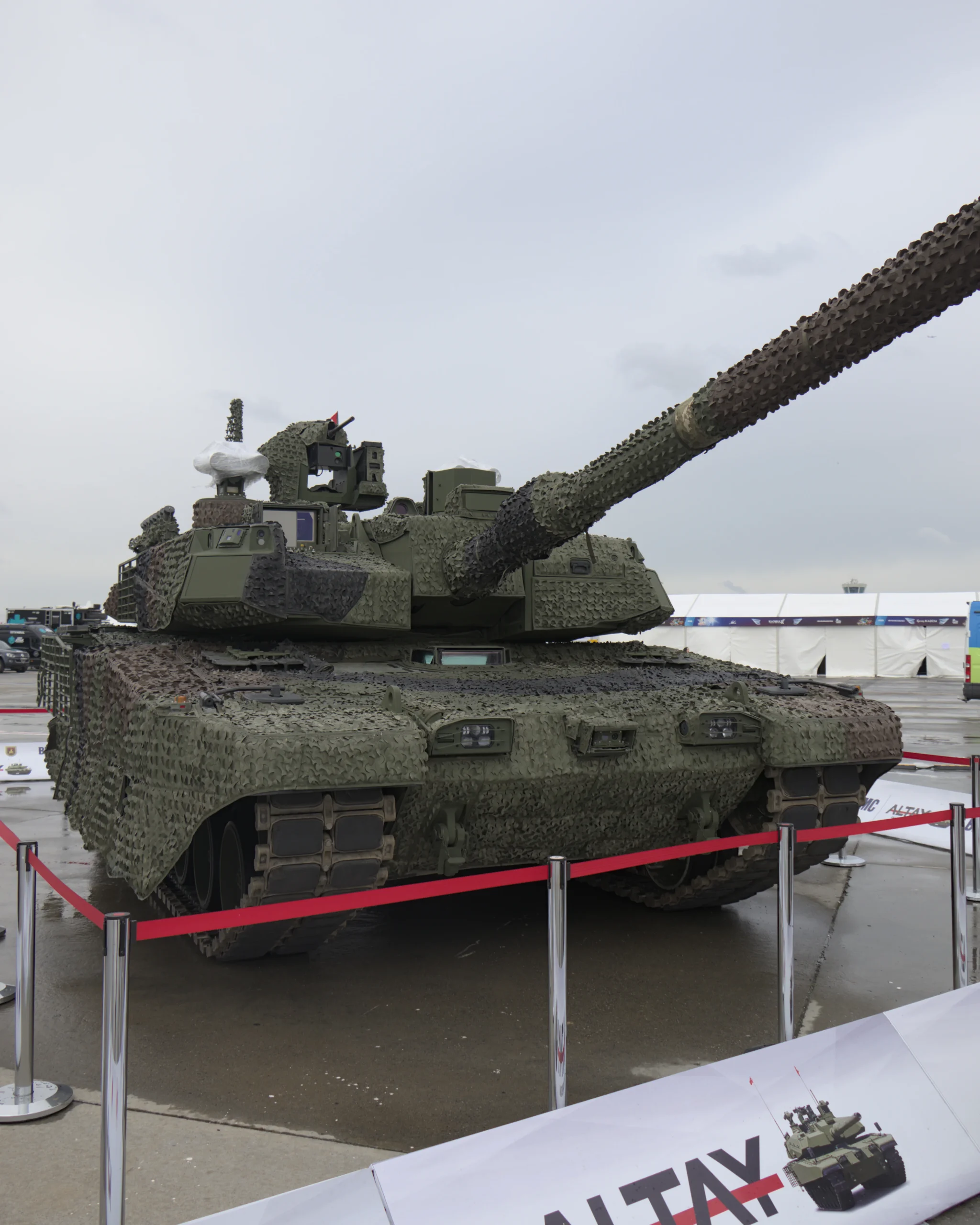
The design philosophy indicated by the M1E3 program — reduced mass, hybrid propulsion, unmanned turret, distributed active protection — holds special significance for Turkey’s main battle tank roadmap. The current configuration of the ALTAY T1, developed by Otokar and with a serial production contract awarded to BMC, carries the domestic PULAT (ASELSAN) system instead of a Trophy-like Rafael-based active protection. This situation provides Turkey with a critical advantage for a fully domestic hard-kill standardization parallel to the U.S.’s single standard APS registration process.
Furthermore, Turkey is working on the integration of the domestic engine BATU (BMC Power) and the VOLKAN (ASELSAN) fire control system for the ALTAY; it has also preemptively addressed Pacific-like bridge and sea transport constraints with the KAPLAN MT medium tank platform. In other words, Turkish industry has started a step ahead in the equation that Washington is currently discussing as “60 tons for the Pacific” with the 35-ton class solution of the KAPLAN MT. The fact that the ALTAY is in the serial production phase compared to the M1E3 can be interpreted as a concrete gain from Turkey’s persistent domestic tank strategy over the past decade.
Frequently Asked Questions
What is the difference between M1E3 and M1A3? M1E3 is the code name for the engineering development design. With the maturation of the program and its field deployment, the official serial name will change to M1A3. However, the U.S. Army emphasizes that this is not an “upgrade,” but rather a completely new tank.
What will happen to the existing M1A2 SEPv3s? They will continue to remain in the field in the short to medium term. Modernization packages (LWR, DVE-HD, anti-UAV) are ongoing with Trophy HV. The field deployment of the M1E3 is planned for after 2030.
Can Turkey’s ALTAY tank be compared to the M1E3? The ALTAY is a modern 3.5 generation tank in the 65-70 ton class, carrying a diesel engine and PULAT APS. The M1E3, on the other hand, is a candidate for 4th generation classification with hybrid propulsion and an unmanned turret. In the current version comparison, the ALTAY has practical advantages (in production), while the design philosophy represents a more radical break with the M1E3.
When will the three prototypes enter testing? The U.S. Army will receive three additional test vehicles by the summer of 2026. These prototypes are expected to differ significantly from the pre-prototype shown in January; some technical solutions may be tested in parallel.
Conclusion
The M1E3 concept showcased in Detroit clearly indicates that the U.S. Army will prioritize armored agility and survival in drone-dense environments in the next decade. For Turkey, this once again confirms that the domestic armored strategy centered around ALTAY and KAPLAN MT is seeking answers to the right questions at the right time.