Britain Hands Ukraine the Classified Half of a Cruise Missile

The British government has authorised missile manufacturer MBDA to release classified information on the British components of the SCALP cruise missile to Ukraine. The decision opens the way to assembling a long-range cruise missile on Ukrainian soil while the war is still being fought.
What was actually approved
UK Prime Minister Andy Burnham announced the move during a visit to Kyiv. London has agreed that MBDA may release classified information on British components of the long-range SCALP missile in order to establish local assembly lines in Ukraine.
The scope is narrower than the headline suggests. What is planned in Ukraine is final assembly, not manufacture from raw stock. Key components will continue to arrive from Britain and France. A French-Ukrainian letter of intent signed in February is expected to provide the legal basis for the project.
Ukraine’s long-range problem is not design
Ukraine has spent the past two years building its own deep-strike inventory: land-attack variants of the Neptune, turbojet-powered systems such as Palianytsia and Ruta, and the large-bodied Flamingo. What those programmes share is a production ceiling. Designing a missile and producing it at the tempo the front consumes it are two different industrial problems.
A SCALP assembly line addresses the second one directly. It inherits a mature, combat-proven design instead of carrying first-article risk — at the price of continued dependence on foreign component flow.
One missile, two names
Storm Shadow is the Anglo-French stand-off cruise missile developed in the 1990s and fielded in 2003. The French inventory designates it SCALP-EG; the two names describe the same baseline weapon.
It weighs roughly 1,300 kg and carries a 450 kg penetrating warhead. Cruise speed sits around Mach 0.95 — just below the sound barrier. Stated range exceeds 550 km, though export configurations are commonly capped nearer 250 km. Guidance combines inertial navigation, satellite data, terrain-profile matching and an infrared seeker in the terminal phase.
That four-layer stack is why the weapon has performed in Ukraine since spring 2023. In an environment where satellite navigation is contested almost continuously, a missile that can fall back on terrain matching and imaging seeker recognition is one of the few Western stand-off weapons with a verified record.
Why move assembly at all
Every donated round comes out of a donor’s own war stock, and European production lines have a finite annual output. Moving final assembly forward decouples delivery tempo from donor political calendars, as long as component flow holds.
There is a logistics argument too. A completed missile has to be moved intact from border to launch unit. Components can travel in smaller lots along more dispersed routes, which lowers the loss from any single strike on a storage node.
What classified data means here
Assembling a cruise missile is not bolting airframe sections together. Calibrating the guidance unit, wiring warhead safe-and-arm circuits, integrating the engine and running final acceptance tests all require the manufacturer’s classified technical documentation. That documentation is precisely what London has agreed to open.
In export-control terms this is unusual. Western manufacturers do not normally share stand-off missile technical data with states that are not production partners. Extending it to a country at war resets where Europe’s technology-transfer threshold sits.
The French half and Project Brakestop
France is the other partner. Under a 2025 agreement the two nations relaunched Storm Shadow/SCALP production while working together on a replacement munition. President Emmanuel Macron co-chaired the Coalition of the Willing meeting during Burnham’s visit, underlining that the project has two capitals rather than one.
The move also aligns with Project Brakestop, aimed at developing low-cost long-range strike weapons. The emerging shape is a two-tier inventory: a small number of expensive, high-penetration rounds alongside a large number of cheap ones.
The wider read
The structural lesson matters more than the technical one. Owning a missile design and producing that missile at wartime tempo are separated by a supply chain, and the gap is closed by domestic component capacity rather than by drawings.
Turkey’s own stand-off portfolio illustrates the same calculation from the other direction. TÜBİTAK SAGE’s SOM family and ROKETSAN’s ÇAKIR occupy this band, with SOM-J sized specifically for the F-35 internal bay. The emphasis in those programmes on indigenous guidance software, inertial measurement units and turbojet propulsion is an answer to exactly the dependency problem Ukraine is now negotiating around.
Sources
- Statements by the UK Prime Minister in Kyiv, 24-25 August 2026
- Breaking Defense, 25 August 2026
- Defence Industry Europe, 26 August 2026
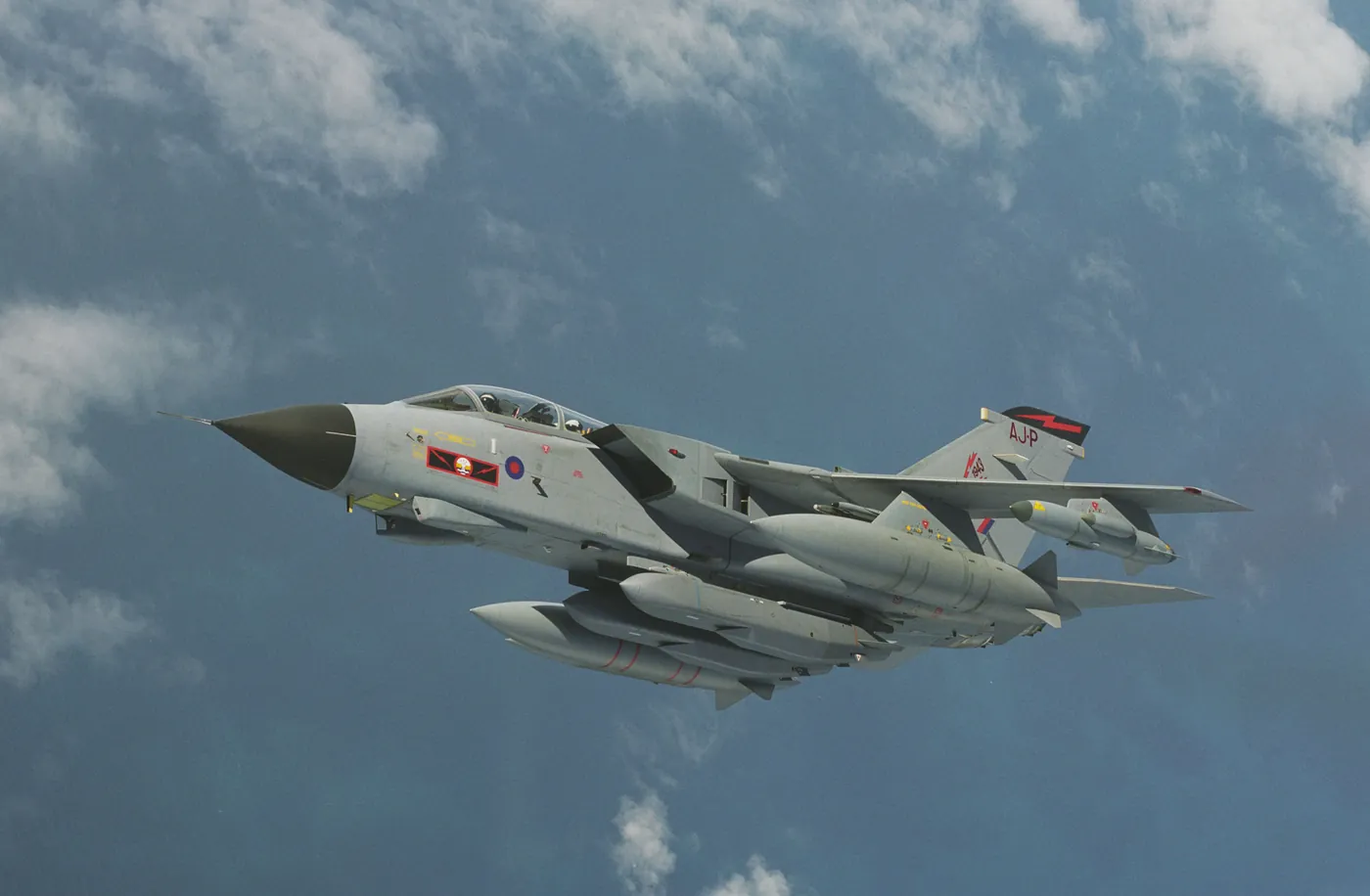
Image: Storm Shadow / SCALP-EG cruise missile (representative). Source: Wikimedia Commons.