USS Theodore Roosevelt Relieves George Washington in the Middle East as Navy Admits Firing ‘Expired’ Munitions

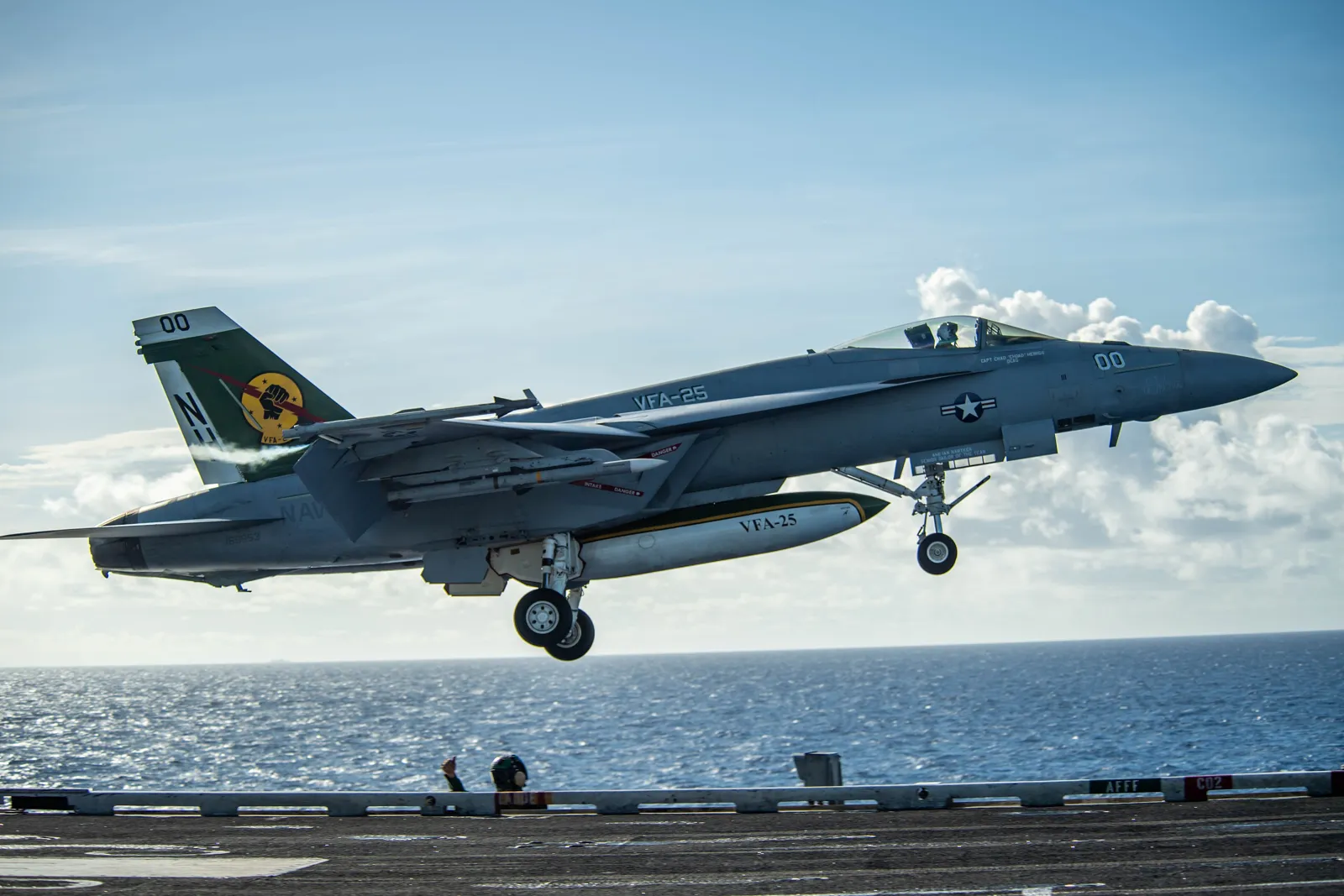
The aircraft carrier USS Theodore Roosevelt is now operating in the Middle East after relieving USS George Washington, the US Navy confirmed in late November 2026. The rotation comes as Acting Navy Secretary Hung Cao told senators that the service recoded and fired munitions classified as “expired” during the war with Iran, a disclosure that has sharpened debate in Washington about the depth of US weapons stocks.
The carrier rotation
Theodore Roosevelt left San Diego on 27 September, called at Singapore and passed through the Strait of Malacca before entering the Central Command area around 15 November. For a short period three US carriers were in the region, together carrying ten F/A-18E/F Super Hornet squadrons, two F-35C squadrons and three EA-18G Growler squadrons. George Washington, which deployed from Yokosuka in May and arrived in the Middle East on 19 August to relieve USS Abraham Lincoln, has now moved back into the US 7th Fleet area.
USS George H.W. Bush remains in theatre, more than 230 days into a deployment that began on 31 March. Families have been told to expect up to a year at sea, and the Navy is preparing USS Dwight D. Eisenhower to relieve it eventually. Theodore Roosevelt’s escorts include the cruiser USS Chosin and the destroyer USS Decatur.
| Carrier | Status (late Nov 2026) |
|---|---|
| USS Theodore Roosevelt (CVN-71) | Arrived in CENTCOM, mid-November |
| USS George H.W. Bush (CVN-77) | In theatre since April; extended deployment |
| USS George Washington (CVN-73) | Departed to 7th Fleet area |
“Code echo, code foxtrot”
At his Senate Armed Services Committee confirmation hearing on 17 November, Cao said many munitions used during Operation Epic Fury had been recoded from “code echo” and “code foxtrot”, categories for material classed as unserviceable but repairable. He compared the process to reviving stale bread, a remark that drew criticism. Experts quoted by Military Times said such munitions can remain effective after inspection for cracks, mechanical faults and fuze function, much like medicines past their labelled shelf life.
Cao also said the Navy faces five years with nine carriers available, two short of the 11 required by law, and that 17 destroyers support the blockade of Iran. The Washington Post reported in March that at least 850 Tomahawks were fired in the first month of the war; Raytheon received a $22.9 billion, seven-year contract in August to raise Tomahawk output to more than 1,000 a year.
Analysis: stretched carriers, thin magazines
The rotation keeps two carriers in the Middle East, but at a cost elsewhere. Senators have questioned the lack of carrier coverage in the Pacific, and long deployments are wearing down ships and crews; food shortages were reported aboard George Washington. The munitions disclosure points to the same pressure. Using older stock is sensible if it works, but it also shows that production has not kept pace with consumption. For allies in Europe and Asia who rely on US stocks and production lines, the message is that replenishment will take years, not months.
How many US carriers are in the Middle East now?
Two: Theodore Roosevelt and George H.W. Bush.
Were the “expired” munitions unsafe?
The Navy has not said so. Cao described them as recoded after review; the details of the process were not disclosed.
Sources
- Navy Times – USS Theodore Roosevelt replaces USS George Washington in the Middle East
- The War Zone – USS Theodore Roosevelt arrives in the Middle East, relieving USS George Washington
- Navy Times – US Navy used expired munitions during Iran war, Cao says
- USNI News – USS Theodore Roosevelt now in the Middle East