North Korea Test-Fires Twin Ballistic Missiles From Wonsan, Reviving Focus on the Hwasong-11 Family

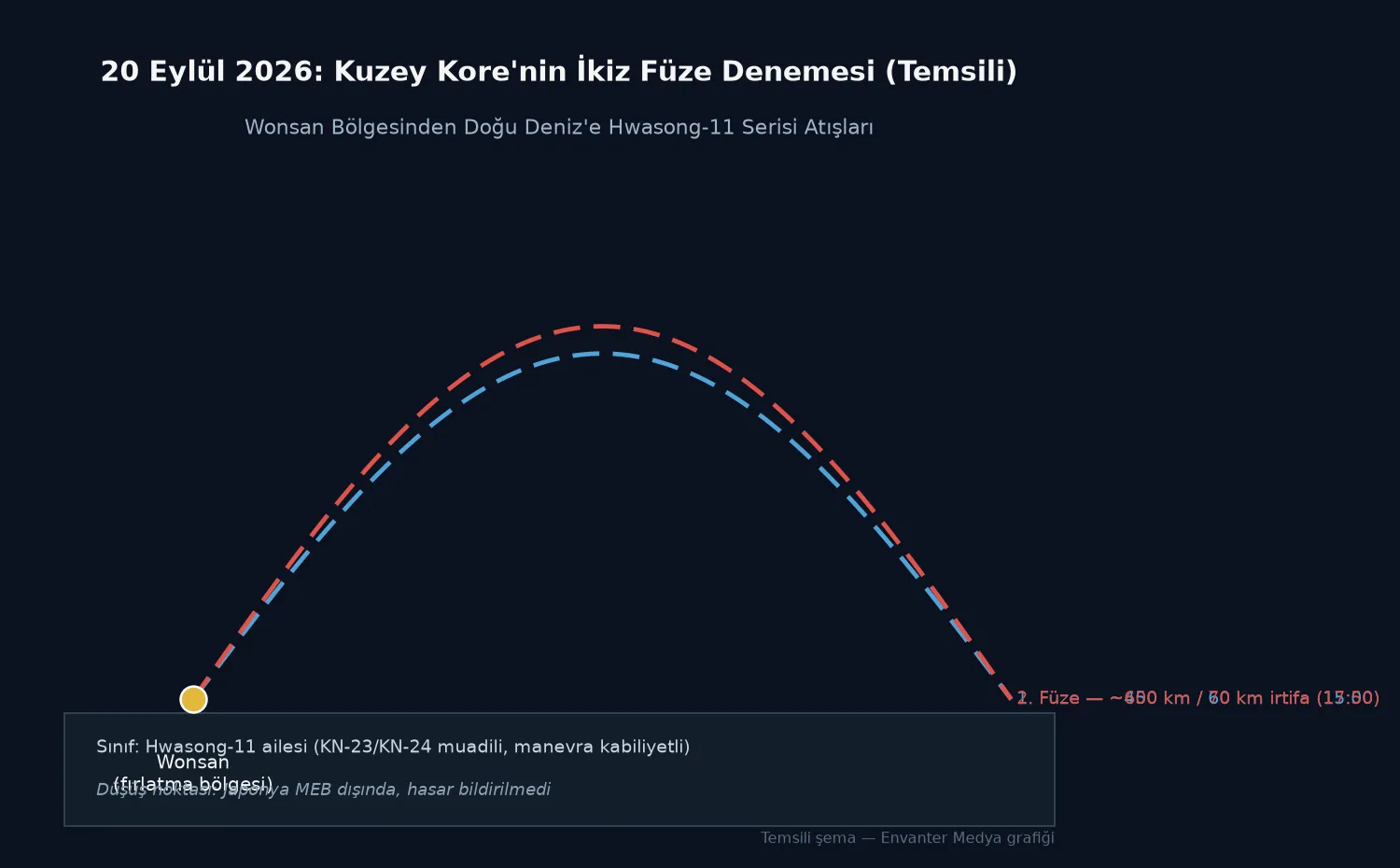
North Korea launched two short-range ballistic missiles from the Wonsan area on its east coast toward the East Sea on September 20, 2026. South Korean and Japanese preliminary assessments identify the first missile as belonging to the Hwasong-11 family; both weapons fell outside Japan’s exclusive economic zone with no reported damage.
At a Glance
- The first launch occurred around 3:00 p.m. local time, the second roughly three hours later, around 5:50 p.m.
- South Korea’s military assessed the first missile’s range at roughly 450 km with a 60 km apogee; Japan estimated 440 km at 60 km altitude.
- For the second missile, South Korea measured a range over 600 km, while Japan calculated roughly 590 km at 70 km altitude.
- South Korea preliminarily identified the first missile as belonging to the Hwasong-11 series, with detailed analysis ongoing; the second remains classified only as a short-range ballistic missile.
- Japan, the US and South Korea held trilateral consultations on September 21, reaffirming that the launches violated UN Security Council resolutions.
Background
The Hwasong-11 family forms the core of North Korea’s solid-fuel, maneuverable tactical ballistic missile portfolio, with the Hwasong-11A (KN-23, often compared to Russia’s Iskander) and the Hwasong-11B (KN-24) among its known variants. The ability of these missiles to maneuver at low altitude complicates missile-defense tracking, while their compatibility with dispersed, mobile launch platforms strengthens their deterrent value. Wonsan is one of North Korea’s frequently used launch sites, and this test is viewed as the latest in a series through which the regime periodically tests and refreshes its solid-fuel tactical missile inventory. The US military said initial assessments indicated no immediate threat to personnel or allies, while South Korea’s National Security Office condemned the launches as a violation of UN resolutions. Ukrainian intelligence’s August claim that a related variant (KN-30/Hwasong-11C) had already been transferred to Russia illustrates North Korea’s tendency to use this missile family both for its own deterrence and as an instrument of external transfer.
Regional Impact
The Hwasong-11 family’s maneuverability and its compatibility with dispersed launch tactics present exactly the scenario against which regional missile-defense architectures — THAAD, Patriot PAC-3, Aegis — are tested, reinforcing sustained global demand for layered, domestically-developed air and missile defense. The design logic behind Türkiye’s own national air-defense system, SİPER, is likewise driven by the need to counter a similar diversity of threats — maneuverable, low-altitude tactical ballistic missiles — making North Korea’s tests a further data point underscoring the industry-wide relevance of this threat category. Claims that part of this missile family has already reached Russia also keep North Korea-Russia military technology transfer, and its indirect implications for European security, on the agenda.
FAQ
Where did the missiles land?
Both fell outside Japan’s exclusive economic zone; no damage or injuries were reported.
What exactly is the Hwasong-11?
A family of solid-fuel, maneuverable tactical ballistic missiles, including variants such as the KN-23 (Iskander-like) and KN-24.
Has the second missile been identified?
No — it remains classified only as a short-range ballistic missile pending further analysis.
Sources
armyrecognition.com (September 21, 2026), South Korea’s National Security Office statement, Japan’s Ministry of Defense preliminary assessment, US-Japan-South Korea trilateral consultation statement (September 21, 2026).