Navantia Names Spanish Navy’s New Submarine Rescue Vessel Poseidón

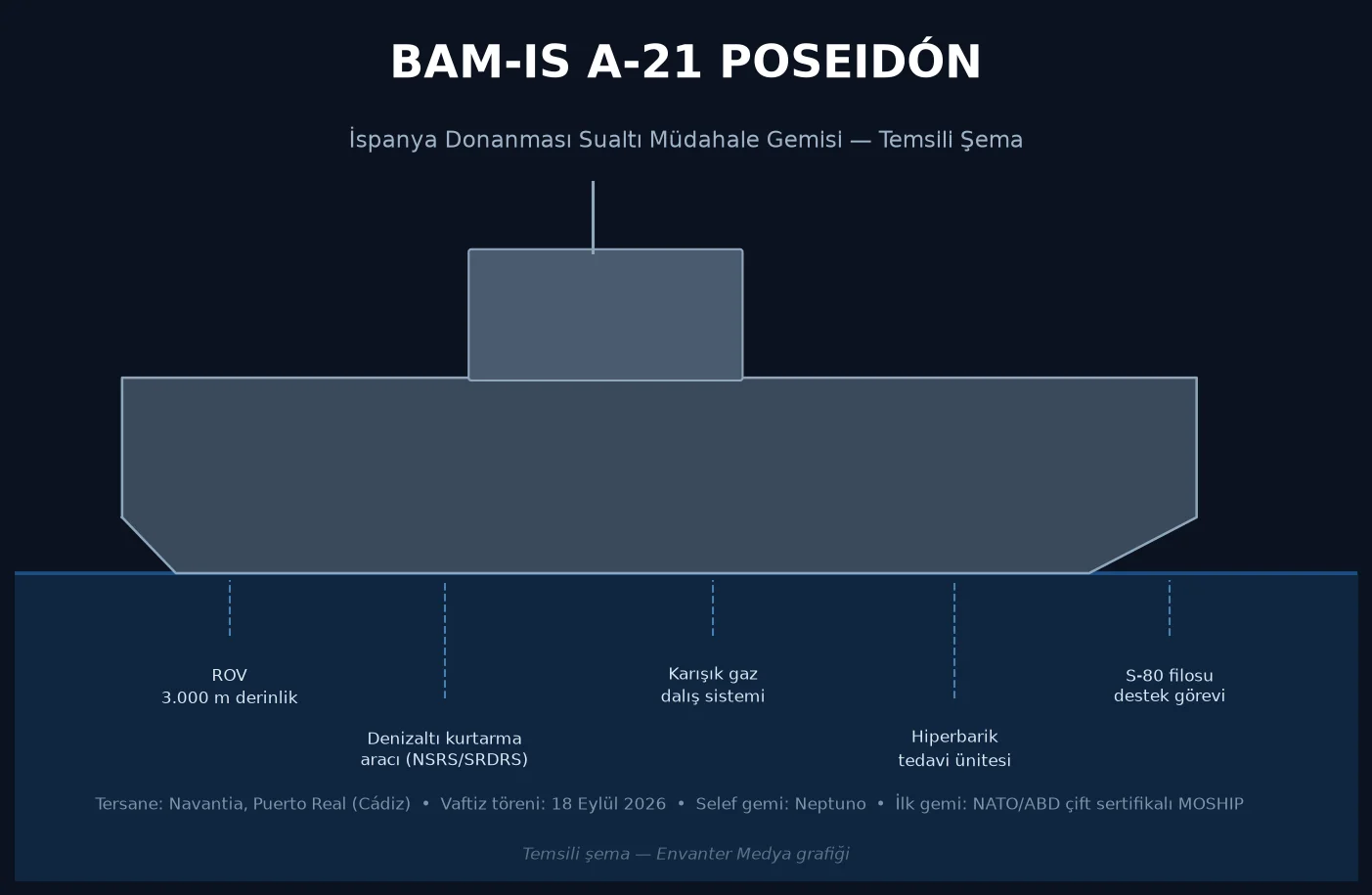
Spanish shipbuilder Navantia held the naming ceremony for the Underwater Intervention Maritime Action Vessel (BAM-IS) A-21 Poseidón at its Puerto Real shipyard in Cádiz on September 18, 2026. The vessel will substantially strengthen the Spanish Navy’s submarine rescue and underwater intervention capability.
At a Glance
- The naming ceremony was held on September 18, 2026, shortly after the ship’s float-out at the Puerto Real shipyard.
- Poseidón is designed as the successor to Neptuno, the Spanish Navy’s current rescue and salvage vessel.
- The ship will carry remotely operated vehicles (ROVs) capable of operating to depths of 3,000 meters.
- A mixed-gas diving system, a hyperbaric treatment unit and integration with a submarine rescue vehicle give the ship versatile underwater intervention capability.
- Poseidón will become the first Spanish Navy ship certified as a mother ship (MOSHIP) for both NATO’s Submarine Rescue System (NSRS) and the US Navy’s Submarine Rescue Diving and Recompression System (SRDRS).
- Construction began in 2021; the ship’s sponsor was María Dolores Higueras Rodríguez, Spain’s first underwater archaeologist.
Background
Poseidón’s development is directly tied to the Spanish Navy’s new S-80-class submarine fleet. For a submarine fleet to be considered operationally credible under NATO standards, it needs a dedicated support vessel capable of rescuing crews in the event of an accident. Poseidón is therefore positioned not merely as a new ship, but as a complementary piece of the S-80 program’s operational readiness. Navantia Chairman Ricardo Domínguez said the vessel reflects the company’s commitment to the “Navy 2050 Plan” and to Europe’s strategic defense capabilities. The MOSHIP certification means Poseidón will be able to host international rescue operations not only for Spanish submarines but for allied NATO nations’ submarine incidents as well, expanding the ship’s role within NATO’s collective undersea-safety architecture.
Following the naming ceremony, the vessel is expected to proceed through outfitting, sea trials, and crew training before formally entering Spanish Navy service. Coming after decades of service by its predecessor Neptuno, Poseidón represents a significant generational leap in underwater intervention technology.
Regional Impact
Poseidón’s entry into service is a concrete example of European navies expanding submarine fleets while simultaneously strengthening the support infrastructure behind them. Viewed alongside developments such as Germany, Norway and Canada launching joint planning with TKMS on the 212CD submarine program, it is clear that European submarine fleets are growing in both numbers and support capability in parallel. Purpose-built support vessels of this kind are increasingly regarded as being as critical to the sustainability of NATO’s undersea-warfare capability as the submarines themselves.
FAQ
When will Poseidón enter service?
While the naming ceremony marks a major construction milestone, the ship must still complete outfitting and sea trials before formally joining the Spanish Navy; an exact in-service date has not yet been announced.
What does MOSHIP certification mean?
MOSHIP certifies a vessel as a “mother ship” capable of carrying and deploying NATO or allied submarine rescue systems, indicating its capacity to host international rescue operations.
What happens to Poseidón’s predecessor, Neptuno?
Neptuno is the Spanish Navy’s current rescue and salvage vessel, expected to be gradually retired after decades of service.
Sources
- Naval News, “Navantia Celebrates Naming of BAM-IS Submarine Rescue Vessel”
- Infodefensa, “Navantia bautiza el BAM-IS Poseidón”
- Galaxia Militar, “NAVANTIA celebra el amadrinamiento del BAM-IS A-21 Poseidón”