GlobalEye AEW&C: Saab’s Multi-Domain Surveillance Aircraft — France SEK 12.3bn Contract Explained

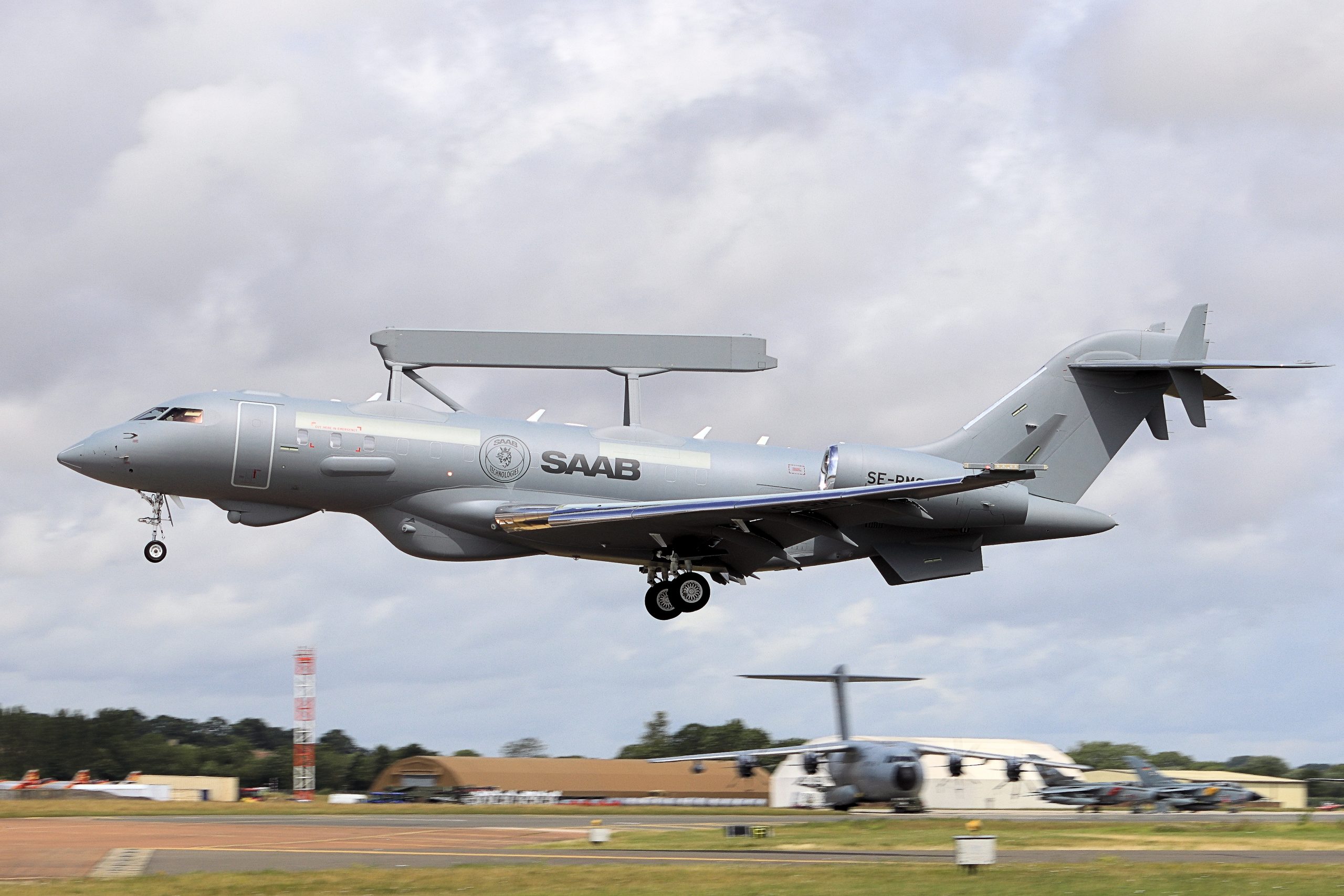
Saab GlobalEye is an airborne early warning and control (AEW&C) platform built around the Bombardier Global 6000 business jet, integrating the Erieye ER AESA radar, a maritime surface search radar and electro-optical/infrared sensors into a single multi-domain surveillance system. With a 550 km air detection range and an 11-hour mission endurance, GlobalEye offers most of the strategic value of large AEW&C platforms like the E-3 Sentry at a fraction of the acquisition and operating cost. France’s 2025 order for two aircraft — worth SEK 12.3 billion, exceeding $1 billion — is the programme’s most credible commercial endorsement yet from a major European air power.
The Strategic Value of Airborne Radar
Ground-based radar systems are limited by the curvature of the earth. A radar antenna at sea level can see targets flying at low altitude only out to roughly 50 km. An aircraft carrying the same radar at 10,000 metres extends that horizon to 350–400 km. Low-altitude cruise missiles, terrain-following aircraft and sea-skimming anti-ship weapons are the most difficult targets for ground-based radar to detect at useful ranges — precisely the threats that matter most in modern warfare. GlobalEye provides persistent coverage of these difficult target categories while simultaneously managing the air picture for friendly aircraft and warships.
Three Simultaneous Missions
GlobalEye is engineered to conduct three domain-coverage missions simultaneously without degradation: the Erieye ER AESA radar handles air surveillance to 550 km; the Leonardo Seaspray 7500E provides maritime surface and ground target detection; the FLIR Star Safire 380HD electro-optical system enables specific target identification. This integration is operationally significant: a single aircraft can cue surface warships to an inbound anti-ship threat, vector fighters onto an air contact and identify a vessel of interest — all at the same moment.
Technical Specifications
| Parameter | Value |
|---|---|
| Platform | Bombardier Global 6000/6500 |
| Primary Radar | Erieye ER AESA (GaN modules) |
| Air Detection Range | 550 km |
| Maritime Radar | Leonardo Seaspray 7500E |
| EO/IR Sensor | FLIR Star Safire 380HD |
| Maximum Speed | 1,110 km/h |
| Service Ceiling | 16,000 m |
| Ferry Range | 11,000 km |
| Mission Endurance | Up to 11 hours |
| Datalink | JTIDS / Link 16 |
Operators and Orders
| Country | Quantity | Status |
|---|---|---|
| UAE | 5 | Operational |
| Sweden | 2 | Ordered (2025) |
| France | 2 | Ordered (2025); 2029–2032 delivery |
Strengths
- Three-domain simultaneous coverage: air, maritime, ground
- Operating cost far below large-body platforms (E-3 Sentry, E-7 Wedgetail)
- Small airframe — compatible with short runways and a wide range of basing options
- France NATO selection: first major European air force to choose GlobalEye
Limitations
- Single aircraft — survivability concern in high-intensity conflict without escort
- Operator base still limited (UAE + 2 new orders)
Competitive Landscape
| System | Origin | Platform | Radar Range | Multi-Domain |
|---|---|---|---|---|
| GlobalEye | Sweden | Bombardier Global 6000 | 550 km | Yes |
| E-7 Wedgetail | USA/Boeing | 737-700 | 600 km | Air + some surface |
| E-2D Hawkeye | USA | Turboprop | 550 km | Air-focused |
| A-100M | Russia | IL-76 | ~350 km | Air |
| KJ-500 | China | Shaanxi Y-9 | ~460 km | Air |
Why It Matters for Turkey
Turkey’s AEW&C gap is one of the most discussed strategic shortfalls in Turkish air power. The ASELSAN–TAI B737 AEW&C programme is in development, but a domestically produced, operationally capable radar at GlobalEye’s performance level remains years away. Without persistent airborne radar coverage, Turkish air operations over the Eastern Mediterranean rely on ground-based networks that have inherent geometric limitations against low-flying threats. Closing this gap — whether through accelerated domestic development or an interim acquisition — is a first-order air force modernisation priority.
Bottom Line
GlobalEye makes the case that AEW&C capability does not require a wide-body airliner. France’s selection — choosing it over the E-7 Wedgetail — shows that GlobalEye is competitive against US-origin alternatives in the most demanding evaluation environments. For Turkey, the platform is both a commercial opportunity and a capability benchmark: what the domestic B737 AEW&C programme must match or exceed to justify the investment.