Germany’s First F-35A Leaves Final Assembly, and With It the Tornado Era Starts to Close
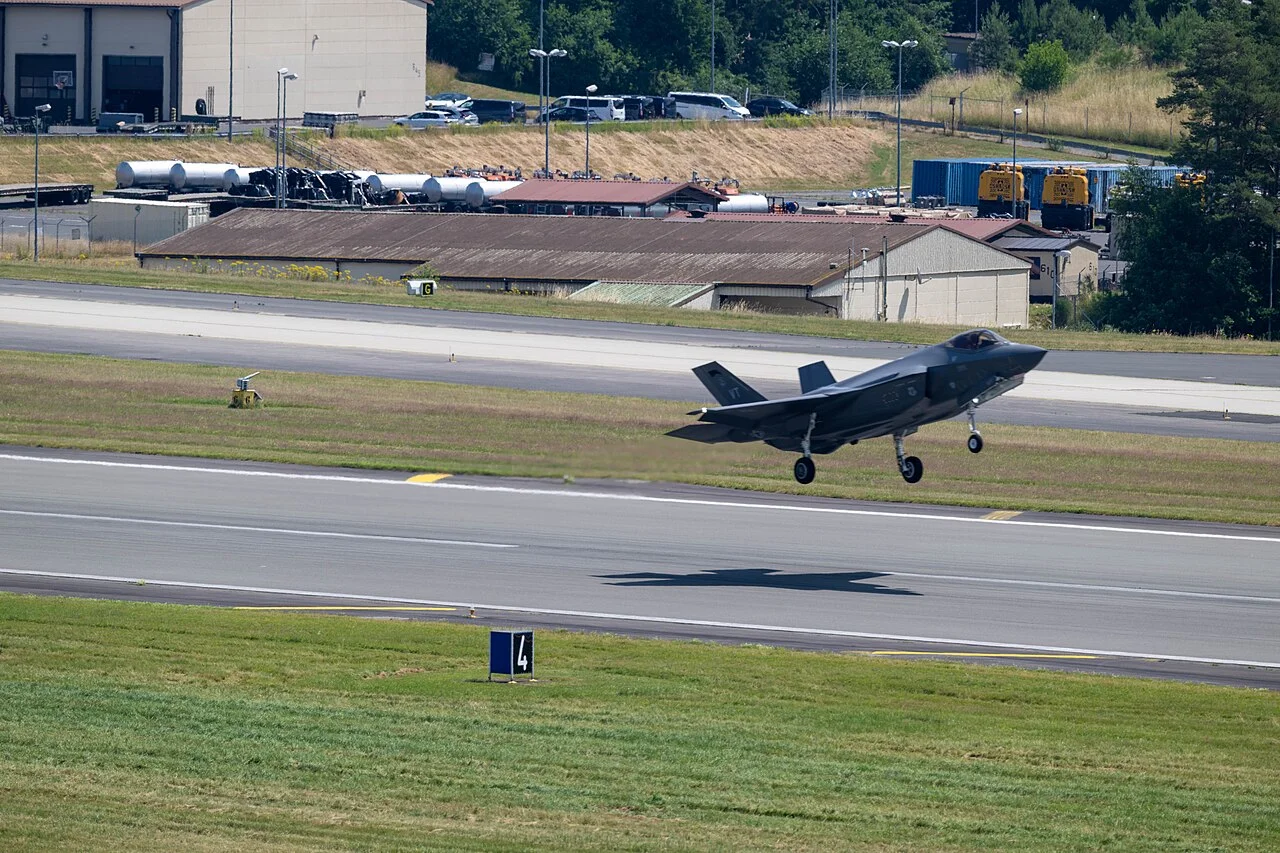
The first F-35A built for the German Air Force has come off the final assembly line in Fort Worth, Texas, and moved into final finishing. Lockheed Martin has set the rollout ceremony for 18 September. Germany’s Defence Ministry says seven more Luftwaffe aircraft are in assembly behind it.
Germany has 35 F-35As on order, acquired through the U.S. Foreign Military Sales system in a package valued at roughly $8.4 billion including munitions, spares, training and infrastructure.
Arkansas first, Büchel later
The first eight aircraft will not fly to Germany. They are bound for Ebbing Air National Guard Base at Fort Smith, Arkansas, which has been built up in recent years as a shared training hub for allied F-35 and F-16 operators. German pilots and maintainers will convert there.
The operational home will be Büchel Air Base in Rhineland-Palatinate, with initial operational capability expected in early 2027. That basing decision is the entire point of the programme: Büchel hosts the German squadron assigned to NATO’s nuclear-sharing arrangement.
The requirement behind the purchase
Germany’s F-35 decision followed Russia’s full-scale invasion of Ukraine in 2022 and the €100 billion special defence fund announced in its wake, but the underlying requirement predated the politics. The Luftwaffe’s Tornado IDS fleet was running out of airframe life, and the nuclear-sharing mission requires an aircraft certified to carry the B61-12 gravity bomb. The Eurofighter Typhoon was not certified, and getting it there would have been slow and expensive.
The F-35A already was. Its low observability, sensor fusion and data-sharing architecture also fit the high-low mix the Luftwaffe intends to operate alongside its Typhoons.
German industry is inside the programme
Berlin did not settle for being an FMS customer. Rheinmetall has stood up a facility at Weeze in North Rhine-Westphalia to build F-35 centre fuselage sections, with the intention of supplying the global supply chain rather than just German jets. Assembly of Germany’s first aircraft began at Marietta, Georgia, in late 2024 with the forward fuselage.
Europe’s F-35 map keeps filling in
With Germany, the number of European operators and customers moves solidly into double digits: the United Kingdom, Italy, the Netherlands, Norway, Denmark, Belgium, Poland, Finland, Switzerland, Czechia, Romania and Greece are all on the same platform. That concentration is pulling sustainment infrastructure into Europe, anchored by the Cameri facility in Italy and engine depot work in Norway.
The picture is not uniformly smooth. Block 4 modernisation delays, the delivery backlog created by the TR-3 hardware upgrade, and software certification timelines continue to complicate operational planning for every customer in the queue.
For the Tornado, meanwhile, the clock is running down on more than four decades of service as the backbone of German strike and suppression of enemy air defences. The electronic-warfare role flown by the Tornado ECR is heading in a different direction: Germany has invested in an electronic-warfare configuration of the Eurofighter to take it over.
Sources
- Lockheed Martin statement, 18 August 2026
- German Federal Ministry of Defence
- F35.com programme announcements