Denmark Buys a Single Picture of Its Own Sky: Terma to Build Nationwide Counter-Drone Network
After two years in which unidentified drones repeatedly shut down northern European airports and loitered over military sites, Denmark has decided that its problem is not a shortage of sensors. It is that the sensors do not talk to each other.
The Danish Ministry of Defence Acquisition and Logistics Organisation (DALO) has signed an agreement with Terma, the country’s largest defence electronics firm, for a nationwide counter-drone command-and-control system. The contract buys software and integration rather than hardware — a layer that pulls what military radars, civilian airport sensors and critical-infrastructure monitoring already see into one continuously updated picture of Danish airspace.
What the contract covers
The backbone is Terma Helion, the company’s multi-domain data spine, which collects output from geographically distributed systems and turns it into information usable at both the local and the central level. Command, control and data fusion run on the FACE platform from OSL Technology, a firm Terma acquired to give itself exactly this capability.
Crucially, the architecture is not closed. Feeds from Terma’s own radar and surveillance products sit alongside third-party sensors and effectors, and an AI-assisted layer classifies and prioritises tracks before they reach an operator — a design choice aimed squarely at the moment when a swarm generates more contacts than a human can triage.
Coverage extends well past the fence line of military bases: airports, ports, energy facilities and government buildings all fall inside the same network. The system is modular, with additional sensors and countermeasures expected to be plugged in over time.
Lieutenant General Per Pugholm Olsen, who heads DALO, called the agreement a cornerstone of building a serious counter-drone capability. Terma chief executive Henriette H. Thygesen framed the requirement in terms of being able to detect, classify and act across domains. Neither side disclosed the contract value.
Why integration is the hard part
Small uncrewed aircraft break the assumptions built into conventional air defence. Their radar cross-section is closer to a bird’s than an aircraft’s, they fly slower than helicopters, and they routinely operate below the rooflines where ground clutter is worst. Any one of those characteristics is manageable; together, they guarantee that a single radar will both miss real drones and cry wolf over false ones.
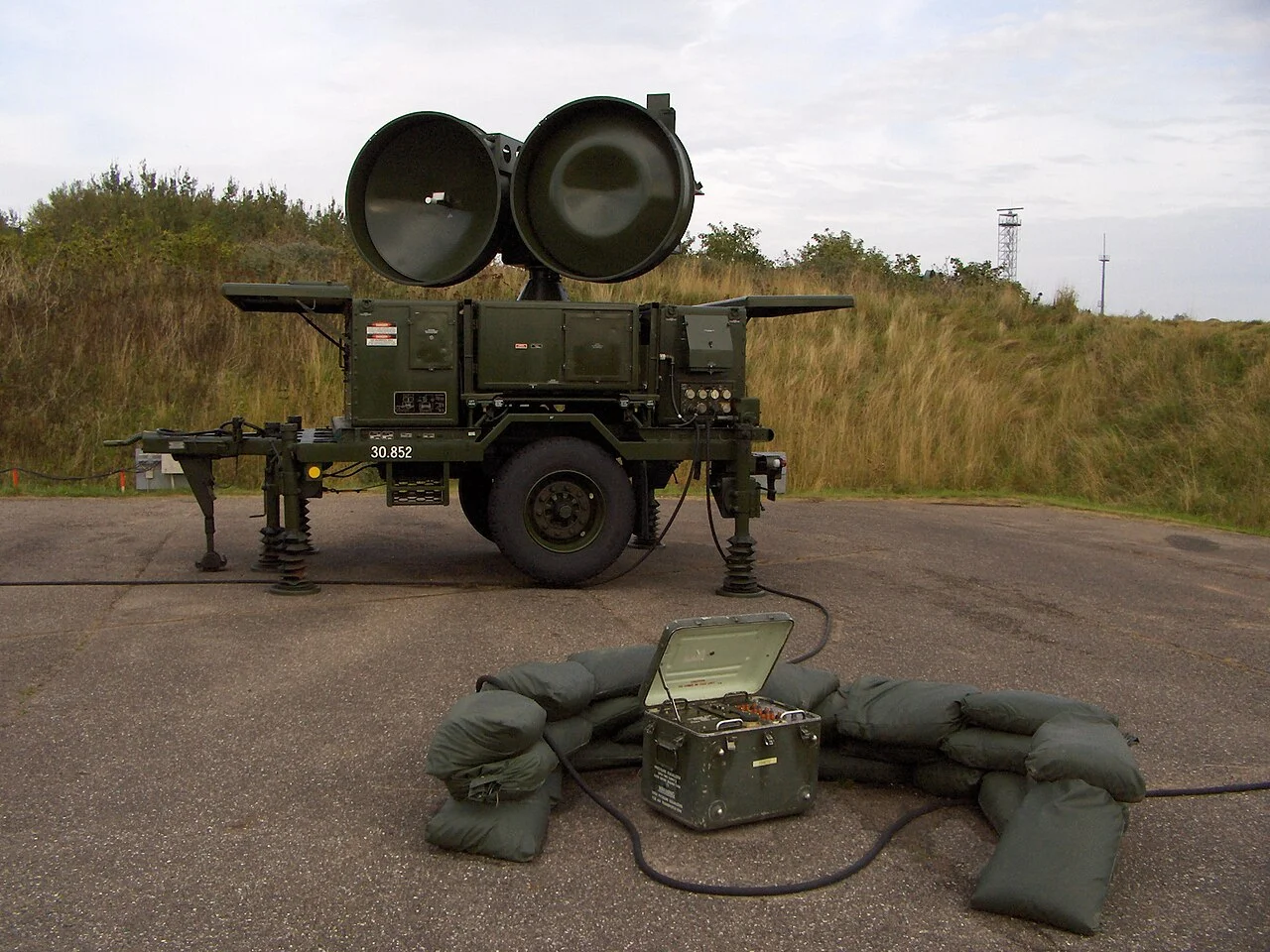
That is why serious counter-UAS work layers four detection methods. Short-range 3D radar supplies position and velocity. Radio-frequency monitoring identifies the control link and, often, the operator’s location. Electro-optical and thermal cameras provide the visual confirmation that turns a track into a target. Acoustic sensors fill gaps in cluttered urban environments where the other three struggle. Denmark has bought the layer that makes those four streams resolve into one track instead of four.
The effector side is equally constrained. Jamming cannot be used freely near airports without disrupting civil communications; net-capture systems, interceptor drones and gun-based solutions each carry their own rules of engagement. Part of the command-and-control layer’s job is telling an operator, in real time, which response is authorised in which patch of airspace.
A pattern across northern Europe
Denmark’s move fits a broader shift. The drone sightings that began disrupting Copenhagen and other northern European airports from autumn 2025 shared a profile: small, slow, low, and — from a legal and attribution standpoint — deeply awkward. Governments discovered that critical national infrastructure was defended, if at all, by a patchwork of unconnected systems answering to different ministries.
The Danish answer emphasises sovereignty. Keeping the data layer that processes the national air picture under domestic development and control is presented as a hedge against dependency in a crisis — an argument that has gained considerable traction across European capitals over the past three years.
Denmark has been moving quickly on procurement more generally. The country recently ordered Rheinmetall’s MASS decoy system for its frigates and has pushed protection of undersea infrastructure in the North Sea and Baltic up its agenda. The counter-drone network completes the land and air side of that picture.
No timeline for fielding was announced.
Sources
- Terma official statement — “Denmark Deploys Terma’s Integrated Counter-UAS Solution Across Strategic Sites”
- Danish Ministry of Defence Acquisition and Logistics Organisation (DALO)
- Defence Industry Europe, 19 August 2026