China’s DF-61 ICBM Enters Routine Training: Range Estimates Reach 18,000 Kilometers

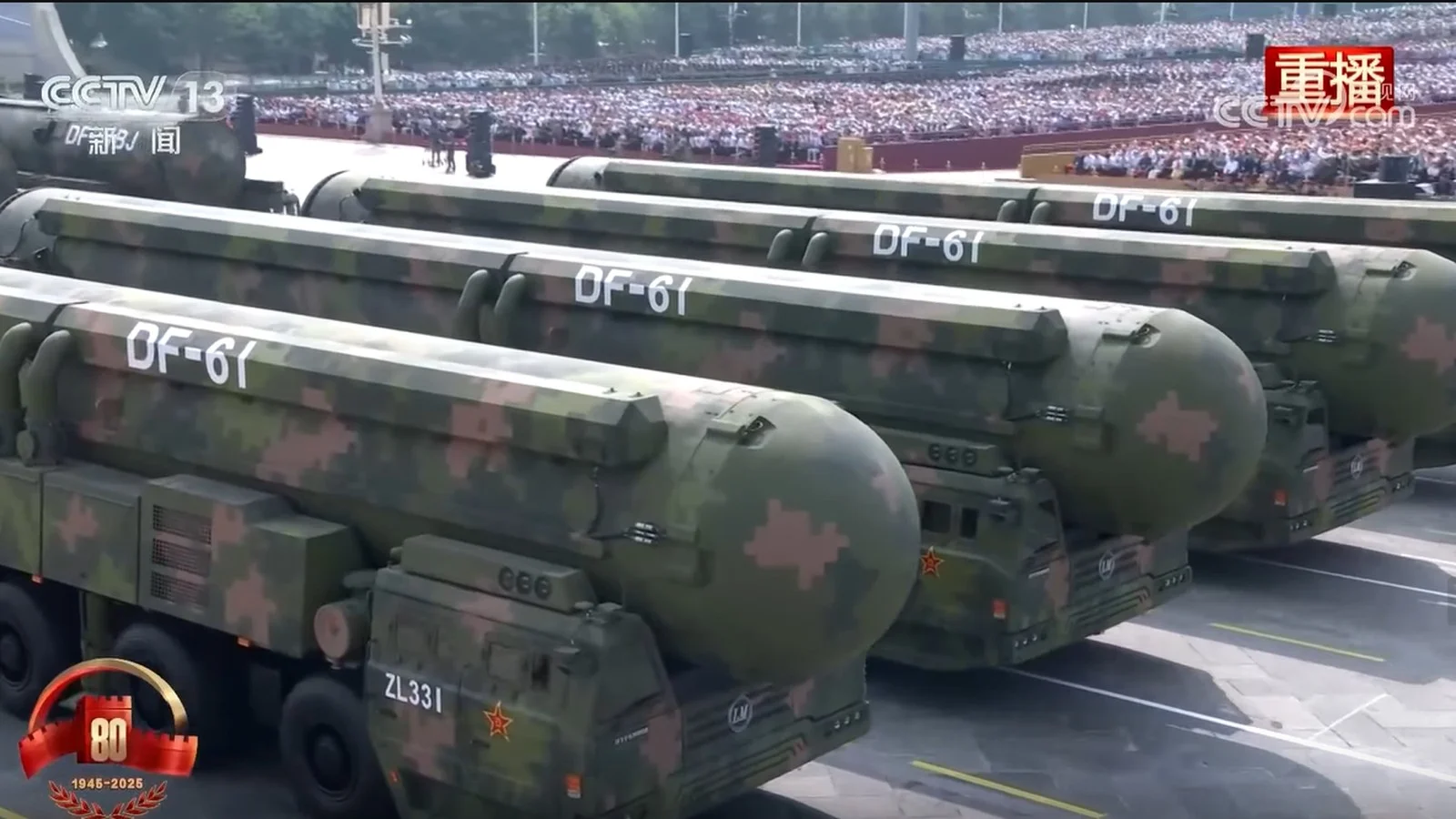
China’s People’s Liberation Army Rocket Force has moved its DF-61 intercontinental ballistic missile (ICBM) into what state media calls “routine” or normalized training, according to a Global Times report published on November 5. The missile was first shown publicly on September 3, 2025, during the Beijing parade marking the 80th anniversary of the end of World War II in Asia.
Per the report, unit training now covers field mobility, changes of launch position, and firing procedures, which analysts read as a sign that the road-mobile transporter erector launcher (TEL) has moved into operational use. An expert cited in the report said the pace at which the DF-61 moved from its parade debut to routine exercises was unusually fast compared with a typical ICBM development-to-deployment timeline, a speed attributed to the missile sharing existing support, maintenance, and training infrastructure with the broader Dong Feng family.
Hard technical data on the DF-61 remains largely a matter of estimates. The Washington-based Federation of American Scientists (FAS) puts its range at roughly 12,100 kilometers, similar to the DF-41, while the UK’s Janes assesses it at up to 18,000 kilometers. FAS has suggested the DF-61 could be a variant of the DF-41, while Janes describes it as a possible successor; both readings rest on the launcher vehicle looking “nearly identical” to the DF-41’s. Some assessments suggest the missile could carry multiple independently targetable reentry vehicles (MIRVs), but Beijing has not officially confirmed that capability.
A report from Singapore-based Defence Security Asia adds an important caveat: the DF-61’s full performance envelope, the number of missiles to be fielded, and its alert status remain unknown. Chinese authorities have issued no official technical statement on the missile’s range, warhead count, or unit structure, and at the time of writing there is no independent confirmation from the United States or any other government. The “entered routine training” claim should therefore be read as a state-media disclosure to be treated with appropriate caution rather than a confirmed operational fact.
FAS had called the DF-61’s 2025 parade debut a “surprise,” since the system looked almost identical to the already-deployed DF-41 and a wholly new missile class had not been expected. The same parade lineup included the hypersonic glide-vehicle DF-17 and the medium-range DF-26, yet Global Times’ “routine training” disclosure has so far been made only for the DF-61 — a selective announcement that suggests Beijing is managing, system by system, when it declares a weapon operational.
The military meaning of “routine training” also matters here: once a system moves from its first public appearance to repeated drills in changing launch position, camouflage, and firing procedure, that is generally read as a sign the weapon has crossed into a minimum-deterrence threshold and is considered ready for crisis use. That is why the language used for the DF-61 implies it is no longer in a test phase and has been handed to operational units — though the unknown alert status, meaning whether warheads are mated to the missiles, limits how far that reading can be pushed.
The DF-61 is widely read as the latest link in China’s modernization of its land, sea, and air nuclear triad. Per a 2025 Army Recognition assessment, the DF-41 has been considered in service since 2017; no equivalent confirmation had previously been issued for the DF-61, which is why the Global Times report is seen as marking that threshold. The program sits alongside the submarine-launched JL-3 ballistic missile and the H-6N bomber fleet as part of a three-pronged nuclear capability.
This rapid progress in China’s strategic missile force adds a new variable to U.S. global nuclear deterrence planning. The Pentagon’s annual China Military Power reports have projected that Beijing’s warhead stockpile would grow substantially through the 2030s, and the DF-61’s faster-than-expected fielding is being read as data reinforcing those projections. By contrast, the United States’ own next-generation ICBM program, Sentinel, has been dogged by publicly reported cost overruns and schedule slippage — a contrast that is drawing attention to the diverging pace of modernization between the two powers.
For NATO and Türkiye, the story is for now an indirect one. The alliance’s strategic-balance planning remains centered on Russia, but Washington’s shifting attention and resources toward the China dimension in the Asia-Pacific could, over the medium term, indirectly affect allied posture and budget priorities on NATO’s European-Atlantic flank, where Türkiye sits. Ankara’s own ballistic and hypersonic missile programs, such as TAYFUN and BORA, are not directly tied to this dynamic, but the accelerating pace of great-power missile competition is being tracked as a broader trend within Turkish defense-industry circles.
Sources
- Global Times, “China’s message: A fully upgraded nuclear triad,” November 5, 2026, https://www.globaltimes.cn/page/202611/1373745.shtml — primary source for the report that the DF-61 entered routine training.
- Defence Security Asia, “China’s DF-61 ICBM Enters Training, Complicating US Nuclear Planning,” https://defencesecurityasia.com/?p=62541 — secondary source for verification and the caveat on unknowns.
- Army Recognition, “China Modernizes Its Nuclear Triad With New DF-61 Intercontinental Ballistic Missile” (2025), https://armyrecognition.com/news/army-news/2025/china-modernizes-its-nuclear-triad-with-new-df-61-intercontinental-ballistic-missile — used for the DF-41 comparison and background.
- Wikipedia, “DF-61,” compiling FAS and Janes assessments, https://en.wikipedia.org/wiki/DF-61 — used for range estimates.