Altınay’s Stabilised Weapon Pedestal for Drones: How It Works, Explained

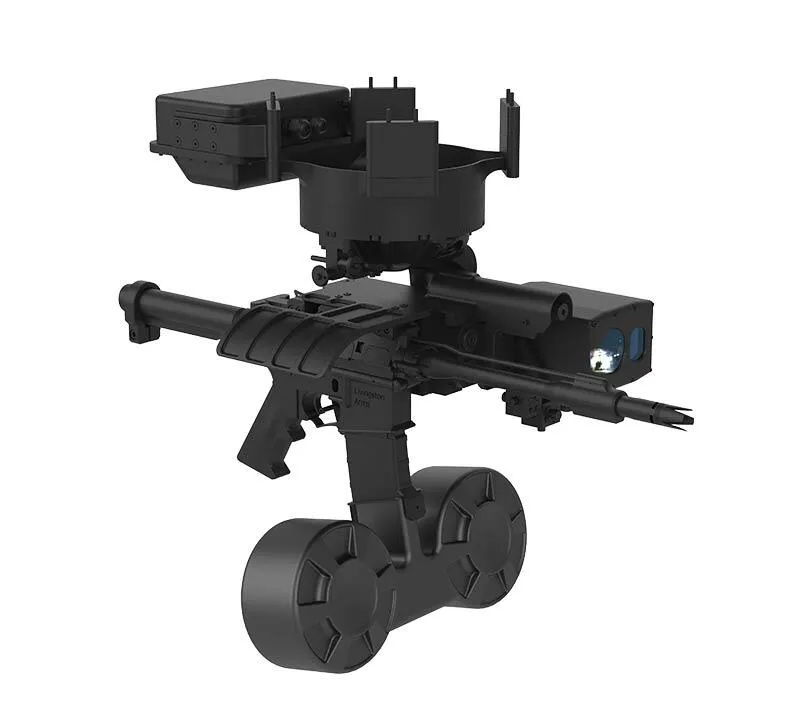
Putting a rifle on a drone is the easy part. The hard part is keeping the muzzle still while the aircraft rocks in the wind and kicks back with every shot. Altınay Savunma, the Istanbul-based motion-control company listed on Borsa Istanbul as ALTNY, built its 2-axis stabilised weapon pedestal around that problem. On its official product page the company gives concrete numbers: a Kale KCR556 5.56 mm rifle, 200 rounds on board, 4 rounds per second, ±0.12° stabilisation accuracy, a 1 km laser rangefinder and a total weight below 13 kg. This explainer walks through what those figures mean, where the system fits and what has not been disclosed.
What a weapon pedestal is
A pedestal is the moving base a weapon sits on. In military usage the term covers the mechanics and electronics that turn a gun in two axes — traverse and elevation — and let an operator aim and fire it remotely through a screen. On armoured vehicles this is the familiar remote weapon station. Altınay’s product scales the same idea down for an unmanned aircraft: instead of a vehicle roof, the base is the underside of a medium or heavy multirotor, and the operator sits at a ground control station.
Altınay has been a motion-control company since its founding in 2014, and the pedestal draws on the same building blocks as its other products: servo electronics such as the X Motion drive family, precision mechanics and stabilisation software. A Turkish language file on Altınay’s earlier ground-vehicle pedestal work is here.
Why stabilisation is the whole story
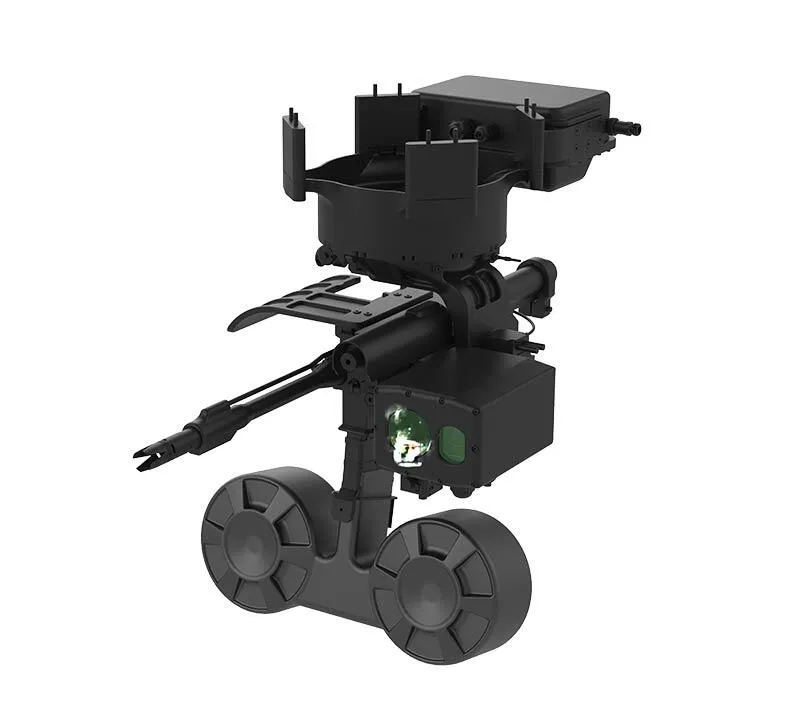
A hovering drone is never truly still. Wind gusts, rotor vibration and small control corrections produce constant motion, and a rifle bolted straight to the airframe would carry every one of those movements to the muzzle. Recoil adds a second problem: each shot pushes the aircraft and can knock it off station. Altınay answers both in two layers. The 2-axis stabilisation keeps the weapon pointed independently of the airframe in yaw and pitch, and what the company calls an original shock-damping technology absorbs recoil so that, according to the product page, the aircraft keeps its position while firing single shots or bursts.
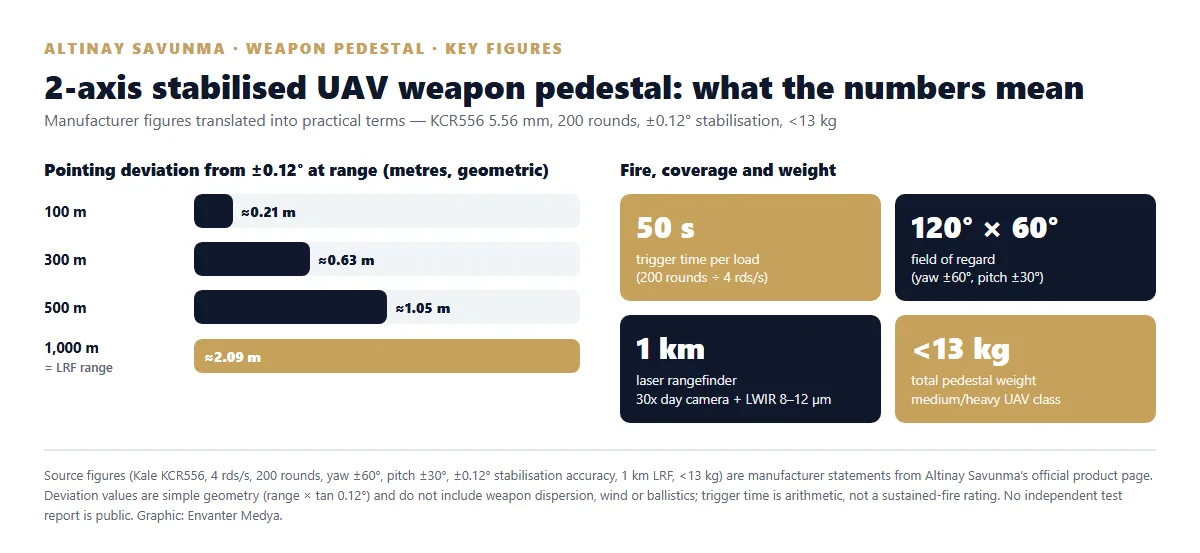
The ±0.12° figure is worth translating. By simple geometry it corresponds to about 0.21 m at 100 m, 0.63 m at 300 m and roughly 2.1 m at 1,000 m — the edge of the rangefinder’s reach. These values describe pointing stability only; rifle dispersion, wind and ballistics come on top. The graphic below sets out the conversion.
Technical specifications
All values below are manufacturer statements from Altınay Savunma’s official product page. No independent test report has been published.
| Parameter | Value |
|---|---|
| Weapon | Kale KCR556 — 5.56 mm NATO, AR-15 class |
| Rate of fire | 4 rounds per second |
| Ammunition capacity | 200 rounds |
| Motion | 2-axis stabilised |
| Yaw (traverse) | ±60° |
| Pitch (elevation) | ±30° |
| Stabilisation accuracy | ±0.12° |
| Day camera | Sony EO, 30x optical zoom, HD 720p |
| Thermal camera | LWIR, 8–12 µm |
| Laser rangefinder | 1 km |
| Weight | <13 kg |
| Mission profile | Raid, pursuit and suppressive (harassing) fire |
The sensor chain: see, measure, engage
The pedestal carries its own sight. A Sony day camera with 30x optical zoom handles recognition at distance, a long-wave infrared (8–12 µm) thermal camera covers night, smoke and dust, and a laser rangefinder with a 1 km range gives the fire-control software the distance it needs for a ballistic solution. The day-plus-LWIR combination is the same family of electro-optics Altınay uses in its Venüs-4 gimbal, which shows how the company reuses one sensor architecture across surveillance and weapon products.
Ammunition arithmetic is straightforward: 200 rounds at 4 rounds per second is about 50 seconds of trigger time per sortie. That matches the stated mission profile — raid, pursuit and suppressive fire — rather than long engagements. It is a tool for short, precise bursts from an aircraft that can reposition quickly.
Where it sits among similar systems
The pedestal occupies a niche between two better-known categories. The comparison below is qualitative and is not a performance ranking; it is meant to show what problem each solution addresses.
| Solution | Platform | Typical weapon | Weight class | Stabilisation |
|---|---|---|---|---|
| Altınay 2-axis pedestal | Medium/heavy UAV | 5.56 mm rifle | <13 kg | 2-axis stabilised + shock damping |
| Ground RCWS (e.g. ASELSAN SARP class) | Armoured / tactical vehicle | 7.62–12.7 mm MG, grenade launcher | Vehicle-scale | 2-axis stabilised |
| Fixed gun mount on a drone | Small/medium UAV | Rifle or MG | Lighter | None — aircraft must aim itself |
Which drones can carry it?
Altınay defines the target platform as medium and heavy UAV systems, which fits the weight: a small FPV drone cannot lift 13 kg plus fuel or batteries. Altınay’s subsidiary DASAL builds multirotors in that class, including the PUHU C75 and PUHU C100 cargo drones and the CONDOR C150 (see our DASAL and TAAC profile). However, neither company has officially stated which airframe the pedestal is integrated on, so this explainer does not link the two. The same applies to inventory status: no user or contract has been announced for the pedestal itself.
Context matters here. DASAL systems such as MİKON and PUHU C75 took part in the Turkish Armed Forces’ Ateş Serbest 2026 exercise in Polatlı in tactical smoke, target engagement and autonomous resupply roles, according to DASAL. That shows the group’s drones are operating with Turkish forces; it does not by itself confirm pedestal deployment.
Why the product matters for Turkey
Armed small drones have become standard equipment on recent battlefields, and the stabilised mount is the part that separates an accurate system from an improvised one. Its key ingredients — servo drives, gearing, stabilisation algorithms and electro-optics — are exactly the components that tend to be held back by export licences. Producing them domestically keeps Turkish integrators independent of foreign approval for this category.
For Altınay the pedestal is also a showcase of a system-level approach: mechanics, drive electronics and sensors under one roof. The same capability sits behind the telescopic masts and the Kuşkapanı helicopter-handling system. An overview of the company’s programme involvement is in our projects file.
| Altınay Weapon Pedestal — Fact Box | |
|---|---|
| Product | 2-axis stabilised weapon pedestal |
| Manufacturer | Altınay Savunma Teknolojileri A.Ş. (Borsa Istanbul: ALTNY) |
| Platform class | Medium and heavy UAV systems |
| Weapon | Kale KCR556, 5.56 mm NATO |
| Key figures | 200 rounds, 4 rds/s, ±0.12°, 1 km LRF, <13 kg |
| Sensors | Sony EO 30x day camera, LWIR 8–12 µm thermal camera, LRF |
| Disclosed users / platform | Not announced |
Frequently Asked Questions
What is Altınay’s weapon pedestal?
It is a 2-axis stabilised remote weapon module for medium and heavy UAVs, developed by Turkish company Altınay Savunma. It carries a Kale KCR556 5.56 mm rifle with 200 rounds and its own day camera, thermal camera and laser rangefinder.
What weapon does it use?
The Kale KCR556, an AR-15-class rifle chambered in 5.56 mm NATO and produced in Türkiye by Kale. The pedestal fires it at 4 rounds per second.
How accurate is the stabilisation?
Altınay states ±0.12°. Geometrically that is about 0.6 m at 300 m and about 2.1 m at 1 km, before rifle dispersion, wind and ballistics are added.
How much does it weigh?
Under 13 kg, according to the manufacturer — which is why it targets medium and heavy UAVs rather than small FPV-type drones.
Can the drone hold its position while firing?
That is the purpose of the company’s shock-damping technology. The product page states that the aircraft can fire single shots or bursts without losing position; no independent test data has been published.
Which drone carries it?
Altınay has not named a platform. Its subsidiary DASAL makes multirotors in the right class, but an official integration has not been announced.
Is it in Turkish Armed Forces service?
No user or contract for the pedestal has been publicly announced. DASAL drones did take part in the Ateş Serbest 2026 exercise, but that does not confirm pedestal deployment.
How is it different from a ground RCWS?
The principle is the same — remote, stabilised two-axis aiming — but the scale differs: a vehicle RCWS carries heavier weapons and weighs far more, while this pedestal is a light rifle module built for an aircraft.
Sources
- Altınay Savunma official product page — Weapon Pedestal (altinaysavunma.com/tr/urunler/silah-pedestali)
- DASAL Havacılık Teknolojileri news releases on Ateş Serbest 2025 and 2026 (dasal.com.tr)
- Altınay Savunma corporate and investor relations pages (altinaysavunma.com)
- Envanter Medya Altınay archive