





What is the 9M133 Kornet? Russia’s Standard Long-Range Anti-Tank Missile, Explained

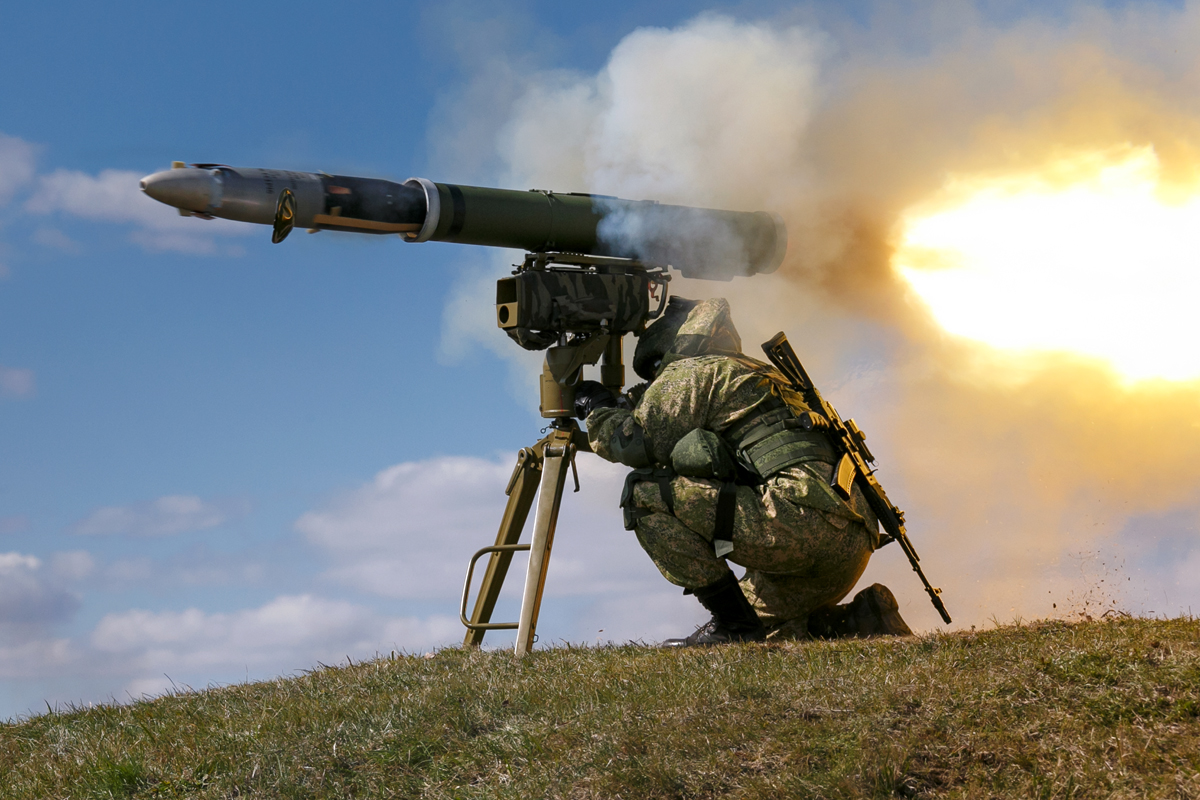
The 9M133 Kornet — NATO reporting name AT-14 Spriggan — is Russia’s standard long-range man-portable and vehicle-mounted anti-tank guided missile (ATGM). Developed by the KBP Instrument Design Bureau in Tula and produced by the Degtyaryov Plant, the Kornet entered Russian Army service in 1998 to replace the older Konkurs and Metis families. Distinguished by its laser-beam-riding guidance and large tandem-shaped-charge warhead, the Kornet has destroyed more Western armored vehicles in combat than any other modern Russian ATGM — most famously, the disabling of an Israeli Merkava IV during the 2006 Lebanon war and the destruction of multiple M1A1, Leopard 2 and Bradley vehicles in Iraq, Syria and Ukraine.
Key facts at a glance
| Attribute | Value |
|---|---|
| Type | Long-range man-portable / vehicle-mounted ATGM |
| Origin | Russia |
| Manufacturer | KBP Tula (design); Degtyaryov Plant (production) |
| In service | 1998 — present |
| Length | 1.20 m |
| Diameter | 152 mm |
| Missile weight | 27 kg |
| System weight (tripod) | 63 kg |
| Range | 5,500 m (legacy); 8,000 m (Kornet-D); 10,000 m (Kornet-EM dual-launcher mode) |
| Speed | 240–300 m/s |
| Guidance | Laser beam-riding (SACLOS, semi-automatic command-to-line-of-sight) |
| Warhead | Tandem HEAT (1,200 mm RHA-e after ERA); thermobaric option |
| Platforms | Tripod (man-portable), BMP-3M, BMD-4M, Tigr-M, Typhoon-K, BTR-82A, Kornet-D1 ATV-mounted |
| Operators | 30+ nations including Russia, Algeria, Belarus, Egypt, India, Iran, Syria, Türkiye (limited), Eritrea, Cyprus, Greece (early model), Vietnam |
| Unit cost | ~ USD 30,000–50,000 per missile |
Laser-beam riding: why Kornet is not a Javelin
The Kornet uses laser beam-riding guidance rather than the wire-guided command of older Soviet ATGMs (Konkurs, Fagot) or the imaging-IR fire-and-forget of Javelin. The launcher projects a coded laser beam at the target; the missile, equipped with a tail-mounted laser receiver, flies to keep itself centered in the beam. The gunner must keep the cross-hairs on the target until impact — there is no fire-and-forget.
The advantage is simplicity, jam-resistance and accuracy at extreme range. The drawback is that the gunner is exposed during the entire flight time — at 5.5 km, that’s nearly 24 seconds during which the launch position can be located and counter-fired upon.
Variants
| Variant | Year | Key feature |
|---|---|---|
| 9M133-1 Kornet-E (export baseline) | 1998 | 5,500 m range; tandem HEAT |
| 9M133-1F Kornet-F | 2003 | Thermobaric warhead for soft / building targets |
| 9M133M-2 Kornet-EM | 2010 | Double-launcher option; range to 8,000 m; vehicle-mounted only |
| 9M133-2 Kornet-D | 2012 | Improved Russian Army variant; range 8,000 m |
| Kornet-D1 (ATV-mounted) | 2017 | Buggy/ATV-mounted variant with thermal sight |
| Kornet-T (mounted, anti-aircraft) | 2018 | Anti-helicopter/UAV use; vehicle turret variant |
Combat record
- 2003 — Iraq. Iraqi Republican Guard units used Kornets against advancing U.S. armor; at least two M1A1 Abrams were damaged.
- 2006 — Lebanon war. Hezbollah Kornets destroyed at least 10 Israeli Merkava III/IV tanks during the 33-day war. The Merkava IV’s reactive-armor system was specifically redesigned post-2006 in response.
- 2014–present — Syria. Both Syrian government and opposition forces used Kornets extensively; multiple Turkish Leopard 2A4 losses in 2016–2018 are attributed to Kornets fired by Islamic State and PKK-aligned forces.
- 2014–present — Iraq. Iraqi Army and Hashd al-Shaabi units used Kornets against ISIS positions.
- 2015–present — Yemen. Houthi Kornet teams destroyed multiple Saudi M1A2 Abrams in southern Yemen.
- 2022–present — Ukraine. Russian Kornet teams have engaged Ukrainian tanks, IFVs and Western-supplied platforms; verified kills include several T-72M1 and at least three Leopard 2A6 tanks.
Kornet vs. its peers
| Kornet-D | Javelin FGM-148F | Spike LR2 | HJ-12 (China) | |
|---|---|---|---|---|
| Range | 8,000 m | 4,000 m | 5,500 m | 4,000 m |
| Guidance | Laser beam-riding | Imaging IR (fire-and-forget) | Fiber-optic or IR fire-and-forget | Imaging IR fire-and-forget |
| System weight | 63 kg (tripod) | 22 kg | ~33 kg | 22 kg |
| Top-attack | No | Yes | Yes | Yes |
| Tandem-HEAT penetration | ~1,200 mm RHA | ~750 mm RHA | ~1,000 mm RHA | ~1,000 mm RHA |
| Combat-proven | Lebanon, Syria, Iraq, Yemen, Ukraine | Iraq, Syria, Ukraine | Iraq, Syria, Yemen, Ukraine | Limited |
Why the Kornet matters
The Kornet remains the most widely fielded long-range Russian-pattern ATGM and has destroyed more Western-built armored vehicles in combat than any other 21st-century anti-tank weapon. Its laser-beam-riding architecture is technologically inferior to Javelin and Spike, but its large warhead, long range and low unit cost have kept it the workhorse of non-Western forces and an enduring threat to Western armor doctrine through the 2030s.