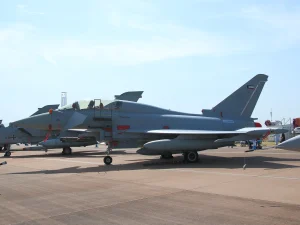
Pakistan Integrates Turkish GAZAP Thermobaric Weapon Into Its F-16 Fleet


Pakistan’s Air Force has added a Turkish-made thermobaric weapon to its F-16 inventory, according to reporting by The Defense Post citing Pakistani media. The weapon in question is GAZAP, a system Turkey introduced publicly in 2025 and designed specifically for use against hardened targets — fortified positions, underground facilities, and enclosed defensive structures where conventional munitions tend to deliver limited effect.
Thermobaric weapons operate on a different physical principle than standard high-explosive warheads. Rather than relying solely on chemical energy stored in the munition, they ignite a fuel-air mixture using atmospheric oxygen at detonation, producing a prolonged blast wave with a wider overpressure radius. The effect is most pronounced in confined spaces such as tunnel networks, reinforced bunkers, and urban structures — environments where standard warheads may fail to achieve the overpressure levels needed for structural defeat. The technology has been used by several major military powers for decades but has attracted renewed interest as recent conflicts have featured extensive fortified and underground defensive lines.
Integrating a Turkish Munition on an American Platform
Pakistan operates roughly 80 F-16s across Block 15 and Block 52 variants — the backbone of its air combat capability since the 1980s. Qualifying a foreign-origin munition for use on these aircraft involves meaningful technical work: F-16 avionics and weapons management systems are built around US standards, and integrating a new weapon type requires software interface development and test validation.
The specific parameters of the GAZAP–F-16 integration have not been publicly disclosed, nor have the financial terms or signing date of any procurement agreement. The reporting, which originates from Times of Islamabad and was picked up by The Defense Post, does not include official confirmation from the Pakistani Ministry of Defence or from Turkish Aerospace Industries.
A Defence Partnership Spanning Platforms and Domains
The GAZAP integration fits into a steadily expanding relationship. In September 2023, Turkey delivered the first of four Babur-class corvettes to the Pakistani Navy — vessels built in Turkish shipyards to bolster Pakistan’s surface warfare capability. In parallel, both countries are parties to the National Combat Aircraft programme, a joint development effort between Turkish Aerospace Industries (TAI/TUSAŞ) and Pakistan Aeronautical Complex (PAC) targeting a service entry of around 2030.
More recently, reports from January 2026 indicated that Turkey was in discussions to join a trilateral defence alliance that Pakistan and Saudi Arabia established in September 2025. No formal agreement has been confirmed.
Regional Context and What It Signals for Turkish Exports
Pakistan’s selection of a Turkish munition for its primary fighter fleet carries significance beyond the bilateral relationship. India — Pakistan’s principal strategic rival — has pursued a multi-source modernisation programme including French Rafales, Russian Su-30MKIs, and Israeli UAVs. Against that backdrop, expanding the capability envelope of the F-16 fleet with Turkish precision munitions reflects both the depth of the Ankara–Islamabad partnership and Turkey’s growing footprint as a supplier of full-spectrum warfighting systems.
For Turkish defence exports, GAZAP adds another data point to a trend already established by the Bayraktar family of UAVs and the KORAL electronic warfare system: Turkey now exports not just platforms but critical combat subsystems and precision weapons — a capability tier that few countries outside the traditional tier-one defence industrial nations have managed to reach.
Verification Note: Original reporting from Times of Islamabad via The Defense Post. Deal value, signing date, and technical integration details have not been officially confirmed by Pakistan’s Ministry of Defence or Turkish Aerospace Industries. Treat as reported claim pending official confirmation.
Sources: The Defense Post, “Pakistan Acquires Turkish Gazap Thermobaric Weapon for F-16 Fighter Fleet”, June 9, 2026 | Times of Islamabad (original source)