Five Days After Iran’s Airport Attack, Washington Approves $2 Billion in Counter-Drone Systems for Kuwait


- Sale: $1.98 billion FMS (Foreign Military Sale)
- Manufacturer: Anduril Industries (U.S.)
- System: Lattice C2 + electronic and kinetic defeat capabilities
- Trigger: June 3 drone/missile strike on Kuwait International Airport (1 killed, 60+ injured)
- Approval: June 8, 2026 — just 5 days after the attack
- Kuwait status: U.S. major non-NATO ally
The Five-Day Approval That Signals a Policy Shift
A standard Foreign Military Sale moves through Congressionally-mandated notification periods, technical review boards, and interagency coordination that routinely stretches across months. The Kuwait counter-drone package moved in five days. That compression is not administrative efficiency — it reflects a deliberate policy decision by the State Department and Pentagon to treat Gulf counter-drone capability as an emergency requirement rather than a planned procurement.
The triggering event made the case clearly. The June 3 strike on Kuwait International Airport was not an isolated incident: three days later, on June 6, Iran’s Revolutionary Guard Corps directly targeted U.S. military bases in Kuwait and Bahrain. Two attacks in six days, one on civilian infrastructure and one on American installations, constituted the threat signal that pushed the approval process into overdrive. Washington’s message, embedded in the approval timeline rather than any official statement, is that it will no longer accept a situation where Gulf partners lack autonomous counter-drone capability.
The centerpiece of the package is Anduril’s Lattice platform. Founded in 2017 by Palmer Luckey — Oculus VR’s creator before Facebook’s acquisition — Anduril built its reputation on software-first, open-architecture defense systems that integrate with third-party hardware rather than requiring proprietary ecosystems. Lattice ingests sensor feeds from radar, optical, acoustic, and radio-frequency sources regardless of manufacturer, fuses them into a common operational picture, and autonomously generates response recommendations across electronic and kinetic defeat options. For Kuwait, which operates a patchwork of legacy and modern systems from multiple origins, this hardware agnosticism is operationally significant.
The Cost Equation That Makes Lattice Necessary
The economics of counter-drone warfare are brutal and simple. A Shahed-136 loitering munition, the type deployed repeatedly against Gulf targets, costs its operator somewhere between $10,000 and $20,000 — possibly less with scaled Iranian production. A PAC-3 Patriot interceptor costs approximately $4–5 million per round. Every time a high-end interceptor engages a low-end threat, the attacker wins the economic exchange decisively: the defender consumes hundreds of times the dollar value of what it destroys. Saturation attacks — sending dozens of cheap drones simultaneously to overwhelm a finite interceptor magazine — exploit this asymmetry deliberately.
Lattice’s design addresses this directly. By maintaining a layered response stack, the system matches threat cost to response cost: radio-frequency jamming, GPS spoofing, directed energy, and short-range kinetics at the low end; conventional interceptors reserved for genuinely high-value threats. The intelligence value of the engagement data — which threats get through, which countermeasures work, how swarms are timed — also feeds back into the AI model’s training cycle, improving performance with each engagement.

Frequently Asked Questions
What is Anduril Lattice?
Lattice is Anduril’s AI-enabled, open-architecture command-and-control software platform. It ingests data from heterogeneous sensors — radar, optical, acoustic — classifies threats in real time, and autonomously recommends both electronic (jamming, GPS spoofing) and kinetic (interceptor) responses. Unlike legacy systems built around proprietary hardware, Lattice runs on standard computing infrastructure and integrates with third-party sensors from any manufacturer.
Why can’t existing Patriot systems handle cheap drones?
Patriot and similar long-range systems are exceptionally effective against ballistic missiles and high-altitude aircraft. Against a $10,000–$20,000 Shahed-136 drone, however, firing a $4–5 million PAC-3 missile creates an unsustainable cost ratio. Lattice addresses this by enabling layered responses: cheaper intercept options (laser, directed energy, short-range kinetics) are matched to low-cost threats, while high-value interceptors are reserved for high-value targets.
What exactly happened in the June 3 attack on Kuwait?
Iranian-linked forces launched a combined drone and ballistic missile strike on Kuwait International Airport on June 3, killing one person and injuring 60+. Flights were halted and terminal facilities were damaged. Three days later, Iran’s Revolutionary Guard Corps escalated further by targeting U.S. military bases in Kuwait and Bahrain — a direct attack on American infrastructure that accelerated Washington’s decision to rush the FMS approval through in five days rather than the typical months-long process.
How does this affect Turkey’s defense export position in the Gulf?
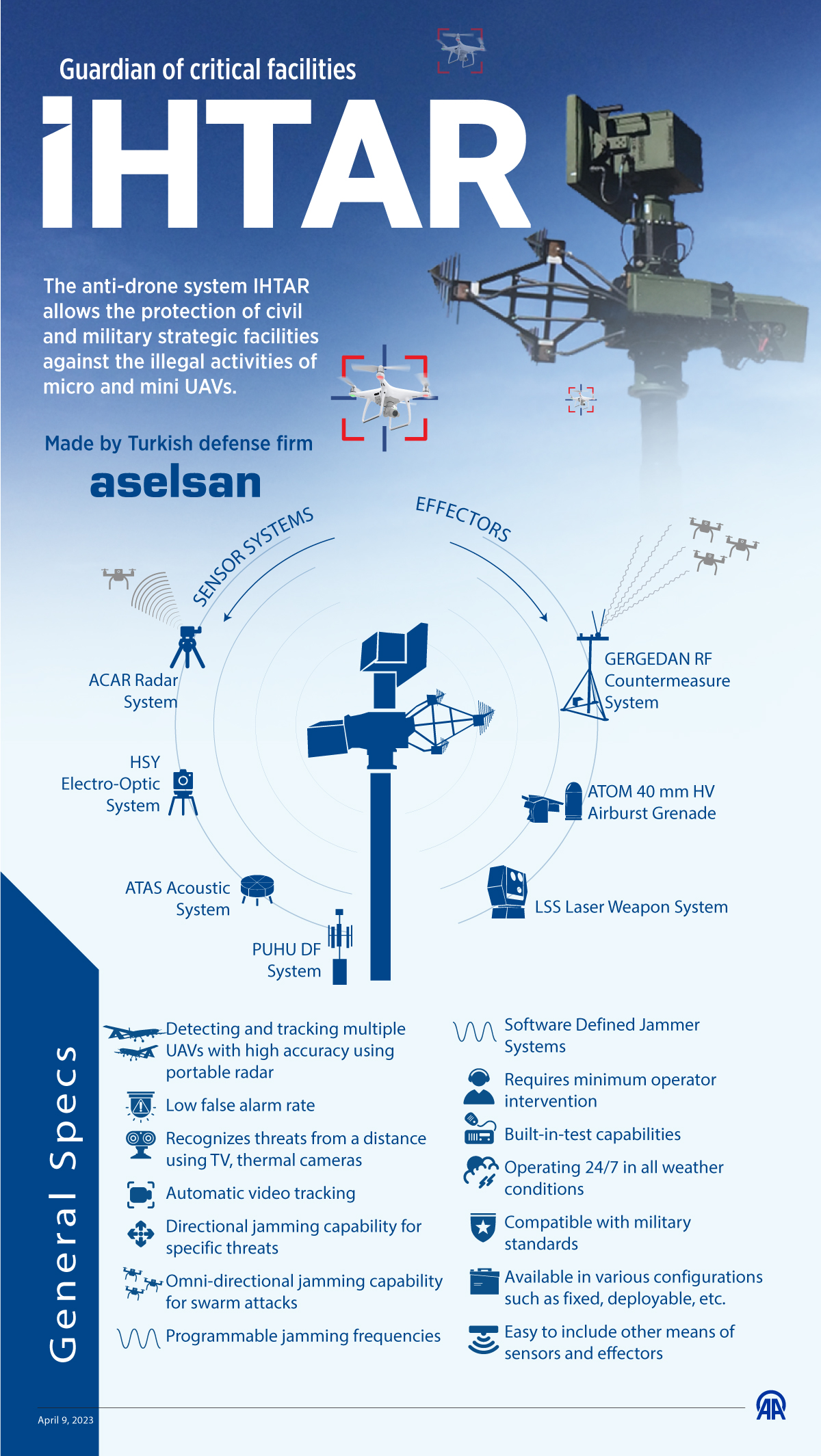
Turkey’s ASELSAN KORKUT and İHTAR counter-drone platforms are increasingly visible in Gulf security discussions. KORKUT combines rapid-fire cannon with radar-guided targeting against low-altitude threats; İHTAR integrates electronic and kinetic defeat options similar in concept to what Anduril offers. With Gulf states actively diversifying away from sole reliance on U.S. systems after repeated attack incidents, Turkish manufacturers have a credible entry point — particularly given Turkey’s established defense relationships with Qatar and Saudi Arabia.