Sweden picks the French hull: $5 billion FDI buy will defend the Baltic

Sweden’s long-awaited decision finally landed on 19 May: the country’s next-generation frigate fleet will be built around a French design. Naval Group’s FDI will be constructed as four ships at its Lorient yard; deliveries start in 2030 and the bill comes to roughly five billion dollars.
At a Glance
- What: Sweden selects Naval Group’s FDI design for the Luleå class
- Quantity/Value: 4 frigates — ~SEK 40 billion (~$5 billion)
- Rivals beaten: German and British bids dropped
- First delivery: 2030, then one ship per year
- Weapons: Aster 30 (ballistic defence) + CAMM-ER, RBS 15, Torped 47
- Context: Russia’s 2022 invasion, Sweden’s NATO accession, Baltic security
Prime Minister Ulf Kristersson framed the choice in one short sentence: “We are tripling Sweden’s ground- and surface-based air defences.” Plain talk, but the math behind it is large. The Swedish Navy has not operated a meaningful shipborne air-defence missile since the Seacat retired in the early 1980s. Aster 30 fills that gap — and adds ballistic-missile defence on top of it. The decision sits at the natural end of Sweden’s two-year strategic shift: Russia’s 2022 invasion, then NATO membership, and now a fleet designed for the Baltic.
The French design beat its German and British rivals on three pillars: speed of delivery, because Naval Group’s FDI line is already running in Lorient; design maturity, because the first French FDI (Amiral Ronarc’h) is close to commissioning and the second (Amiral Louzeau) hit the water in the same weeks as the Swedish deal; and cost sharing with other operators, because Sweden joins France and Greece in the same supply pipeline. Lorient will build the four hulls in sequence, the first ready in 2030.
Look at the small print and the agreement is two-way. The hull is French; the weapons and sensors are largely Swedish. In practical terms that means Saab’s Giraffe 1X radar, RBS 15 anti-ship missiles, Torped 47 ASW torpedoes, Trackfire remote weapon stations and BAE Systems Bofors 57 mm and 40 mm guns will all be integrated on a hull built abroad. Air defence stays close to the French configuration: a layered Aster 30 (short-to-mid range, including some ballistic threats) and CAMM-ER umbrella.
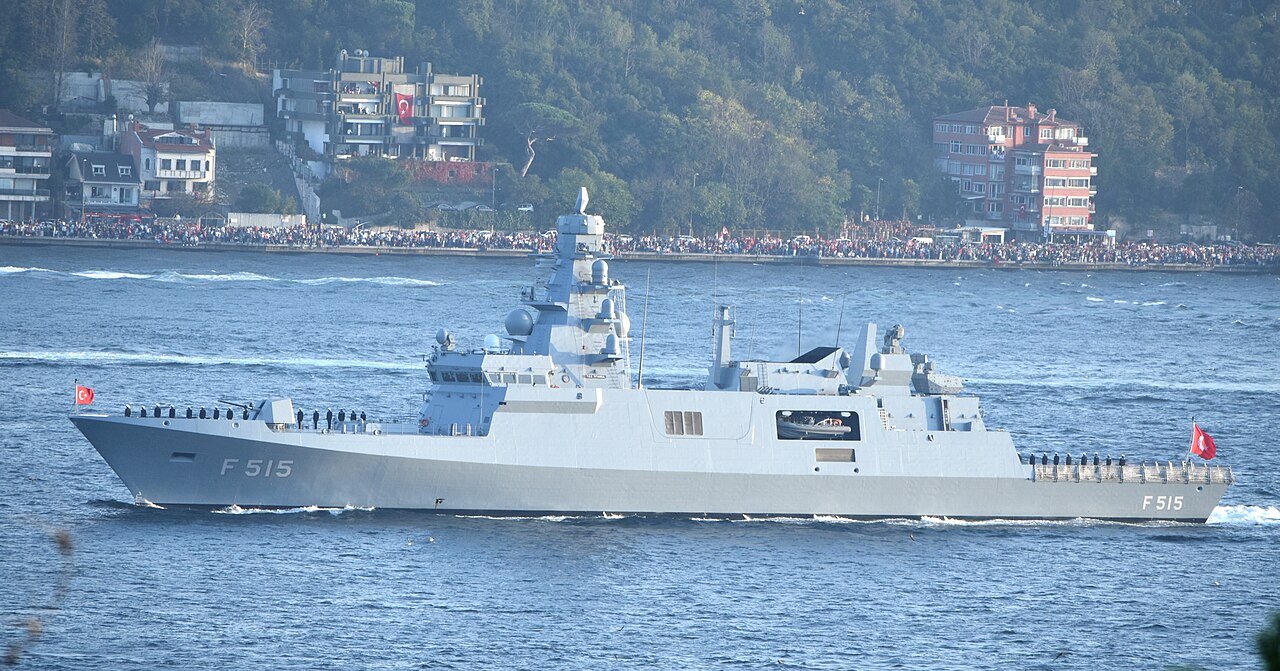
FDI: a modern mid-tonnage frigate, designed to do everything
Naval Group’s Frégate de Défense et d’Intervention (FDI) is a next-generation mid-tonnage frigate, displacing about 4,500 tons at roughly 122 metres. The headline architecture choice is the integrated mast — all sensors and antennas built into a single below-deck array, sharply cutting radar cross-section. France launched its first FDI, Amiral Ronarc’h, in 2026; Greece has three on order under the Pyriform/Kimon name. The design squeezes anti-surface, anti-submarine and air-defence roles into one hull — the most ambitious of the modern European frigate wave alongside Germany’s F126 and Italy’s FREMM evolution.
Step back and the Swedish choice reads as momentum for Naval Group inside Europe’s shipbuilding race. The company added a fifth FDI for France in late March; took the four-ship Swedish order in May; and saw Navantia and Kongsberg ink a long-term support frame for Norway’s F-310 fleet in the same window. European navies, according to industry tallies, currently carry roughly $105.8 billion in unawarded shipbuilding contracts — a pie that will shape who builds what, where, for years.
It is worth remembering that Sweden is no ordinary buyer either. Saab radars and electronic-warfare suites, BAE Bofors guns, RBS 15 anti-ship missiles — these are mature export products in their own right. The FDI choice creates a “French hull, Swedish kit” division of labour and keeps a large slice of the package inside Sweden’s own industrial base. Stockholm picked Lorient to get to sea quickly; it managed to do so without giving up its own industry’s seat at the table.
The Turkish angle: MİLGEM is mature; next come exports and the air-defence destroyer
Turkey is already established in the modern frigate league. The İstif class (TCG İstanbul and her sisters), the mature step in the MİLGEM programme, is built around an indigenous design, indigenous integration and a national combat-management system. Four Babür-class corvettes sold to Pakistan already form a real export reference; the deal signed with Indonesia shows MİLGEM is no longer a Turkish-Navy-only project. The next step is the TF-2000 air-defence destroyer — an indigenous MIDLAS vertical-launch system, the ÇAFRAD radar family, and a layered SİPER + HİSAR + GÖKDENİZ package that maps directly onto the Aster 30 / Aegis bracket.
Sweden’s FDI choice underlines two trends in this league: demand for mid-tonnage, multi-role frigates is at a peak, and buyers expect one hull to deliver air defence, surface warfare and ASW all at once. If Turkey can fuse MİLGEM’s maturity with the TF-2000 development tempo — particularly in the Gulf, Africa and South Asia — it has a chance to position itself not just as a supplier but as a design authority. The headline buried in this Swedish announcement, for an Ankara reader, is simply that: Europe’s frigate pie is growing, and Turkey is one of the most mature non-EU options for a share of it.
Sources
- Naval News — “Sweden Selects Naval Group’s FDI for Future Luleå-class Frigates”
- Defence Industry Europe
- Army Recognition
- Wikipedia — Luleå-class frigate / FDI frigate
- Naval Group official site
Related Coverage
- Germany and Norway move to put 4 Type 212CD submarines on Canada’s table
- The US Navy’s new FF(X) frigate: a modular, containerized weapons payload
- The US Navy goes all in on submarines: undersea priority in a $65.8 billion plan