US Moves to Approve $700 Million F110 Engine Sale for Turkey’s KAAN Fighter
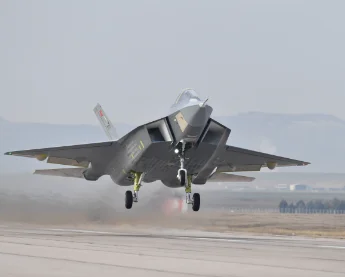
The US State Department has notified Congress of its intent to approve the sale of General Electric (GE) Aerospace F110 turbofan engines to Turkey, in support of the country’s indigenous KAAN fighter programme. The package, submitted for congressional notification on June 24, is valued at more than $700 million and arrives just days before NATO leaders gather in Ankara on July 7-8.
Deal details
The notification covers roughly 80 F110 engines that Ankara has been seeking for some time to move the KAAN programme beyond its prototype phase. Turkey already holds ten F110-GE-129E engines, delivered under a separate subcontract between Turkish Aerospace Industries (TAI) and GE Aerospace in September 2025. Those engines currently power the KAAN prototypes through an ongoing flight-test campaign, and were procured under an earlier, smaller agreement than the batch now before Congress.
Should the new package be approved, it would shift KAAN’s engine supply from a limited test arrangement toward a pipeline capable of supporting series production. Like most major foreign arms sales, the deal has passed through an informal congressional review process before formal notification. Representative Gregory Meeks of New York, the ranking Democrat on the House Foreign Affairs Committee, is reported to have placed an informal hold on the sale, but the administration is expected to proceed regardless. Formal notifications under US arms-export law typically open a statutory window, commonly cited as 15 days, during which lawmakers can object before a sale moves forward.
Reporting on the exact engine count and delivery schedule is not fully consistent across outlets; some accounts put the figure at around 80 units, though Washington has not published an official breakdown. The headline value of more than $700 million and the earlier September 2025 delivery of ten engines are, however, corroborated across multiple sources.
Why it matters
The timing is unlikely to be coincidental. Moving on the sale just ahead of a NATO summit hosted in Ankara reads as a signal of thawing defence ties between Washington and Ankara, which have been strained since 2019, when Turkey was removed from the F-35 programme after acquiring the Russian S-400 air-defence system. That decision cost Turkish industry an estimated $9 billion in projected workshare, and current US law still bars Turkey’s return to the F-35 programme unless it gives up the S-400s.
The F110 engine sale is being handled on a separate track from that dispute, which matters because it suggests KAAN’s engine supply no longer needs to wait on a resolution to the F-35 standoff. That said, the sale is not without domestic opposition in Washington; groups such as the American Hellenic Institute have publicly urged the administration to block it, underscoring that the issue remains contentious even as the administration pushes ahead.
For the KAAN programme itself, the engines mark a transition point. The aircraft flew for the first time on February 21, 2024, for 13 minutes, followed by a second test flight on May 6, 2024. Early production standards, designated Block 10 and Block 20, are expected to rely on the F110, while Turkish Aerospace’s engine affiliate, TEI, is developing an indigenous engine, the TF35000, intended for Block 30 and Block 40 aircraft from around 2032 onward. Until that engine matures, imported F110s remain the only path to expanding KAAN’s flight-test fleet and, eventually, its operational squadrons.
Sources: Army Recognition, FlightGlobal.