Above the Horizon: MALE/HALE ISR Platforms and the Gulf’s Surveillance Build-Out

Gulf air forces are quietly reshaping their intelligence, surveillance and reconnaissance posture around a single platform class: the medium-altitude, long-endurance (MALE) and high-altitude, long-endurance (HALE) unmanned aircraft that can loiter over a maritime chokepoint or a land border for twenty hours or more. Unlike the strike-focused combat drones this series examined earlier this year, MALE/HALE ISR platforms are valued primarily for persistence and sensor reach rather than munitions carriage, and the choice between American, Chinese, Israeli and Turkish types now shapes how Gulf Cooperation Council states track Iranian naval activity, Houthi launch sites and their own contested airspace. The market has become more consequential, and more openly contested, since the 2026 Iran war exposed both the value of persistent overhead surveillance and the vulnerability of medium-altitude platforms operating in contested airspace.
Executive Summary
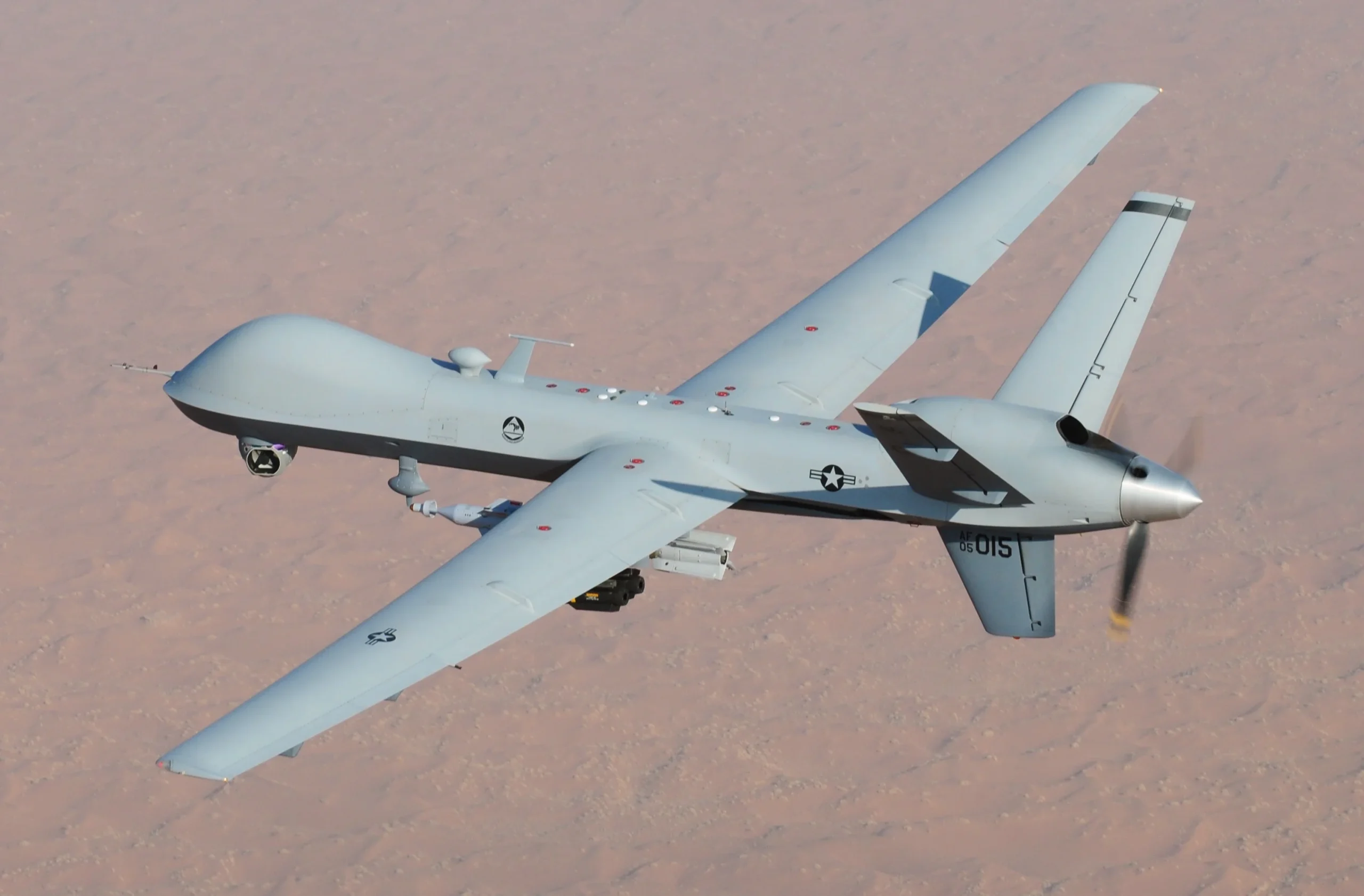
Three supplier ecosystems currently compete for Gulf MALE/HALE ISR budgets. The United States, through General Atomics Aeronautical Systems, offers the MQ-9B SkyGuardian and its maritime derivative SeaGuardian, both benefiting from NATO-standard detect-and-avoid certification and a maturing package of synthetic aperture radar, multi-spectral targeting and, from 2026, an early-warning sensor option. China’s state-owned CASC has built the largest installed base in the region through the Wing Loong II and the CH-4B, both operated by Saudi Arabia and the UAE, and has followed with the higher-altitude Wing Loong-10B ordered by Riyadh in 2024. Israel’s IAI and Elbit Systems have pursued the market opportunistically since the Abraham Accords, with leaked correspondence in 2026 showing Elbit proposed an expedited Hermes-family sale to the UAE, though no confirmed contract has followed; the approach itself drew criticism given the timing amid Israel’s continuing military campaign in Gaza. Turkish platforms, chiefly the TAI Anka family, remain a smaller but growing presence, positioned on cost and openness of technology transfer rather than raw performance. Procurement decisions increasingly hinge less on unit cost than on data-sharing terms, satellite bandwidth allocation and integration with the wide-area maritime and border sensor networks GCC states have built since 2020.
Operational Context
The operational case for MALE/HALE ISR in the Gulf rests on geography as much as threat perception. The distances involved — from the Strait of Hormuz to the southern Red Sea, from Kuwait’s northern border to Yemen’s Houthi-controlled coastline — exceed what tactical UAVs or manned maritime patrol aircraft can cover persistently without prohibitive sortie rates. A single MQ-9B or Wing Loong II, cruising at altitude for eighteen to twenty-seven hours depending on payload, can hold a wide-area maritime picture or watch a border crossing through a full operational cycle in a way that a four-hour manned patrol cannot.
That case sharpened considerably during 2026. Iranian air defences shot down at least two Wing Loong II aircraft attributed to Saudi or Emirati operators over Shiraz and the Gulf in early April, according to open-source reporting that Tehran itself amplified by displaying wreckage. Whatever the precise mission profile of those sorties, the episode demonstrated that medium-altitude ISR platforms without stealth or standoff sensor reach are not immune from modern integrated air defences even when operating for reconnaissance rather than strike purposes — a consideration that now factors into every Gulf MALE procurement discussion. At the same time, the same conflict period saw a documented surge in counter-UAS spending across Bahrain, Kuwait, Oman, Qatar, Saudi Arabia and the UAE, reflecting a regional recognition that ISR and strike drones alike now operate in an increasingly contested lower and middle airspace.
Sensor payload has become the more decisive procurement variable than airframe performance. Synthetic aperture radar with ground-moving-target indication, multi-spectral electro-optical/infrared turrets, automatic identification system receivers for maritime tracking, and signals-intelligence pods are now routinely bundled or offered as modular options, and GCC buyers increasingly specify these packages before airframe selection rather than after.
Comparative Analysis
The table below sets out the principal MALE/HALE ISR types either in service with, ordered by, or actively offered to Gulf states, alongside the supplier restrictions that shape each option’s attractiveness.
| Platform | Origin | Class | Endurance | Service ceiling | Gulf status | Principal sensor fit |
|---|---|---|---|---|---|---|
| MQ-9B SkyGuardian / SeaGuardian | United States (General Atomics) | MALE/HALE | ~27–40 hours | ~40,000 ft | UAE approved for sale; regional interest reported at DIMDEX 2026 | SAR/GMTI, MTS-B EO/IR, maritime AIS, optional AEW package |
| Wing Loong II | China (CASC/Chengdu) | MALE | ~20 hours | ~29,500 ft | In service — Saudi Arabia, UAE | EO/IR turret, SAR, SIGINT variants offered |
| Wing Loong-10B | China (CASC) | HALE | ~30+ hours (reported) | ~45,000 ft (reported) | Ordered — Saudi Arabia (2024) | Extended SAR/EO-IR suite, long-range datalink |
| CH-4B Rainbow | China (CASC) | MALE | ~14 hours | ~16,000 ft | In service — Saudi Arabia (RSAF 202/203 Sqn) | EO/IR, SAR, basic SIGINT options |
| Heron / Heron TP (Eitan) | Israel (IAI) | MALE/HALE | ~30–45 hours | ~45,000 ft | Pitched to UAE (Elbit Hermes family, 2026 leak); no confirmed sale | SATCOM-linked EO/IR, SAR, SIGINT |
| Anka-S / Aksungur (ISR role) | Turkey (TAI) | MALE | ~24 hours (Aksungur) | ~34,000 ft (Aksungur) | Export discussions reported; no confirmed GCC operator | SAR, EO/IR, SIGINT pod options |
Endurance and altitude figures for platforms not yet independently verified in Gulf service are drawn from manufacturer specifications and should be treated as indicative rather than operationally confirmed; several sources give ranges rather than single figures for the Wing Loong-10B in particular, reflecting its limited open reporting.
The American and Chinese offerings currently dominate actual fielded numbers, for different reasons. The MQ-9B’s advantage is regulatory: its NATO-standard STANAG 4671 airworthiness certification allows it to fly in non-segregated civil airspace, a genuine operational advantage for states that want ISR platforms operating routinely rather than confined to military corridors. Its constraint is political — US export approval carries end-use monitoring and, in the case of armed variants, congressional notification requirements that Gulf buyers have at times found slower than they would prefer. China’s Wing Loong and CH-4 families carry no comparable end-use restriction and have consequently achieved the largest actual fielded numbers in the region, at the cost of a less mature sensor ecosystem and, as the April 2026 losses illustrated, a combat record that includes vulnerability to modern air defences.
Procurement Considerations
Gulf ISR procurement now weighs at least four variables beyond unit price. First is data sovereignty: several GCC states have pushed suppliers for ground control stations and downlink architecture that keep collected imagery and signals data within national or regional infrastructure rather than routed through supplier-controlled networks, a concern that applies to American, Chinese and Israeli offerings alike. Second is integration cost — a MALE/HALE type is only as useful as the command-and-control architecture that fuses its feed with national air-defence and maritime-domain-awareness pictures, and buyers increasingly evaluate open architecture and interoperability with existing radar and C2 investments (examined in Week 8 of this series) ahead of airframe specifications. Third is sustainment: Saudi Arabia’s pursuit of a domestic CH-4 assembly and maintenance arrangement with CASC, though its final scope remains unconfirmed in open sources, reflects a broader Gulf preference for local depot-level support that reduces dependence on any single foreign supplier during a crisis. Fourth, and increasingly explicit since April 2026, is survivability: buyers are asking suppliers pointed questions about self-protection suites, low-observable features and stand-off sensor range, pushing the market gradually toward HALE types that can operate outside the engagement envelope of medium-range Iranian and Houthi air-defence systems rather than within it.
The Israeli option illustrates how procurement in this segment is inseparable from politics. The 2026 leak of Elbit’s Hermes-family proposal to the UAE surfaced amid continuing international criticism of Israel’s conduct in Gaza, and the timing generated domestic and regional pushback that has so far kept the deal at the proposal stage rather than converting it into a signed contract. Any eventual Gulf acquisition of Israeli MALE/HALE platforms will be read regionally through that lens regardless of the technical merits of the Heron TP airframe, which remains one of the more capable HALE ISR types on the international market.
Outlook
The next eighteen months are likely to see the American and Chinese ecosystems consolidate their respective positions rather than a wholesale shift toward a new supplier. UAE movement on the MQ-9B, if it converts from stated interest into a signed order, would mark the most significant single addition to Gulf HALE ISR capacity since Saudi Arabia’s original MH-60R and Wing Loong commitments, and would likely accelerate Qatari and Kuwaiti interest in comparable Western platforms as GCC states continue to favour interoperable, nationally-supported architectures over single-vendor dependence. China’s Wing Loong-10B delivery schedule to Saudi Arabia will be an early test of whether Beijing can match the sensor sophistication that has so far kept American platforms ahead on capability, even as Chinese types retain a durable cost and export-restriction advantage. Turkish and Israeli suppliers are likely to remain secondary players in this specific segment through the medium term — Turkey constrained more by production capacity and export prioritisation than by capability, Israel by the political sensitivity that continues to attach to any Gulf-Israel defence transaction in the current regional climate — though both retain the underlying technology to compete more directly should regional dynamics shift.