JAS 39 Gripen E/F: Sweden’s Cost-Effective 4.5-Gen Fighter — Specs, Operators and the Colombia Deal Explained

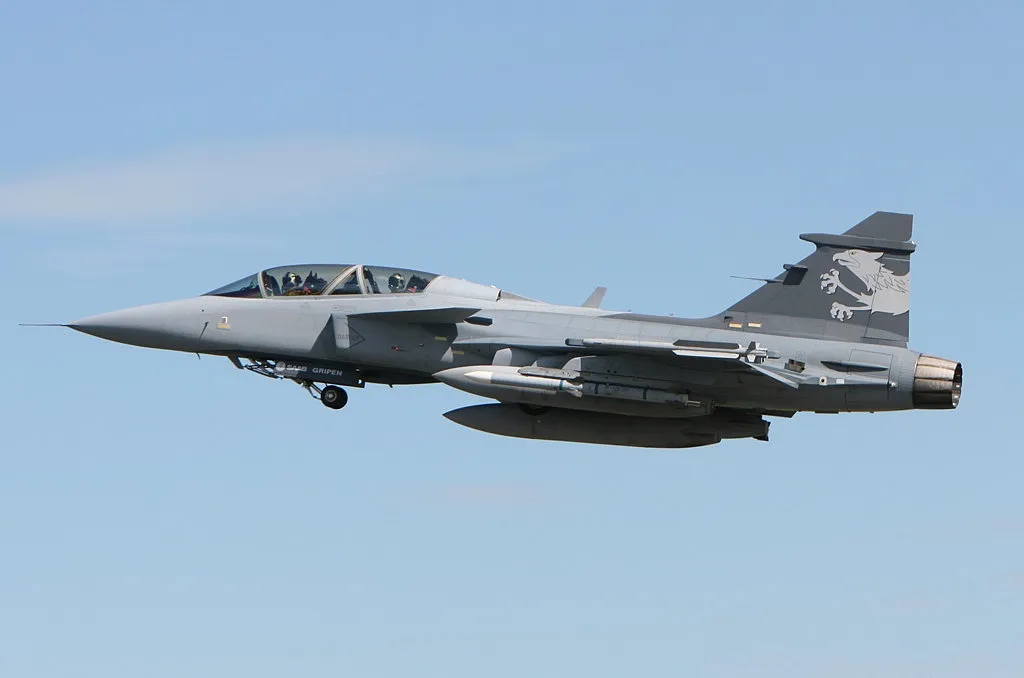
The JAS 39 Gripen E/F is Sweden’s front-line multi-role fighter and Saab’s most commercially successful export product. A genuine 4.5-generation platform, the Gripen E combines a GE F414G engine producing 98 kN of thrust, the Raven ES-05 AESA radar and a significantly expanded combat radius over earlier variants — all packaged at a lifecycle cost that manufacturers of twin-engine competitors struggle to match. By late 2025, a landmark €3.1 billion contract with Colombia had been signed, while Ukraine issued a letter of intent for up to 150 aircraft, confirming the Gripen family’s momentum at a time when European air power is under intense scrutiny.
Design Philosophy: Three Missions, One Airframe
The “JAS” designation encodes the aircraft’s three core roles: Jakt (air combat), Attack (strike) and Spaning (reconnaissance). Saab’s engineering team made three bets that proved prescient. First, a single engine — the Volvo RM12, later replaced by the GE F414G — reduces weight and operating cost without sacrificing combat capability at the altitudes and distances Sweden needs to defend. Second, a delta-canard configuration delivers agility at high angles of attack where straight-winged aircraft lose control. Third, an open-architecture software bus allows national weapons to be integrated without Saab’s direct involvement, a policy feature that has won contracts in markets wary of technology dependency.
The first JAS 39A prototype flew in 1988; the C/D standard entered service in 1999. The E variant commenced deliveries in 2019, with the two-seat F variant available for training and advanced strike roles.
Technical Specifications
| Parameter | Gripen C/D | Gripen E | Gripen F (two-seat) |
|---|---|---|---|
| Engine | Volvo RM12 (80.5 kN) | GE F414G (98 kN) | GE F414G (98 kN) |
| Max Speed | Mach 2.0 | Mach 2.0+ | Mach 2.0+ |
| Combat Radius | ~800 km | ~1,300 km | ~1,300 km |
| Service Ceiling | 15,240 m | 15,240 m+ | 15,240 m+ |
| Empty Weight | 6,622 kg | ~8,000 kg | ~8,500 kg |
| Max Take-off Weight | 14,000 kg | 16,500 kg | 16,500 kg |
| Length | 14.1 m | 15.2 m | 15.2 m |
| Hardpoints | 8 | 10 | 10 |
| Internal Gun | 27 mm Mauser BK-27 | 27 mm Mauser BK-27 | 27 mm Mauser BK-27 |
| Radar | PS-05/A AESA | Raven ES-05 AESA | Raven ES-05 AESA |
Operators and Contracts: Who Bought, How Much
| Country | Variant | Quantity | Status |
|---|---|---|---|
| Sweden | C/D + E | 60 active + 60 E ordered | Deliveries ongoing |
| Brazil | E/F | 36 | Domestic assembly ongoing |
| South Africa | C/D | 26 | Active |
| Hungary | C/D | 14 | Active (leased) |
| Czech Republic | C/D | 14 | Active (leased) |
| Thailand | E/F | 14 (planned total) | Partial delivery |
| Colombia | E/F | 17 | Contract signed 2025 |
| Ukraine | E/F | Up to 150 (letter of intent) | Under negotiation |
The Colombia deal is the programme’s most significant win in a decade. Signed at a headline value of €3.1 billion, it covers 17 Gripen E/F aircraft, a training package and a substantial industrial participation component — a pattern Saab has used successfully in Brazil, where Embraer assists with final assembly. Saab has also positioned the Gripen E as a near-term option for Ukraine, though the political and logistical dimensions of that proposition remain complex.
Operational Record
South African Gripen C/D aircraft have flown under UN oversight in the Democratic Republic of Congo. Swedish aircraft regularly rotate through NATO’s Baltic Air Policing mission. Czech and Hungarian leased fleets contribute to NATO’s eastern flank air-defence coverage. None of these engagements constitute high-intensity air-to-air combat, but they demonstrate sustained operational availability at realistic sortie rates.
Strengths
- Lifecycle cost estimated at roughly one-fifth of an F-35A
- Road-base and short-field take-off/landing capability
- Open avionics architecture enables national weapons integration without vendor dependency
- +9/−3 g and 70–80° angle-of-attack controlled flight
- Industry-leading technology transfer offers (Brazil, Colombia)
Limitations
- Single engine — survivability risk on engine failure over water or hostile territory
- No high-intensity combat record against peer air forces
- Nations without domestic maintenance infrastructure face supply-chain dependency
Competitive Landscape
| Aircraft | Origin | Engines | Combat Radius | Unit Price (est.) |
|---|---|---|---|---|
| JAS 39 Gripen E | Sweden | Single | ~1,300 km | ~$85M |
| F-16 Block 70 | USA | Single | ~550 km | ~$80–90M |
| Eurofighter Typhoon | Europe | Twin | ~1,400 km | ~$100M |
| Dassault Rafale F4 | France | Twin | ~1,850 km | ~$125M |
| F-35A | USA | Single | ~1,100 km | ~$100M |
Why It Matters for Turkey
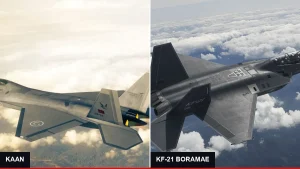
Turkey’s direct domestic equivalent is the TUSAS KAAN (TF-X), which completed its maiden flight in February 2023. KAAN currently flies on interim F110-GE engines while the indigenous TEI TF engine programme matures. The comparison between the two platforms is less about generation and more about operational readiness: the Gripen E is certified, in service with five operators and generating export revenue. KAAN is a promising prototype. The critical milestones for KAAN — engine certification, domestic AESA radar (MURAD) integration and series production — will determine when the comparison becomes competitive rather than aspirational.
| Parameter | JAS 39 Gripen E | TUSAS KAAN |
|---|---|---|
| Generation | 4.5 | 5th (target) |
| Engine | GE F414G (operational) | F110-GE (interim); target: TEI TF |
| AESA Radar | Raven ES-05 (operational) | MURAD (development) |
| Operational Status | Active in 5 nations | Prototype |
| Export Record | 280+ delivered | None yet |
Bottom Line
The JAS 39 Gripen E/F remains the most compelling cost-performance proposition for air forces that cannot or will not operate F-35s. The Colombia contract and Ukraine letter of intent confirm that Saab’s blend of capability, price and industrial participation continues to win in competitive markets. Turkey’s KAAN programme is the correct long-term response to this segment; bridging the gap between prototype and operational fleet is the work of the next decade.