What Does Oshkosh Defense Produce? All Vehicle Families and Systems

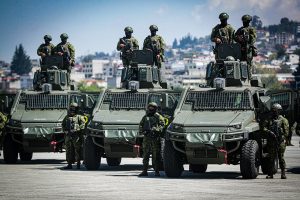
Oshkosh Defense’s product range spans five major categories — from light tactical vehicles to 700-horsepower tank transporters, and from semi-autonomous fire platforms to convoy robotics. Each platform addresses a distinct operational requirement, and several are simultaneously in active service with more than 20 countries.
Since its founding in 1917, Oshkosh Defense has produced more than 190,000 vehicles. But the portfolio has moved far beyond trucks and logistics platforms over the past decade. The company now runs multiple active programs in autonomous vehicle technology and unmanned systems — fields where it holds a first-mover advantage with fielded, combat-tested hardware.
Light Tactical Vehicles
The centerpiece of this category is the JLTV (Joint Light Tactical Vehicle), which entered service with the U.S. Army and Marine Corps in 2019 to replace the aging HMMWV. With a 340 hp engine, TAK-4i intelligent independent suspension, and a V-hull blast-resistant structure, more than 24,000 JLTVs have been produced across seven variants — and the platform is now in service with 12 countries. The eJLTV hybrid-electric variant is in development, targeting reduced acoustic signature for dismounted operations.
MRAP and Protected Vehicles
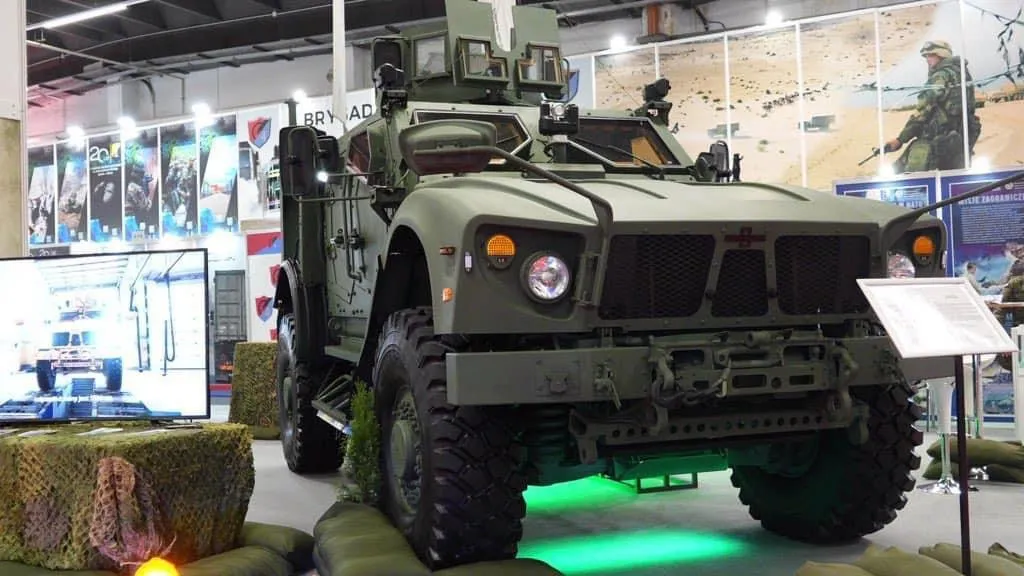
The M-ATV was developed in 2009 as a direct response to the IED threat in Afghanistan. Powered by a 370 hp Caterpillar C7 engine and fitted with TAK-4 suspension — which provides true off-road mobility unlike earlier MRAP designs — the M-ATV reached more than 10,000 units across eight mission variants. The UAE is the largest non-U.S. operator, having received more than 800 vehicles in 2011–2012.
Medium Tactical Vehicles
The FMTV A2 (Family of Medium Tactical Vehicles) forms the backbone of U.S. Army medium logistics. With 12 truck variants, four chassis configurations, and three trailer options, the family covers cargo, wrecker, dump, tractor, and airdrop roles. The LVAD variant successfully completed C-130 and C-17 low-velocity airdrop tests in 2024 — a capability that enables rapid force insertion without fixed logistics infrastructure. The Marine Corps operates the MTVR (MK23/MK25) for similar roles.
Heavy Tactical Vehicles
HEMTT (Heavy Expanded Mobility Tactical Truck), in production since 1982, is Oshkosh’s highest-volume program at more than 35,800 units. The 8×8 platform operates at 515 hp and supports 11 mission variants — cargo, fuel tanker, Patriot tractor (M983), recovery wrecker (M984), MLRS resupply (M985), load handling system (M1120), and bridge transporter (M1977). The HET (M1070) uses a 700 hp Caterpillar C18 to transport the M1 Abrams at up to 70 tons — and has done so in every major U.S. armor operation since 1991. The PLS loads and unloads in under one minute via its hydraulic load handling system; more than 8,500 have been produced.
Autonomous and Unmanned Systems
ROGUE-Fires, built on the JLTV chassis, is the first semi-autonomous ground fires platform fielded by U.S. forces. The Forterra AutoDrive system enables GPS-denied navigation; integrated weapon options include the Naval Strike Missile, HIMARS munitions, and Tomahawk cruise missiles. The Marine Corps signed a $92 million Block 2 contract. TerraMax is a retrofit autonomy kit that converts existing FMTV and M-ATV vehicles into autonomous convoy participants — one operator supervises up to five vehicles. The FMAV family, revealed at AUSA 2025, adds X-MAV (heavy), M-MAV (FMTV A2-derived), and L-MAV (ROGUE-Fires-derived) for light-to-extreme payload autonomous operations.
Platform Summary
| Category | Platform | HP | In Service Since | Units Produced |
|---|---|---|---|---|
| Light Tactical | JLTV | 340 | 2019 | 24,000+ |
| MRAP | M-ATV | 370 | 2009 | 10,000+ |
| Medium Tactical | FMTV A2 | 375–600 | 1980s (A2: 2022) | Tens of thousands |
| Heavy Tactical | HEMTT | 515 | 1982 | 35,800+ |
| Heavy Tactical | HET M1070 | 700 | 1976 | 4,600+ |
| Heavy Tactical | PLS | 600 | 1990s | 8,500+ |
| Autonomous | ROGUE-Fires | 340 | 2022 | In production |
Sources
- Oshkosh Defense Official Website (oshkoshdefense.com)
- U.S. DoD Contract Announcements (defense.gov)
- Breaking Defense, Army Technology, Defense News