VT-4 (MBT-3000): NORINCO’s Export Champion Tank — Pakistan, Thailand and Nigeria Operators Explained

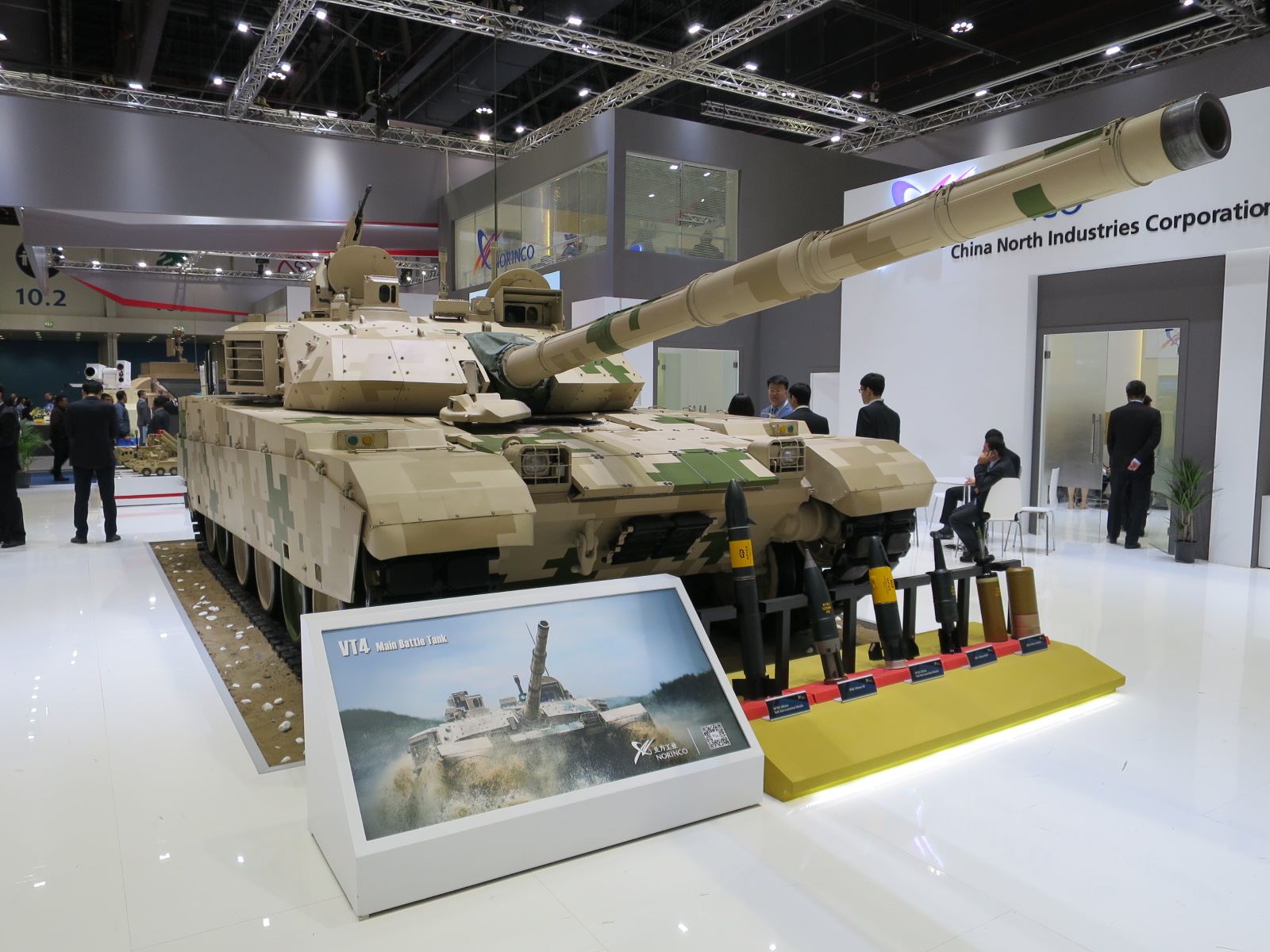
China’s most visible land-warfare export is the VT-4 (factory code MBT-3000), a 52-tonne third-generation main battle tank sold across three continents since 2017. Pakistan placed a $860 million order for 176 units, Thailand built Southeast Asia’s largest VT-4 fleet with 60 tanks, and Nigeria has deployed it against Boko Haram. The question that follows every NORINCO export brochure: does the VT-4 really compete with the Leopard 2A4 or the T-90M — and where does it sit next to Turkey’s ALTAY? We compiled the answer from open sources.
At a Glance
What Is the VT-4?
The VT-4 is a main battle tank developed by NORINCO (China North Industries Corporation) jointly with the First Inner Mongolia Machinery Factory. It is essentially a lighter, simpler and cheaper relative of the Type 99A that serves with the People’s Liberation Army (PLA), but designed from the start for export. The factory code is MBT-3000; the export marketing name is VT-4.
Development began in 2009. The prototype made its international debut at Eurosatory 2012, and the tank was rebranded as VT-4 at China’s Zhuhai air show in 2014. The first serious export contracts were signed in 2016-2017, with deliveries reaching customer armies from 2017 onward.
Design Philosophy: Three Selling Points
- Autoloader-equipped three-man crew (versus four in Leopard 2 or ALTAY). Smaller turret, lower silhouette, lighter logistical footprint.
- Modular composite armor + FY-4 explosive reactive armor (ERA) — buyer-configurable kit so operators can add or remove ERA panels.
- Hunter-killer fire control — commander hunts the next target while the gunner engages the previous one. A feature standard on Western tanks since the 1980s but absent on the VT-4’s Type 96 predecessor.
Technical Specifications
| Specification | Value |
|---|---|
| Crew | 3 (commander, gunner, driver) |
| Combat Weight | 52 tonnes |
| Length (gun forward) | 10.10 m |
| Width | 3.44 m |
| Height | 2.40 m |
| Main Armament | 125 mm ZPT-98A smoothbore, autoloader, 38 rounds (22 in carousel) |
| Ammunition Types | APFSDS (sabot), HEAT, HE, gun-launched ATGM (GLATGM) |
| Secondary Armament | 12.7 mm remote weapon station + 7.62 mm coaxial MG |
| Engine | VT/E1 V12 diesel, 1,200 hp (895 kW) @ 2,300 rpm |
| Power-to-Weight | 23 hp/tonne |
| Transmission | Ch1000B automatic, 6 forward / 2 reverse |
| Suspension | Torsion bar |
| Max Speed | 70 km/h (road) |
| Range | 500 km |
| Armor | Composite + FY-4 ERA; frontal ~500 mm RHA-equivalent, ERA ~700 mm additional |
| Fire Control | Panoramic commander sight, Thales Catherine-FC thermal, laser rangefinder, hunter-killer |
| Active Protection (VT-4A1) | GL5 hard-kill APS, laser warning, additional smoke launchers |
Operators and Contracts: Who Bought, How Much
| Customer | Units | Year / Value | Status |
|---|---|---|---|
| Pakistan | 176 | 2018-2019, ~$860M | In service 2021; indigenous “Haider” variant unveiled 2024 (Heavy Industries Taxila) |
| Thailand (Contract 1) | 28 | May 2016, $150M | First delivery October 2017 |
| Thailand (Contract 2) | 10 | April 2017, $58M | Delivered |
| Thailand (Contract 3) | 14 | Jan 2019, $72.5M | All accepted by 2023 |
| Nigeria | ~17 | 2020 first delivery | Combat debut against Boko Haram in Operation Tura Takai Bango; one tank lost |
| Algeria | Trials | 2024 evaluation | No decision announced |
The Pakistan contract is NORINCO’s largest single tank export to date. Unit cost is roughly $4.9 million — by reference, South Korea’s K2 Black Panther is $8.5 million and Germany’s new-production Leopard 2A7+ runs $10-13 million. The VT-4 competes on price, not capability.
Combat Record: Thailand Barrel Burst, Nigeria Asymmetric Test
- Nigeria — Boko Haram operations (2024-2025). Deployed against irregular forces. One tank suffered a main-gun failure during an official display; another was lost to a Boko Haram attack. Overall Nigerian Army verdict: “satisfactory but logistics-dependent.”
- Thailand — Cambodia border incident (December 2025). A Royal Thai Army VT-4 had its 125 mm barrel rupture during border combat. The incident reignited debate about NORINCO barrel quality control.
- Pakistan. The 176-tank fleet is active but no confirmed combat use on the Indian or Afghan border.
Variants
- MBT-3000: Prototype / factory designation (2012 Eurosatory).
- VT-4: Production export model (2017+).
- VT-4A1: Modified turret, repositioned grenade launchers, GL5 hard-kill APS, laser warning device, drone-launcher capability. China’s 2024 Zhuhai showcase configuration.
- Haider: Pakistan’s locally built variant (Heavy Industries Taxila, unveiled 2024). Adds local sensors and communications.
- VN20: Heavy IFV derivative on the same chassis.
Global Counterparts
Three tanks sit in the VT-4’s price-segment bracket:
- T-90M (Russia): 46 t, 1,130 hp, 125 mm 2A46M-5, Relikt ERA. ~$4.5-5M. Same price band, similar gun caliber, far more combat data thanks to Ukraine.
- Leopard 2A4 (Germany — used market): 55 t, 1,500 hp, 120 mm Rh-120, advanced composite armor. Refurbished units ~$3-5M. Mature industrial support and training pipeline outclass the VT-4.
- K2 Black Panther (South Korea): 55 t, 1,500 hp, 120 mm L55, hydropneumatic suspension, APS standard. $8.5M. Cleanly above the VT-4; Poland ordered 1,000.
The VT-4 sits below all three but offers Type 99A-derived technology in an export-friendly package — a fit for Pakistan, Nigeria and Thailand-class buyers.
Why It Matters for Turkey: Next to ALTAY
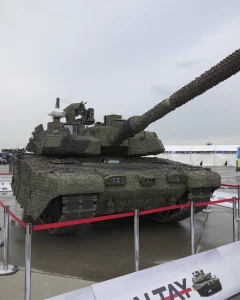
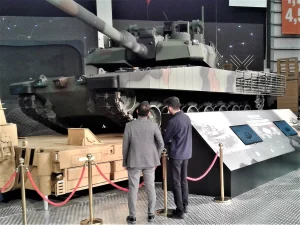
Putting the VT-4 next to Turkey’s ALTAY is not an apples-to-apples comparison. The two tanks answer different strategic requirements. ALTAY sits in the 65-tonne class with a 1,500 hp BATU engine, 120 mm MKE smoothbore, ASELSAN AKKOR active protection system and indigenous composite armor — placing it firmly in the upper segment alongside the K2 Black Panther and Leopard 2A7. The VT-4, at 52 tonnes and a simpler package, occupies the export-oriented middle-upper bracket.
The key intersection: Pakistan operates the VT-4 while simultaneously sourcing Bayraktar Akıncı and other Turkish UCAV systems. Chinese armor and Turkish unmanned air power are operating under the same Pakistani command structure — illustrating Pakistan’s diversification strategy and the operational compatibility of Turkish technology alongside Chinese platforms.
Turkey, meanwhile, has ALTAY in serial production at BMC’s Sakarya plant under a 250-unit initial order with longer-term plans exceeding 1,000. ALTAY’s configuration — indigenous engine (BATU), indigenous APS (AKKOR), indigenous fire control (VOLKAN-2) — gives Turkey’s defense industry a clear supply-chain independence advantage over the VT-4’s significant reliance on Thales Catherine-FC thermals and historically Ukraine-derived powertrain technology. The strategic question shifts from “does Turkey have a VT-4 competitor?” to “can Turkey offer a credible alternative to VT-4 customers?” — and with export clearance and the right price point, the answer is yes.
Frequently Asked Questions
How much does a VT-4 cost?
Approximately $4.9 million per unit per open-source reporting. Pakistan paid roughly $860 million for 176 tanks.
Which countries operate the VT-4?
Pakistan (176, with local “Haider” production), Thailand (60), Nigeria (~17). Algeria conducted trials in 2024 with no public decision.
Is the VT-4 the same as the Type 99A?
No. The Type 99A is the PLA’s frontline main battle tank with more advanced armor and electronics. The VT-4 is the export-grade, simplified, lower-cost derivative.
Does the VT-4 use foreign components?
The VT/E1 engine is marketed as Chinese-made, but the powertrain (transmission and drive train) historically benefited from Ukrainian technology transfer. The Thales Catherine-FC thermal imager is licensed French content.
Is Pakistan building the VT-4 locally?
Yes. The Pakistani “Haider” variant entered local production at Heavy Industries Taxila in 2024.
Does the VT-4 compete with the ALTAY?
Different segments. ALTAY (65 t, upper, K2/Leopard 2A7 class) doesn’t share an export market with the VT-4 (52 t, middle export). If Turkey exports ALTAY they will overlap on price-sensitive buyers.
Bottom Line
The VT-4 is the most visible product of China’s land-warfare export strategy. Since 2017 it has entered service in Pakistan, Thailand and Nigeria, and Pakistan now trusts the platform enough to license a local variant. Technically it does not reach Leopard 2A4 or K2 standards, but at a $4.9 million unit price it competes squarely with the Russian T-90M. For Turkey the VT-4 is no direct threat — but as Turkey pushes ALTAY into export markets, NORINCO customers like Pakistan, Indonesia and Algeria sit on the same shelf.
Related Reading
Sources
- VT-4 — Wikipedia (en.wikipedia.org/wiki/VT-4)
- Army Technology — VT4 (MBT-3000) Main Battle Tank
- Army Recognition — Pakistan officially confirms NORINCO VT4 MBT induction
- Defence Security Asia — China’s NORINCO Completes Delivery of 60 VT-4 Main Battle Tanks To Thailand
- Shephard Media — Nigeria takes delivery of first batch of Chinese VT4s
- NORINCO official catalog and IDEX 2017 / Eurosatory 2012 exhibition material