What Is TUSAŞ ANKA-III? Turkey’s Stealth UCAV Blurs the Line Between Drone and Fighter

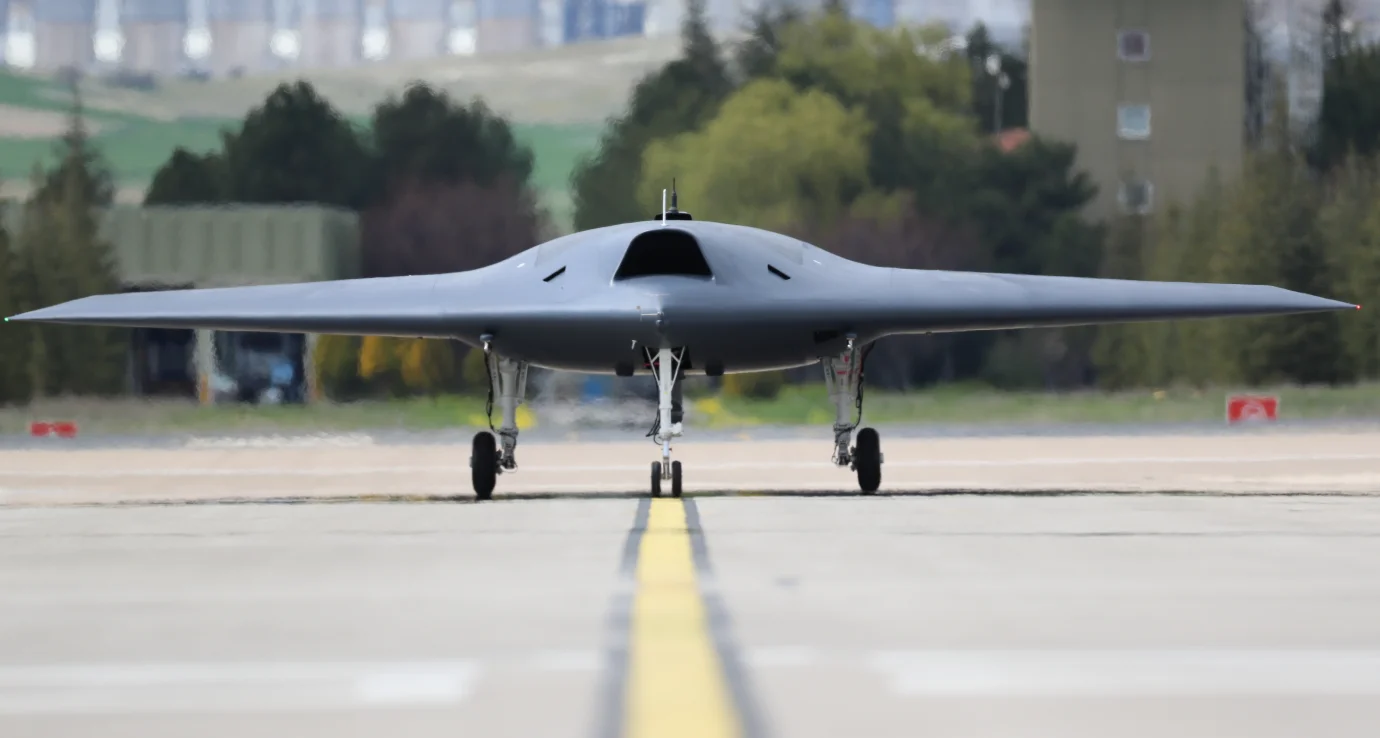
On December 28, 2023, ANKA-III completed its maiden flight entirely autonomously — more than an hour in the air, ending with an automatic landing that required no human intervention. That flight placed Turkey among the small group of nations operating flying-wing stealth unmanned combat aerial vehicles, a category previously occupied only by the United States and a handful of other major powers. TUSAŞ built ANKA-III on the back of 250,000 flight hours accumulated across its ANKA and AKSUNGUR programmes.
Technical Specifications
| Specification | Value |
|---|---|
| Length | 7.9 m |
| Wingspan | 12.5 m |
| Height | 2.5 m |
| Max Takeoff Weight | 6,500 kg |
| Max Payload | 1,200 kg |
| Service Ceiling | 40,000 ft |
| Endurance at 30,000 ft | 10 hours |
| Max Speed | 425 knots / Mach 0.7 |
| Cruise Speed | 250 knots / Mach 0.42 |
| Weapon Stations | 2 internal + 5 external |
The Flying Wing: Stealth Built Into the Shape
ANKA-III adopts a tailless flying-wing planform — the same fundamental geometry used in the B-2 Spirit bomber and the X-47B demonstrator. The reasoning is both elegant and practical: a flying wing concentrates radar-reflective edges into narrow angular sectors that can be managed with radar-absorbent coatings, dramatically reducing the aircraft’s radar cross-section from most threat angles. Two internal weapons bays keep ordnance tucked inside the clean outer mould line during ingress, eliminating the external pylons that would otherwise betray the aircraft’s radar signature at the worst possible moment.
From First Flight to Armed Testing: A Short Road
What distinguished the ANKA-III programme was the pace at which TUSAŞ moved from maiden flight to live weapons testing. Following the December 2023 first flight, the aircraft proceeded rapidly to armed test sorties, conducting successful strikes with TEBER-82 laser guidance kits and TOLUN precision munitions. The engineers drew directly on ANKA’s flight control data and AKSUNGUR’s payload integration experience — decades of institutional knowledge compressed into a much shorter development cycle.
Mission Flexibility Across Seven Stations
The seven hardpoints — two internal, five external — can accommodate a wide spectrum of payloads. ISR missions can be flown with EO/IR imaging sensors and SAR radar; electronic warfare missions use ELINT collection, communication intelligence and active jamming systems; strike missions carry laser-guided and GPS-guided munitions. This flexibility means the same airframe can be reconfigured between sorties, maximising the operational utility of every platform in the inventory.
Where ANKA-III Sits Strategically
ANKA-III remains in development and testing, but its trajectory is clear. Turkey is building a deep-penetration unmanned strike capability at a speed and cost that few expected. In a regional environment where peer competitors are investing heavily in air defences, a low-observable platform that can operate without risking a pilot is not a luxury — it is quickly becoming a necessity. ANKA-III is Turkey’s answer to that requirement.