What is the K9 Thunder? South Korea’s Self-Propelled Howitzer That Became NATO’s Favorite, Explained
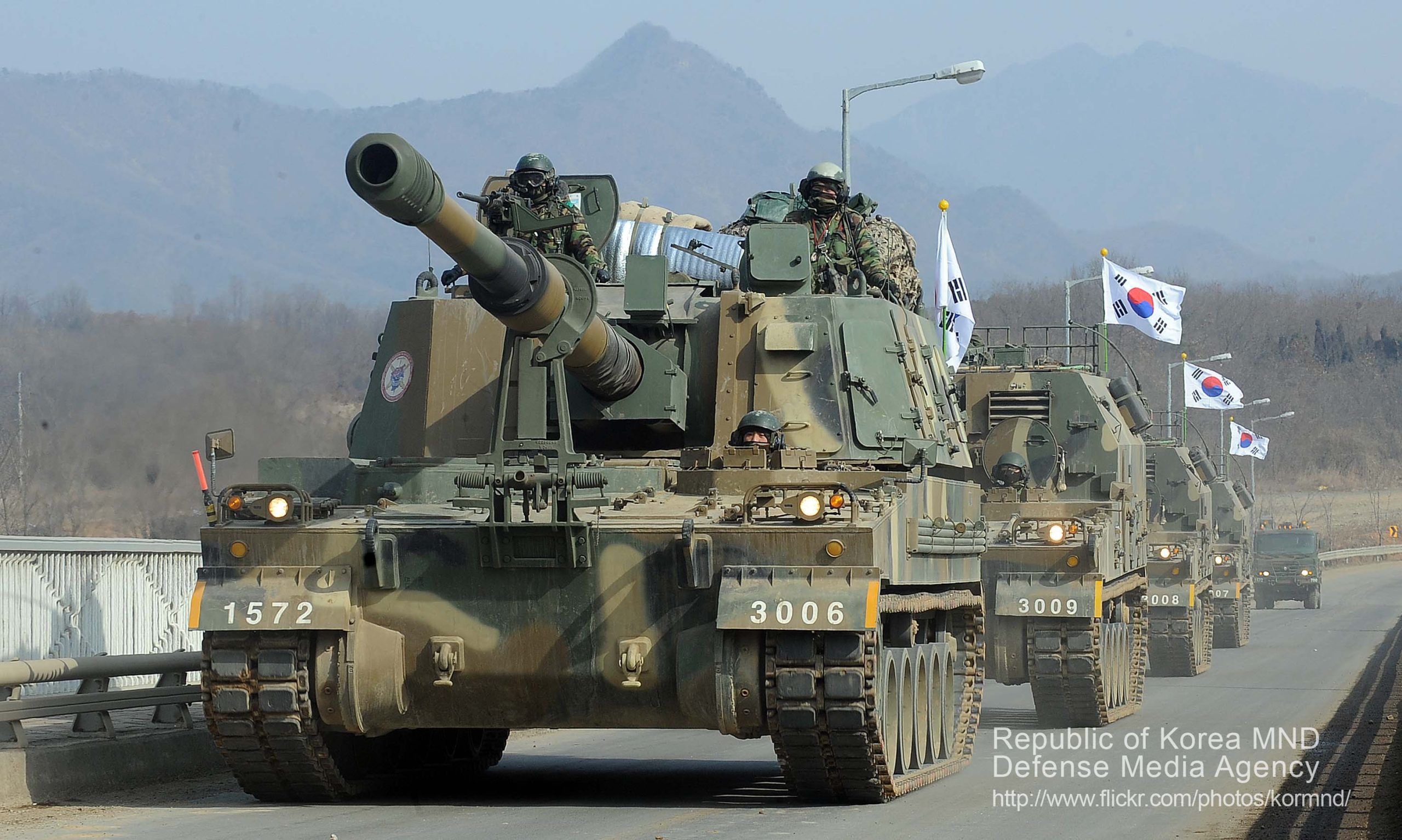
The K9 Thunder is a 155 mm 52-caliber tracked self-propelled howitzer (SPH) developed by South Korea’s Agency for Defense Development and manufactured by Hanwha Aerospace (formerly Samsung Techwin). First entering Republic of Korea Army service in 1999 to replace the older K55 (a license-built M109), the K9 has become the most-exported self-propelled howitzer in the world: more than 1,800 vehicles are in service with nine nations, and another 800+ are on order as of 2026. The platform’s defining selling point is the ratio of price, performance and delivery time it offers — beating the German PzH 2000 in three of the four major European competitions since 2022.
Key facts at a glance
| Attribute | Value |
|---|---|
| Type | 155 mm tracked self-propelled howitzer |
| Manufacturer | Hanwha Aerospace |
| In service | 1999 — present |
| Crew | 5 |
| Combat weight | 47 t |
| Length | 12 m (gun forward) |
| Main armament | 155 mm 52-cal CN98 (Korean-built) |
| Range (base bleed) | 40 km |
| Range (HE-RAP) | up to 60 km (Korean V-LAP); 80+ km (K9A2 with longer barrel) |
| Rate of fire | 6–8 rounds/minute sustained; 3 rounds in 15 seconds burst |
| Onboard ammunition | 48 rounds |
| Engine | MTU MT 881 Ka-500 diesel, 1,000 hp |
| Max road speed | 67 km/h |
| Operational range | 480 km |
| Operators | South Korea, Türkiye (T-155 Fırtına license), Norway, Estonia, Finland, Poland, India (Vajra-T), Australia, Egypt, UK (selected), Romania (selected) |
| Unit cost | ~ USD 4 million (basic K9); ~ USD 5.5 million (K9A2 with K10 ammunition vehicle) |
Origins: from K55 to K9
South Korea began studying a successor to its M109-derived K55 in 1989, focusing on extended range, automated fire control and a Korean-designed barrel. Production started in 1996 and the first K9 batteries reached the Republic of Korea Army in 1999. The platform was named “Thunder” (천둥, Cheondung) for its booming muzzle signature. By 2007 South Korea had purchased over 1,100 K9s — its single largest land-forces procurement.
Variants
| Variant | Year | Key feature |
|---|---|---|
| K9 | 1999 | Original 52-cal Korean baseline |
| K9A1 | 2018 | Improved fire control, auxiliary power unit, color displays |
| K9A2 | 2024+ | Fully autoloaded turret; 8 rounds/min sustained; 80+ km range; reduced crew to 3 |
| K10 Ammunition Resupply Vehicle | 2006 | Tracked, fully automatic, transfers 12 rounds/min to K9 |
| T-155 Fırtına (Türkiye) | 2003 | License-built K9 with Turkish electronics, Volvo engine, Otokar-built upgrades; entered Turkish Army service in 2004 |
| K9 Vajra-T (India) | 2018 | India-modified for desert conditions; 100 ordered + 200 additional in 2024 |
| AS9 Huntsman (Australia) | 2025 | Australian-built K9 variant with local electronics; 30 units |
| K9PL (Poland) | 2024+ | Polish-modified K9A1; final batches Polish-built at HSW Stalowa Wola |
Combat record
- 2010 — Yeonpyeong Island. K9s of the ROK Marine Corps engaged in counter-battery fire with North Korean coastal artillery during the 23 November shelling — the first combat use of the platform.
- 2018 — Yemen. Saudi K9s (export name “Khalid”) engaged Houthi positions in the southern border area.
- 2023–present — Ukraine. Estonia transferred K9 Kõu vehicles to Ukraine; combat use has been confirmed against Russian positions in eastern Ukraine.
- 2024 — Sahel. Algerian K9 batteries reportedly engaged extremist positions in the Algerian-Mali border zone.
Operators worldwide
| Country | Quantity | Notes |
|---|---|---|
| South Korea | 1,100+ | Primary operator since 1999 |
| Türkiye | 300+ T-155 Fırtına | License-built since 2004 |
| Norway | 24 | 2017 + 2022 additions |
| Estonia | 36 (K9 Kõu) | 2018 + 2022; donated some to Ukraine |
| Finland | 96 | Largest northern-European order |
| Poland | 672 (212 K9A1 + 460 K9PL) | Largest export contract by quantity |
| India | 300 (K9 Vajra-T) | License-built at Larsen & Toubro |
| Australia | 30 (AS9 Huntsman) | Built at Hanwha Defense Australia, Geelong |
| Egypt | 216 | 2022 contract; local assembly |
| UK (selected) | 116 (Mobile Fires Platform competition) | 2024 selection; production from 2026 |
| Romania (selected) | 54 (2024 announcement) |
The 2022 European wave
The Russian invasion of Ukraine triggered a complete reset of European SPH procurement. Between 2022 and 2025 South Korea’s K9 won the major competitions in Poland (672 vehicles), the United Kingdom (116), Romania (54) and Estonia (additional); the German PzH 2000 has not won a single major European contract during the same period despite multiple competitions. Industry observers credit three K9 advantages: delivery time (Hanwha can deliver from a warm production line within 12–18 months), price (~30 percent below PzH 2000), and willingness to license-build in the customer nation.
K9 vs. its peers
| K9A2 Thunder | PzH 2000 | CAESAR 8×8 | 2S35 Koalitsiya-SV | |
|---|---|---|---|---|
| Class | Tracked SPH | Tracked SPH | Wheeled SPH | Tracked SPH |
| Caliber | 155 mm L/52 | 155 mm L/52 | 155 mm L/52 | 152 mm L/52 |
| Range (base bleed) | 40 km | 40 km | 40 km | 40 km |
| Range (extended) | 60–80 km | up to 60 km | up to 55 km | up to 70 km |
| Burst rate | 3 in 15 sec | 3 in 9 sec | 3 in 18 sec | 3 in 12 sec |
| Combat-proven | Yes (Yeonpyeong, Ukraine) | Yes (Afghanistan, Ukraine) | Yes (Mali, Iraq, Ukraine) | Limited |
| Unit cost | ~ USD 5.5M | ~ USD 8M | ~ USD 5M | N/A (no export) |
Why the K9 matters
The K9 demonstrated that a 1990s-era Korean platform, persistently upgraded and aggressively exported, could become the most-bought 155 mm self-propelled howitzer of the post-Cold-War era. It is the bedrock of South Korean defense industry’s surge into global tier-1 status, the artillery platform behind NATO’s largest land-forces re-armament programs in Poland and the UK, and — as combat experience accumulates in Ukraine — increasingly battle-tested as well. Hanwha’s annual K9 production is projected to climb past 200 units per year by 2027, the highest sustained SPH output anywhere in the world.