What is TAZI? The four-legged robot built by BİTES

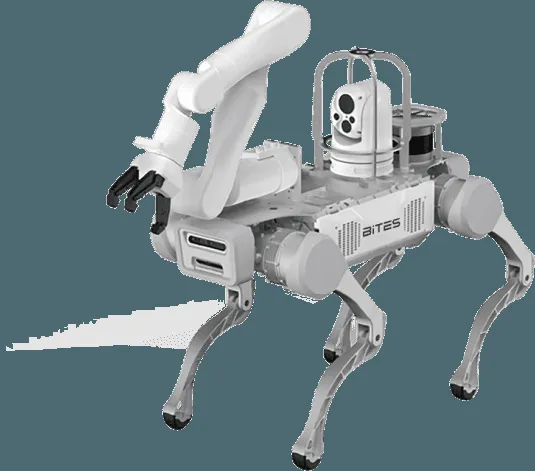
Quick answer: TAZI is the four-legged ground robot developed by BİTES, a subsidiary of Turkish defense electronics manufacturer ASELSAN. According to the official product page, the robot was designed for patrol and reconnaissance, search and rescue, and data collection missions. TAZI runs for 4 hours on a single charge, can carry a payload of up to 25 kilograms, can climb steps of 21 centimeters and can reach a speed of 5 meters per second. The company exhibited small and large versions of the robot at the IDEF fair in July 2025.
What is TAZI, and what was it developed for?
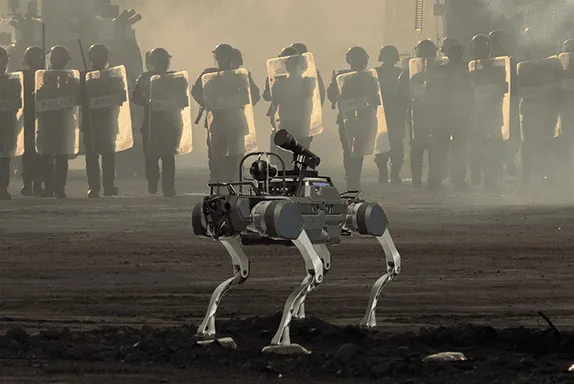
On its official page BİTES describes TAZI as a platform developed in response to the needs of the modern operating environment, capable of adapting to difficult terrain. Four-legged locomotion allows movement on stairs, rubble and broken ground where wheeled and tracked vehicles struggle. According to Anadolu Agency’s report on IDEF 2025, Turkey’s largest defense fair, the robot is positioned in particular for situations where a position that may come under fire has to be entered ahead of personnel.
Technical specifications
| Specification | Value (official product page) |
|---|---|
| Endurance | 4 hours on a single charge; 2 hours with a 25 kg load |
| Payload | 25 kg carrying capacity; lifting up to 85 kg |
| Obstacle clearance | Steps of 21 cm in height; climbing up to 55 degrees |
| Speed | 5 m/s |
| Durability | IP66 against dust and water |
| Missions | Patrol and reconnaissance, search and rescue, assault and data collection |
Payload options and autonomy
According to Anadolu Agency’s report from the fair, TAZI can be modularly configured to carry a machine gun payload, a demolition charge or explosive, rockets and sensors. The report refers to artificial intelligence based stabilization, autonomous movement, obstacle recognition, area mapping and route planning capabilities, and states that the robot can stay balanced on four legs against external interference. Which payloads are offered as series configurations has not been officially disclosed.
Who uses it?
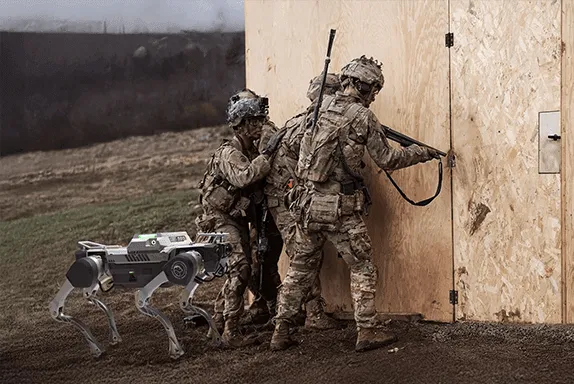
There is no official announcement that TAZI has been delivered to the Turkish Armed Forces or to security forces; for now the robot is seen at fairs and promotional events. The company states that the robot can be adapted to an institution’s requirements. In terms of its potential to integrate with soldier systems in the field, its presence in the same portfolio as the ATOK tactical operation kit stands out; both products are listed in the company’s “Defense Systems” category.
Civilian missions and observations from the fair
The official product page positions TAZI not only for combat but also for civilian operations; its light and compact structure is cited for missions such as search and rescue and post-disaster reconnaissance. Its IP66-level dust and water resistance is a design choice aimed at working in rubble and poor weather conditions. According to accounts from IDEF 2025, the robots performed jumping, somersault and balance demonstrations in the fair area; they were observed staying balanced on four legs against external interference. The company emphasizes that the robot can be modularly configured according to institutional requirements. Patrolling energy and industrial facilities and checking hazardous areas are among the typical civilian uses manufacturers cite for this class of robot.
Its place in the four-legged robot market
Four-legged robots form a growing market with manufacturers such as Ghost Robotics and Boston Dynamics in the United States and Unitree in China. Configuring this class of robot to carry weapons on military missions is a subject of international public debate; for TAZI, an assault mission also appears on the official mission list. In Turkey, TAZI stands out among the products in this class presented to the public. Fair presentations indicated that the robots can be operated by remote control, while autonomous capabilities come into play in mapping and route planning. No independent performance comparison has been published; as the feature setting TAZI apart from competitors, the company highlights integration flexibility based on national software and image processing experience. The full portfolio is examined in the BİTES product guide.

Frequently asked questions
Who produces TAZI?
BİTES, an ASELSAN subsidiary. The robot sits in the company’s Defense Systems category.
How much load can TAZI carry?
According to the official page it can operate with a 25 kg payload and can lift up to 85 kg.
Can TAZI carry weapons?
According to Anadolu Agency’s IDEF 2025 report, it can be configured to carry a machine gun payload, a demolition charge and rockets.
Has TAZI been delivered to the army?
Not officially disclosed; there is no public delivery announcement.
How many versions of TAZI are there?
According to Anadolu Agency, two versions, small and large, were exhibited at the fair.
Does TAZI operate autonomously?
The Anadolu Agency report describes autonomous movement, obstacle recognition, area mapping and route planning capabilities; remote controlled use is also possible.
Sources and verification note
- https://bites.com.tr/tr/products — TAZI official product page and technical values (Accessed: August 12, 2026)
- https://www.aa.com.tr/tr/idef-2025/bites-robot-kopeklerle-urettigi-cozumlerle-idef-2025te/3639769 — IDEF 2025 presentation, payload options, autonomy (Accessed: August 12, 2026)
- https://www.turkiyegazetesi.com.tr/gundem/zipliyor-takla-atiyor-selam-veriyor-idefe-damgalarini-vurdular-1133210 — fair observation (Accessed: August 12, 2026)
Price, procurement status and serial production capacity have not been disclosed and are therefore not covered in this file. The technical values are manufacturer statements; no independent test results have been published.