Rheinmetall unveils an 18-cell container launcher at Eurosatory: FV-014 readies for swarm strikes

German defence prime Rheinmetall gave the world premiere at Eurosatory 2026 of the CML (Containerized Missile Launcher), a container-type multiple launcher for its FV-014 loitering munition. Packing up to 18 munitions into a standard 20-foot container, the system can mount both single strikes and salvo launches in a swarm. With roughly 100 km range and up to 70 minutes of flight, the FV-014 had already been ordered by the Bundeswehr.
Lead
At the Eurosatory 2026 show in Paris, Rheinmetall placed the CML container launcher at the centre of an integrated system that binds loitering munitions, reconnaissance and strike under one network. According to 16 June 2026 reporting by defence-industry.eu and the German outlet suv.report, the Containerized Missile Launcher was shown as a world premiere.
The system’s core claim is that it offers a combat network rather than a single weapon. Rheinmetall links the CML to its in-house Battlesuite digital software platform, stressing that it gathers reconnaissance, command and firepower into one connected frame.
- Maker: Rheinmetall (Germany)
- New item: CML container launcher (world premiere)
- Capacity: 18 munitions in a 20-foot container
- Munition: FV-014 fixed-wing loitering munition
- Performance: ~100 km range, ~70 min flight, ~60 km datalink
- Customer: Bundeswehr (FV-014 order)
Details
As reported by suv.report and ad-hoc-news, the CML comes in a standard 20-foot container format, roughly six metres long and two and a half metres wide and high. That format lets the launcher be loaded onto ships, trains and trucks, or simply positioned like a container. The module holds up to 18 FV-014 munitions and can launch several in a single salvo.
The system features an integrated fire-control and communications unit, remote-launch capability over secure communications, a battery with a sleep mode for extended autonomous standby, and an optional generator to extend operating time. Its open architecture allows fast integration with existing command-and-control systems and other munitions via standard interfaces such as STANAG, ROS2 and MAVLink.
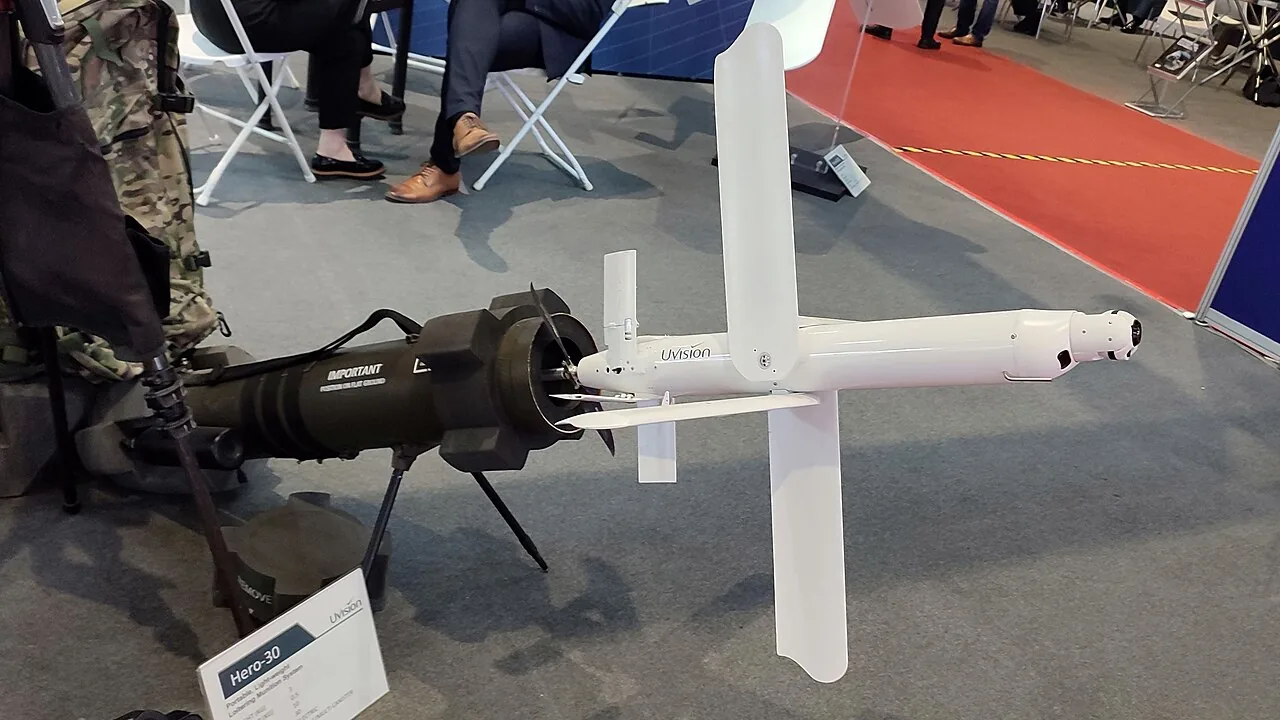
What is the FV-014?
The FV-014 is a fixed-wing loitering munition combining reconnaissance and precision-strike capability. It launches from its transport-and-launch container using a booster, then deploys wings and continues on an electric pusher propeller. Open sources put its range at about 100 km, datalink range near 60 km and flight time around 70 minutes.
Rheinmetall says the FV-014 is designed for both single attacks and swarm use. Per the company’s statements in open sources, verification testing was completed in early 2026 and the system had been ordered by the Bundeswehr. That lets the CML reveal be read as the maturing carrier infrastructure for a munition that already has a customer.
Technical and operational significance
A container-based salvo approach makes loitering-munition use scalable. Vehicles lifting off from an 18-cell module in a single salvo can form a swarm able to press a target area from several directions at once. The container format’s adaptability to ship, train and truck lets the system span a wide use envelope, from a fixed battery to a mobile, distributed architecture.
Still, the range, flight-time and swarm figures rest on manufacturer claims; real combat performance will vary with the electronic-warfare environment and target defences. Field testing of items such as the command-and-control load of swarm operations and resilience to jamming will determine the system’s true maturity.
Background
Loitering munitions have become one of the defence industry’s fastest-growing segments thanks to their potential for high effect at low cost in recent conflicts. The intensive use of unmanned systems exposed in the war in Ukraine pushed European armies toward rapid, scalable procurement in this class. Rheinmetall’s container-based salvo approach claims to answer that demand at industrial scale.
Integrating the reconnaissance-strike loop under the Battlesuite framework is an example of the shift from selling single munitions to selling system architectures. The Bundeswehr order shows the system is not merely a show concept but a programme advancing toward service.
Why it matters for Turkiye and the region
Loitering munitions and swarm technology are among the fields where Turkiye is positioned early and strongly. STM’s KARGU, ALPAGU and TOGAN families have been in the field and on the export market for years, together with a swarm-operations concept. Rheinmetall’s container-based salvo approach points in the same direction as the scalable swarm architecture Turkish industry is also working on — showing Turkiye competes from the front, not behind.
The second dimension is competition and export. Europe’s turn to rapid procurement of loitering munitions means an expanding market for German, Turkish and Israeli players alike. Turkiye’s intensive operational experience and cost-effective production make systems like KARGU strong in that contest. Container-launcher concepts such as the CML are a reference worth watching for Turkish makers; adapting similar carrier solutions to indigenous swarm munitions could raise export value-add.
Open-source verification
- The CML’s world premiere at Eurosatory 2026 and its 18-munition, 20-foot container format are corroborated consistently across multiple independent sources, including defence-industry.eu, suv.report and ad-hoc-news.
- The FV-014’s ~100 km range, ~60 km datalink and ~70-minute flight time are documented across multiple sources, including Rheinmetall’s official statements and Wikipedia.
- The FV-014 being ordered by the Bundeswehr is reported by industry sources, including Aerotime and Handelsblatt.
- The field performance of the swarm and salvo capability is not independently verifiable at this stage; figures rest on manufacturer claims.
Frequently Asked Questions
What is the FV-014?
A Rheinmetall fixed-wing loitering munition combining reconnaissance and precision strike, with roughly 100 km range and 70 minutes of flight.
What is the CML?
A container-type multiple launcher built for the FV-014, packing up to 18 munitions into a 20-foot container and able to fire a salvo.
Which army is it going to?
Open sources say the FV-014 munition has been ordered by the German army (Bundeswehr); the CML launcher had its world premiere at Eurosatory 2026.
Why does it matter for Turkiye?
Turkiye is a front-runner in loitering munitions and swarm tech with STM’s KARGU, ALPAGU and TOGAN families; an expanding European market is an opportunity for Turkish makers.
Bottom line
Rheinmetall’s CML launcher marks how the loitering-munition era is evolving from single vehicles to scalable swarm architectures. Container-based salvo launch carries the potential to make that capability mobile and distributed. For Turkiye the picture is two-sided: it both validates the country’s front-runner position and is a development worth watching on the carrier-and-network front. As the market grows, field-proven and cost-effective solutions will come to the fore.
| System / Munition | Producer / Origin | Range (open source) | Note |
|---|---|---|---|
| FV-014 (CML launcher) | Rheinmetall (Germany) | ~100 km / ~70 min | 18-cell container, swarm |
| KARGU | STM (Turkiye) | tactical / swarm | Rotary-wing, swarm concept |
| ALPAGU | STM (Turkiye) | tactical | Fixed-wing, single-shot |
| Switchblade 600 | AeroVironment (USA) | ~40 km | Tube-launched (comparison) |
Sources
- defence-industry.eu — Rheinmetall unveils CML multi launcher for FV-014 loitering munition (16 June 2026)
- suv.report — Rheinmetall zeigt containerisierten Werfer für Loitering-Munition auf der Eurosatory 2026
- Rheinmetall — Successful testing of the FV-014 loitering munition
- Aerotime — Rheinmetall wins Bundeswehr FV-014 loitering munition order
- Handelsblatt — Rheinmetall setzt bei Kamikaze-Drohnen auf Salven-Schwärme