The Cost-Per-Kill Problem: Layered Counter-UAS Procurement in the Gulf


Executive Summary
The decisive metric in Gulf counter-unmanned-aircraft-system (C-UAS) procurement is no longer probability of kill; it is cost per engagement. A defending state that expends a six-figure interceptor against a four-figure one-way-attack drone wins the engagement and loses the campaign. This analysis examines the layered C-UAS approaches now competing for Gulf budgets — gun-based systems, electronic warfare, directed energy and low-cost interceptors — and frames the choice around magazine depth and exchange ratio rather than headline detection range. Turkish offerings such as the Korkut 35 mm system, the Gökberk mobile laser and a range of soft-kill jammers appear in the same evaluations as Rheinmetall, Leonardo, MBDA and a growing field of US and Chinese entrants. None is a complete answer alone; the procurement question is how to combine them.
Operational Context
The 2019–2024 campaign against Gulf infrastructure established the economic asymmetry now driving requirements. Attacking systems — Shahed-class loitering munitions, repurposed commercial quadcopters, and cruise missiles — cost between a few thousand and a few hundred thousand dollars. The interceptors first used against them frequently cost far more, and were drawn from magazines sized for a different threat. The result was a defender’s dilemma: technically successful intercepts that were financially and logistically unsustainable across a sustained campaign.
This has reframed C-UAS as a layering problem. The lowest-cost threats should be met by the lowest-cost effectors — guns, jamming and, prospectively, directed energy — reserving missiles for targets that justify them. Detection and classification across this layered stack, rather than any single effector, is where most programmes succeed or fail. For Gulf buyers, the operational question is whether a candidate system contributes to an integrated picture or adds another stovepipe to an already crowded airspace.
| Effector layer | Indicative cost per shot | Strengths | Limitations |
|---|---|---|---|
| EW / jamming (soft-kill) | Near-zero per use | Deep magazine, low collateral | Ineffective vs autonomous/fibre-guided drones |
| Gun / airburst (35–40 mm) | Low (rounds) | Cheap, fast reaction, no leakage cost | Short range, slewing limits vs saturation |
| Directed energy (laser) | Very low per shot | Near-unlimited magazine | Power, weather, dwell time; largely pre-series |
| Low-cost interceptor | Moderate | Range and altitude reach | Finite magazine, unit cost vs target |
Comparative Analysis
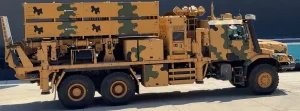
Gun-based hard-kill. Programmable airburst systems in the 35–40 mm class — the Korkut, Rheinmetall’s Oerlikon family and Leonardo’s offerings — converge on a similar concept: cheap rounds, rapid reaction, no per-engagement missile cost. Their constraint is geometry. Against a single low-and-slow drone they are highly efficient; against a coordinated salvo arriving from multiple bearings, a single gun system saturates quickly. The procurement implication is density: gun layers are bought in numbers tied to the perimeter being defended, not as point solutions.
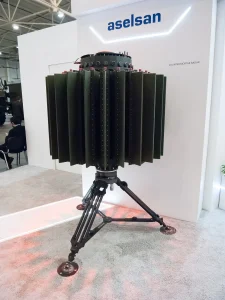
Electronic warfare. Soft-kill jamming offers the deepest magazine and lowest cost per use, and is well suited to the commercial-derivative threat that dominated early Gulf attacks. Its declining utility against autonomous, inertially navigated and fibre-optic-guided drones — increasingly common since 2023 — is the central limitation buyers must price in. EW remains essential but is no longer sufficient on its own, a lesson Ukraine has made unambiguous.
Directed energy. Mobile laser systems, including Turkey’s Gökberk and Western equivalents from Rheinmetall, MBDA and US programmes, promise the magazine economics the threat demands. The honest assessment is that they remain largely pre-series: power generation, thermal management, dwell time against hardened airframes and degradation in dust and humidity — all acute in Gulf conditions — are unresolved at operational scale. They are a credible watch item, not a current backbone.
Low-cost interceptors. The emerging class of sub-$50,000 interceptors aims to restore a favourable exchange ratio at ranges guns cannot reach. This is the most active segment of the market and the one where claimed and demonstrated performance diverge most. Buyers should treat advertised cost figures as floor prices that exclude integration, command and sustainment.
Procurement Considerations
Three considerations should govern a Gulf C-UAS acquisition. First, buy the architecture, not the effector: the sensor and command layer that fuses detections and allocates the cheapest viable effector determines whether the exchange ratio is ever realised. A best-in-class jammer or gun feeding a poor C2 picture underperforms a modest effector inside a good one. Second, weight the magazine, not the brochure range: against saturation, depth of cheap shots matters more than peak engagement range. Third, demand representative trials: detection and classification rates collapse against small, slow, low-signature targets in clutter, and against drones using autonomous navigation. A trial conducted against a cooperative target tells the buyer little.
Outlook
No single system resolves the Gulf C-UAS problem, and vendors claiming otherwise should invite scrutiny rather than confidence. The achievable goal is a layered, sensor-led architecture in which cheap effectors absorb the bulk of the threat and missiles are reserved for what warrants them. Turkish, European, US and Chinese systems all populate this stack; the differentiators are integration openness, magazine economics and demonstrated performance against autonomous targets rather than national pedigree. For procurement officers, the disciplined path is to specify the exchange ratio they must sustain across a multi-day campaign and require candidates to prove it under representative conditions — then buy the combination, in the density, that meets it.