BURC: Roketsan’s Hybrid Gun-Missile Mobile Air Defence System


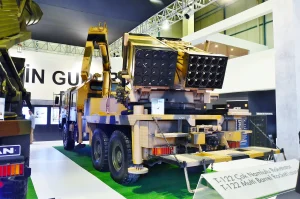
BURC is a mobile low-altitude air-defence system developed by Turkish missile manufacturer Roketsan and unveiled at the IDEX exhibition in February 2025. A single stabilised turret combines 8 SUNGUR infrared-guided missiles, a 20 mm three-barrel gatling gun and 4 RETINA AESA radars providing 360-degree coverage. It is designed to protect manoeuvring units and fixed sites against aircraft, helicopters and drones. The system remains in development and marketing; no Turkish Armed Forces order has been officially announced.
| BURC — At a Glance | |
|---|---|
| Category | Mobile low-altitude air-defence system (hybrid gun-missile) |
| Developer | Roketsan (Türkiye) |
| Unveiled | IDEX, February 2025 |
| Status | Development / marketing stage |
| Missile armament | 8x SUNGUR (2×4 pods), IIR fire-and-forget |
| Missile range | ~0.5-8 km; altitude ~4 km |
| Gun | 20 mm three-barrel gatling (official catalogue) |
| Radar | 4x RETINA S-band AESA, 360-degree coverage |
| Other sensors | EO/IR fire control, IFF |
| Turret | 360-degree stabilised, ~2 tonnes |
| Platform | Vehicles above 12 tonnes; shown on FNSS PARS SCOUT 8×8 |
| Networking | HERIKKS-6 and JREAP-C integration, or autonomous operation |
| Operator | Not officially disclosed |
| Exports | Not officially disclosed |
What is BURC?
BURC is a mobile low-altitude air-defence system developed by Roketsan. In international classification it belongs to the VSHORAD (very short-range air defence) category and follows the hybrid approach of pairing missiles and a gun on the same turret. Its core mission is protecting manoeuvring army units and fixed installations against fixed-wing aircraft, helicopters and unmanned aerial vehicles.
The system made its public debut at the IDEX exhibition in Abu Dhabi in February 2025. BURC is therefore one of the newest members of the Roketsan product family, and publicly available information remains largely catalogue-level. Unlike fielded systems such as ATMACA or SUNGUR, there is as yet no verified field-performance data for BURC in open sources; the figures in this article rest on manufacturer statements and trade-show reporting.
The design logic behind BURC is layered point defence on a single platform: SUNGUR missiles engage targets at longer distances, while the 20 mm gatling gun offers a cost-effective answer to close-in threats and small drones that fall below the missile envelope. Conceptually this places BURC in the same school of thought as Pantsir-style gun-missile hybrid systems.
Technical characteristics and how it works
BURC’s primary armament is 8 SUNGUR missiles carried in two quad pods on either side of the turret. SUNGUR is an imaging-infrared (IIR) fire-and-forget missile with a range of roughly 0.5-8 km and an engagement altitude of around 4 km. Alongside the missiles sits a 20 mm three-barrel gatling gun. Army Recognition reports a 20/30 mm option and a rate of fire of 750 rounds per minute, but the official Roketsan catalogue lists the 20 mm configuration.
The sensor suite is the system’s distinguishing feature: four RETINA S-band AESA radars fixed on the turret faces deliver continuous 360-degree coverage without mechanical rotation. The radars are complemented by an electro-optical/infrared (EO/IR) fire-control system and identification friend-or-foe (IFF). The 360-degree stabilised turret, weighing around 2 tonnes, allows target tracking and engagement while the vehicle is on the move.
- Missiles: 8x SUNGUR, IIR guidance, fire-and-forget; range ~0.5-8 km, altitude ~4 km.
- Gun: 20 mm three-barrel gatling for close-in and counter-drone defence.
- Radar: 4x RETINA S-band AESA, instantaneous 360-degree coverage.
- Networking: integration with the HERIKKS-6 air-defence network and the JREAP-C data link, or fully autonomous operation.
- Platform: integrable on vehicles above 12 tonnes; first shown on the FNSS PARS SCOUT 8×8.
By contrast, key values such as system weight without missiles, reaction time, number of simultaneously tracked targets and radar range have not been officially disclosed.
BURC sits in the hybrid short-range air defence (SHORAD) class that combines missiles and a gun on one platform. The comparison below is at class and role level only; since BURC is still in development, no verified performance comparison between these systems is possible.
Platform, operators and current status
BURC is not tied to a single vehicle; Roketsan states that the turret can be integrated on vehicles above 12 tonnes. At its first public showing, the system was mounted on the FNSS PARS SCOUT 8×8 armoured vehicle. This modular approach is intended to let customers choose configurations suited to their own vehicle fleets.
On the command-and-control side, BURC can plug into Türkiye’s HERIKKS-6 air-defence early-warning and command network and the NATO-compatible JREAP-C data link; it can also operate fully autonomously when required. The system is thus positioned both as a node in an integrated air-defence architecture and as a standalone point-defence asset.
The operator picture, however, is not yet settled: no Turkish Armed Forces order or service entry has been officially announced, and no export customer has been disclosed. Open-source information indicates the system is at the development and marketing stage. Its debut at an international exhibition such as IDEX suggests Roketsan is positioning BURC for the export market from the outset — but that does not amount to a confirmed sale.
Place in Türkiye’s defence industry
BURC targets the lowest tier of Türkiye’s layered air-defence architecture: low altitude and very short range. That tier is already served by Aselsan’s gun-based KORKUT and the gun-missile hybrid GURZ; BURC is Roketsan’s answer to the same mission, built around its own proven SUNGUR missile. Above it, the HISAR family covers medium altitude and SIPER handles long range.
The system’s conceptual strength is combining a fielded missile, a cost-effective gatling gun and modern AESA radar technology in a single mobile package. In a combat environment dominated by drones and loitering munitions, the flexibility to use the gun against cheap targets instead of expending expensive missiles is a notable design choice. On-the-move engagement capability is likewise essential for protecting mechanised formations.
An honest assessment must nonetheless acknowledge that the system is unproven: there is no verified public data on BURC’s test firings, reaction time, radar performance or serial-production timeline. As of today, BURC is a new product whose technical claims are known at catalogue level but untested in the field. A definitive judgement will only become possible with concrete milestones such as a Turkish Armed Forces order or an export contract.
BURC is a new system unveiled at IDEX in February 2025; publicly available information rests largely on the Roketsan catalogue and trade-show reporting. System weight without missiles, reaction time, radar range and the number of simultaneously engaged targets have not been officially disclosed. The gun calibre is 20 mm in the official catalogue; Army Recognition cites a 20/30 mm option and 750 rounds per minute — this discrepancy is noted in the text. No Turkish Armed Forces order and no export sale have been officially announced; there is as yet no proven field-performance data for the system.
Frequently Asked Questions
What is BURC?
BURC is a mobile low-altitude air-defence system developed by Roketsan. A single stabilised turret combines 8 SUNGUR missiles, a 20 mm gatling gun and 4 RETINA AESA radars; it was unveiled at IDEX in February 2025.
What is BURC’s range?
The missile component, SUNGUR, reaches roughly 0.5-8 km in range and around 4 km in altitude. The 20 mm gatling gun handles closer threats. The radar detection range has not been officially disclosed.
Who operates BURC?
No operator is known yet. Neither a Turkish Armed Forces order nor a service entry has been officially announced, and no export customer has been disclosed. The system is in the development and marketing stage.
What vehicle carries BURC?
The turret is designed for integration on vehicles above 12 tonnes. At its first showing the system was displayed on the FNSS PARS SCOUT 8×8 armoured vehicle.
What are BURC’s closest rivals?
In the gun-missile hybrid class, Russia’s Pantsir-S1 and Rheinmetall’s Skyranger 30 are the best-known counterparts. Within Türkiye, Aselsan’s KORKUT and GURZ serve the same low-altitude tier as complementary solutions.
How does BURC differ from KORKUT?
KORKUT is Aselsan’s 35 mm gun-based system, while BURC is Roketsan’s hybrid combining 8 SUNGUR missiles with a 20 mm gatling gun. They represent two manufacturers’ different approaches to the same low-altitude air-defence mission.
Sources
- Roketsan official BURC catalogue — roketsan.com.tr
- Army Recognition — coverage of the BURC air-defence system unveiling (2025)
- official source — report on Roketsan’s BURC mobile air-defence system
- IDEX 2025 exhibition materials and open-source defence publications
- Open-source records verified as of 23 July 2026