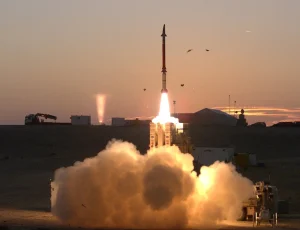
Iron Beam: Israel’s High-Energy Laser Air Defense System — Technical Analysis and Global Directed Energy Race
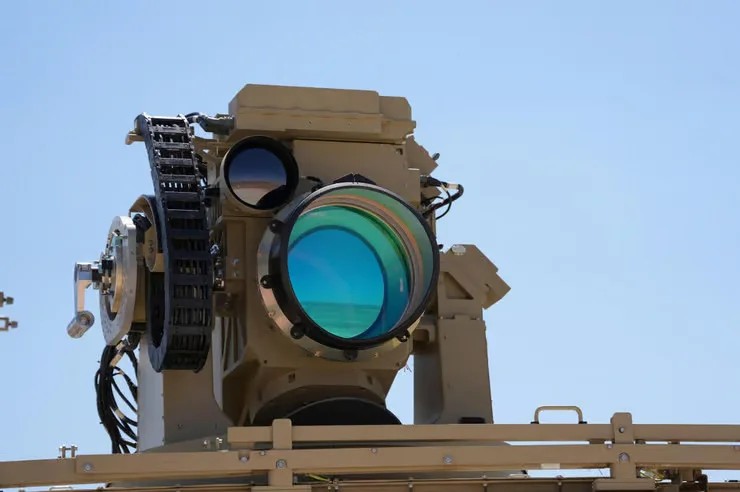
Iron Beam is a high-energy laser (HEL) air defense system under development by Israel’s Rafael Advanced Defense Systems, designed to intercept short-range rockets, mortars, artillery shells, and unmanned aerial vehicles using a directed energy beam. With an estimated cost per engagement in the range of tens to low hundreds of dollars — compared to approximately $50,000 for an Iron Dome Tamir interceptor — the system is designed to reverse the economic asymmetry of high-volume rocket saturation attacks. The system has completed significant test milestones since 2022 and Israeli officials have announced initial operational deployment targets for 2025-2026.
Overview
Conventional counter-rocket systems face a fundamental economic problem: the defender’s interceptor costs far more than the attacker’s projectile. An Iron Dome Tamir missile costs approximately $50,000; a Qassam rocket costs $300–$800. Volley-saturation tactics exploit this asymmetry — force the defender to spend $50,000 for every $800 projectile until interceptor stocks or budgets are exhausted.
Iron Beam’s promise is to eliminate this asymmetry. Its per-shot cost is limited to the electricity consumed by the laser. At ~100 kW power output, each second of sustained laser engagement represents a few dollars of electrical energy — orders of magnitude below any interceptor missile.
The underlying technology is coherent beam combining of fiber laser arrays. Multiple fiber laser outputs are optically combined to produce a single high-intensity beam at the target. This architecture enables high power output in a relatively compact platform, without the thermal lensing and beam quality problems associated with single-aperture high-power lasers.
Technical Specifications
| Parameter | Value |
|---|---|
| Developer | Rafael Advanced Defense Systems (Israel) |
| Laser type | Coherent-combined fiber laser array |
| Power output | ~100 kW (disclosed; capacity expansion in progress) |
| Target types | Short-range rockets (Qassam, Grad), mortars, artillery shells, small UAVs/drones |
| Effective range | ~7 km (target-type dependent; disclosed) |
| Kill mechanism | Thermal; heats target skin until structural failure or propellant/explosive ignition |
| Cost per engagement | ~$10–$100 (electrical energy cost) |
| Comparative cost | Iron Dome Tamir interceptor: ~$50,000 |
| Platform | Vehicle-mounted; fixed installation and naval adaptation under study |
| Power source | Grid power or vehicle generator; high consumption is an operational constraint |
| Weather limitation | Fog, rain, sand, smoke significantly degrade beam intensity |
| Programme start | ~2014 |
| Target IOC | 2025–2026 (latest official statements) |
Development Timeline
~2014: Rafael publicly announced an HEL programme as a complement to Iron Dome, focused on short-range threats (Qassam rockets, mortars).
2020: Technical parameters shared more broadly. Rafael confirmed the 100 kW coherent fiber laser combining approach. Technical information exchange with the US Missile Defense Agency (MDA) was reported.
April 2022: Israeli Ministry of Defense announced field tests over Israeli territory had successfully intercepted drones, rockets, and mortars using the Iron Beam prototype.
October 2023: Following the 7 October Hamas attack and the resulting intensive high-volume rocket campaign against southern Israel, Iron Beam’s strategic priority was significantly elevated.
2025: Israeli official statements confirmed targeting of first operational battery deployment in a southern border location. Full-capacity deployment timeline remains undisclosed.
Advantages
- Economic reversal: Per-shot cost of electrical energy vs $50,000 Tamir interceptor. Makes sustained defense against high-volume saturation attacks economically viable.
- Effectively unlimited magazine: No physical interceptor rounds to exhaust. Defense capability limited only by power supply and maintenance cycles.
- Speed-of-light engagement: No flight time for the “interceptor” — near-instantaneous energy delivery to target, particularly effective against slow-moving drones and low-trajectory rockets.
- Low collateral debris: Thermal disruption (vs. fragmentation warhead) reduces unexploded ordnance debris risk from interception.
Disadvantages and Operational Constraints
- Weather dependency: Atmospheric scattering in fog, rain, sandstorms, and smoke significantly degrades laser intensity over range. The Middle East’s generally dry climate mitigates but does not eliminate this risk.
- High power demand: 100 kW laser output requires substantial power generation infrastructure. Limits tactical mobility; fixed or semi-permanent installations favoured.
- Range limitation (~7 km): Equivalent to the lower end of Iron Dome’s engagement band. Not effective against medium or long-range ballistic threats.
- Single-target focus: Current architecture engages one target at a time. Dense simultaneous volleys require rapid retargeting or force selective engagement.
- Thermal management: Extended high-power operation generates significant heat requiring active cooling systems — adding size, weight, and mechanical complexity.
Global High-Energy Laser Race
| System | Country / Developer | Power / Status | Platform |
|---|---|---|---|
| Iron Beam | Israel / Rafael | 100 kW; field-tested 2022 | Vehicle; fixed |
| HELIOS | USA / Lockheed Martin | 60+ kW; naval testing | Arleigh Burke destroyer |
| HEL TD / CLWS | USA / Boeing-Northrop | ~30 kW; testing | Ground vehicle |
| DragonFire | UK / MBDA-QinetiQ | 50 kW; field test 2024 | Ground; naval planned |
| HEL SyA | Germany / Rheinmetall | 100 kW; demonstrator | Vehicle-mounted |
| ZKZS | China | Undisclosed; claimed fielded | Vehicle; naval |
All programmes share the same core engineering challenges: power management, thermal control, beam quality maintenance at operational ranges, and operational durability under field conditions.
Operational Context: Why Iron Beam Matters Now
The 7 October 2023 attack and subsequent high-volume rocket campaign from Gaza made Iron Dome’s per-shot economics a matter of public strategic discussion. The US DoD and Congress authorized emergency production increases to sustain Tamir interceptor supply to Israel. This made the case for a low-cost-per-shot alternative with unusual clarity.
Iron Beam targets exactly this gap: grid-cost rocket interception instead of $50,000-per-shot Tamir consumption. The system’s failure to reach full operational capability despite eight-plus years of development reflects the genuine engineering difficulty of the challenge — not the absence of strategic motivation.
Envanter Medya Analysis
Iron Beam represents the most consequential near-term shift in short-range air defense economics since Iron Dome itself. If the system achieves reliable operational performance — and if its weather dependency can be managed to an acceptable operational threshold — it fundamentally changes the cost calculus of rocket saturation attacks against defended territory.
The perpetual “two to three years from operational” timeline for Iron Beam should be read as evidence of genuine difficulty, not capability exaggeration. Power management, beam quality over range, and field durability are each individually complex problems. Achieving all three simultaneously in a deployable system is why the timeline has extended.
The global directed energy race has a winner profile: the country that first deploys a battle-proven HEL system against real threats at operational scale will have demonstrated something no laboratory test can replicate. Iron Beam has the best chance of achieving that distinction in the near term — not because the technology is easy, but because the strategic motivation is more acute in Israel than anywhere else, and Rafael has more operational feedback from real threat environments than any competitor programme.