David’s Sling (Magic Wand): Mid-Tier Air Defense System Technical Analysis and Turkish HİSAR-U Comparison
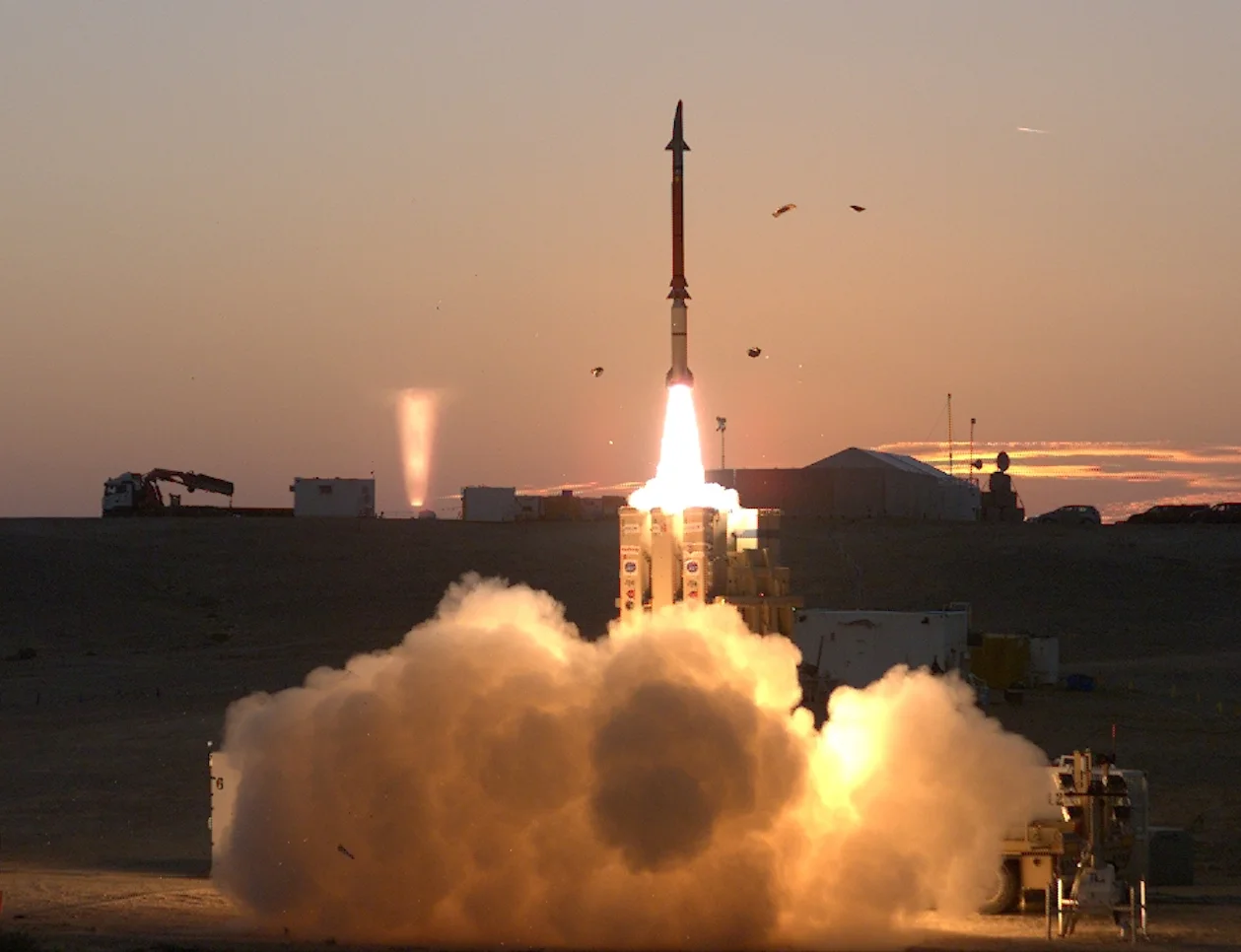
David’s Sling (Hebrew: Kela David; export designation Magic Wand) is a jointly developed medium-to-long range missile defense system produced by Israel’s Rafael Advanced Defense Systems in partnership with US firm Raytheon. Serving as the second tier in Israel’s layered air defense architecture, the system is designed to intercept ballistic missiles, long-range rockets, cruise missiles, and UAVs in the 40–300 kilometre engagement range. Its Stunner interceptor uses a two-stage design with hit-to-kill as the primary engagement mode, supplemented by a fragmentation warhead for difficult targets.
Overview and Strategic Context
Israel’s multi-tier air defense architecture allocates specific threat bands to each layer. Iron Dome handles short-range threats (4–70 km). Arrow 2 and Arrow 3 handle strategic and exoatmospheric ballistic missile threats (70+ km, including exoatmospheric). David’s Sling covers the middle band: threats beyond Iron Dome’s effective range but below Arrow’s strategic engagement zone — a band precisely occupied by Hezbollah’s long-range rocket arsenal (Zelzal, Khaibar-1, Fateh-110) and Iranian medium-range ballistic missile variants.
The US Missile Defense Agency (MDA) was a co-development partner from the programme’s early stages, contributing funding and technical collaboration and enabling future US military export licensing.
System Components
| Component | Role | Developer |
|---|---|---|
| Stunner interceptor (SKD-3) | Two-stage; hit-to-kill + fragmentation fallback warhead | Rafael + Raytheon |
| ELM-2084 Multi-Mission Radar | AESA; threat tracking and classification | Elta Systems (IAI) |
| Battle Management / Fire Control | Threat prioritization, engagement sequencing, fire authorization | Elbit Systems |
| Launch vehicle | 12-round vehicle-mounted launcher | Rafael |
| C2 network | Integration with Arrow, Iron Dome, NATO SHORAD | Israel MoD / Rafael |
Stunner Interceptor — Technical Detail
The Stunner missile uses a two-stage architecture. The first stage (booster) accelerates the weapon to operational velocity. The second stage (endoatmospheric kill vehicle) provides high maneuverability for terminal engagement.
In the terminal phase, Stunner employs two complementary mechanisms:
- Hit-to-kill (HTK): The primary engagement mode. The kill vehicle collides directly with the threat at high closing velocity, destroying it kinetically without a warhead detonation. HTK eliminates the risk of the threat’s warhead detonating above populated areas.
- Fragmentation fallback warhead: Activated if HTK geometry is unfavourable. Provides a secondary kill mechanism against targets that maneuver away from the collision vector.
The two-stage maneuverable design is specifically calibrated against quasi-ballistic threats — missiles that deviate from a purely ballistic trajectory to complicate interception. This is a critical operational advantage over systems optimized solely for fixed-arc ballistic threats.
Technical Specifications
| Parameter | Value |
|---|---|
| Developers | Rafael Advanced Defense Systems + Raytheon (USA) |
| Operator | Israeli Air Force (IAF); US export approval granted |
| Type | Medium-to-long range air and missile defense system |
| Engagement range | ~40 km – ~300 km |
| Target types | Ballistic missiles (TBM), quasi-ballistic missiles, cruise missiles, long-range rockets, UAVs |
| Interceptor | Stunner (SKD-3); two-stage; HTK + fragmentation fallback |
| Radar | ELM-2084 Multi-Mission Radar (AESA, Elta Systems) |
| Launcher capacity | 12 rounds per vehicle |
| Reaction time | Seconds (automated fire authorization protocols) |
| Development cost | ~$1 billion (joint US-Israel funding) |
| Initial Operational Capability (IOC) | 2017 |
| Defense layer | Tier 2 (above Iron Dome, below Arrow) |
Development History
2005–2006: Programme launched with a joint development agreement between Rafael and Raytheon. US MDA joined as co-financier.
2012: Test firings began. ELM-2084 radar developed in parallel and tested for integration with the wider Israeli air defence network.
2015–2016: Extended test series with improved Stunner variants. Joint US-Israel trials validated performance against multiple threat profiles.
March 2017: Initial Operational Capability (IOC) declared. David’s Sling formally entered Israeli Air Force service.
July 2018 — first operational use: Israel fired two Stunner interceptors against a threat approaching from Syrian territory. Israeli officials described the threat as an SS-21 ballistic warhead (Russian-built); the interceptors were fired but one landed in Jordanian territory after the threat reportedly broke up. Jordan subsequently returned the interceptor to Israel. Limited but historically significant operational data.
April 13–14, 2024 — Iran direct attack: Iran launched over 170 UAVs, 120+ ballistic missiles and cruise missiles against Israeli territory — the first direct state-on-state Iranian strike against Israel. David’s Sling engaged the medium-threat band alongside Arrow (high-altitude ballistic) and Iron Dome (low-altitude). Combined interception rate was assessed above 90% by Israeli, US, and Jordanian officials. The most comprehensive real-condition test of the system to date.
Competitor Systems
| System | Country | Range | Key Difference |
|---|---|---|---|
| NASAMS | USA / Kongsberg-Raytheon | ~25–40 km | Shorter range; established NATO integration; AIM-120 based |
| Patriot PAC-3 | USA / Raytheon | ~35–70 km | Long TBM pedigree; partially overlaps David’s Sling range band |
| SAMP/T (Aster 30) | France-Italy / MBDA | ~100 km | Similar tier; European origin; preferred for EU member states |
| IRIS-T SLM | Germany / Diehl | ~40 km | High maneuverability; shorter range; validated in Ukraine |
| HİSAR-U | Turkey / ASELSAN-Roketsan | ~70–100+ km (development) | Domestic; similar mission profile target; not yet operational |
Turkish Counterpart: HİSAR Family and HİSAR-U
Turkey’s ASELSAN-Roketsan HİSAR family covers progressively longer ranges. The HİSAR-U development programme targets the same tier David’s Sling occupies.
| System | Range | Status |
|---|---|---|
| HİSAR-A | ~15 km | Operational |
| HİSAR-O | ~25 km | Operational |
| HİSAR-A+ | ~15 km (improved) | Operational |
| HİSAR-U | ~70–100+ km | Development / test phase |
| Attribute | David’s Sling | HİSAR-U (planned) |
|---|---|---|
| Range | ~40–300 km | ~70–100+ km (development target) |
| Interceptor technology | Stunner: two-stage HTK + fragmentation fallback | Domestic seeker development (active radar) |
| Radar | ELM-2084 AESA (Elta) | ASELSAN domestic AESA (ÇAFRAD derivative, planned) |
| Combat record | July 2018 + April 2024 (live threats) | None (development phase) |
| NATO interoperability | Raytheon co-development; NATO-compatible architecture | Domestic system; NATO compatibility targeted |
Operator Countries
| Country | Status | Notes |
|---|---|---|
| Israel | Operational (2017+) | Primary operator; 2 batteries reported |
| USA | Export approval granted | US Army evaluation ongoing; Raytheon holds US production rights |
| Finland | Evaluation (reports) | Assessed as NASAMS alternative |
Envanter Medya Analysis
David’s Sling illustrates a persistent pattern in Western missile defense: the gap between system declaration and operational validation is often larger than programme timelines suggest. It took David’s Sling nearly twelve years from programme launch to IOC. The Stunner’s two-stage hit-to-kill architecture — technically more sophisticated than kinetically simpler systems — required extended development cycles precisely because of its ambition.
The April 2024 Iranian strike is the event that validated the system’s strategic value publicly. Before that date, David’s Sling had limited real-world data; after it, the combined Israeli air defense architecture demonstrated the highest publicly documented interception rate in history against a large-scale state-launched mixed threat package. This is operationally significant well beyond Israel’s borders: it represents the most thorough live-fire stress test of a layered missile defense concept at national scale.
For Turkey: the HİSAR family’s operational tiers (HİSAR-A and HİSAR-O) represent genuine industrial achievement. The gap is in the upper tier. HİSAR-U must deliver validated two-stage interceptor technology, an active-seeker terminal guidance solution capable of quasi-ballistic engagement, and AESA radar integration that meets the same tier David’s Sling occupies. The KAAN programme entering service will make this gap more operationally acute — a modern air superiority fighter demands an air defense umbrella that extends well beyond 25 km. The investment logic is clear; the timeline remains the open question.