What is the Sukhoi Su-57 Felon? Russia’s Fifth-Generation Stealth Fighter, Explained

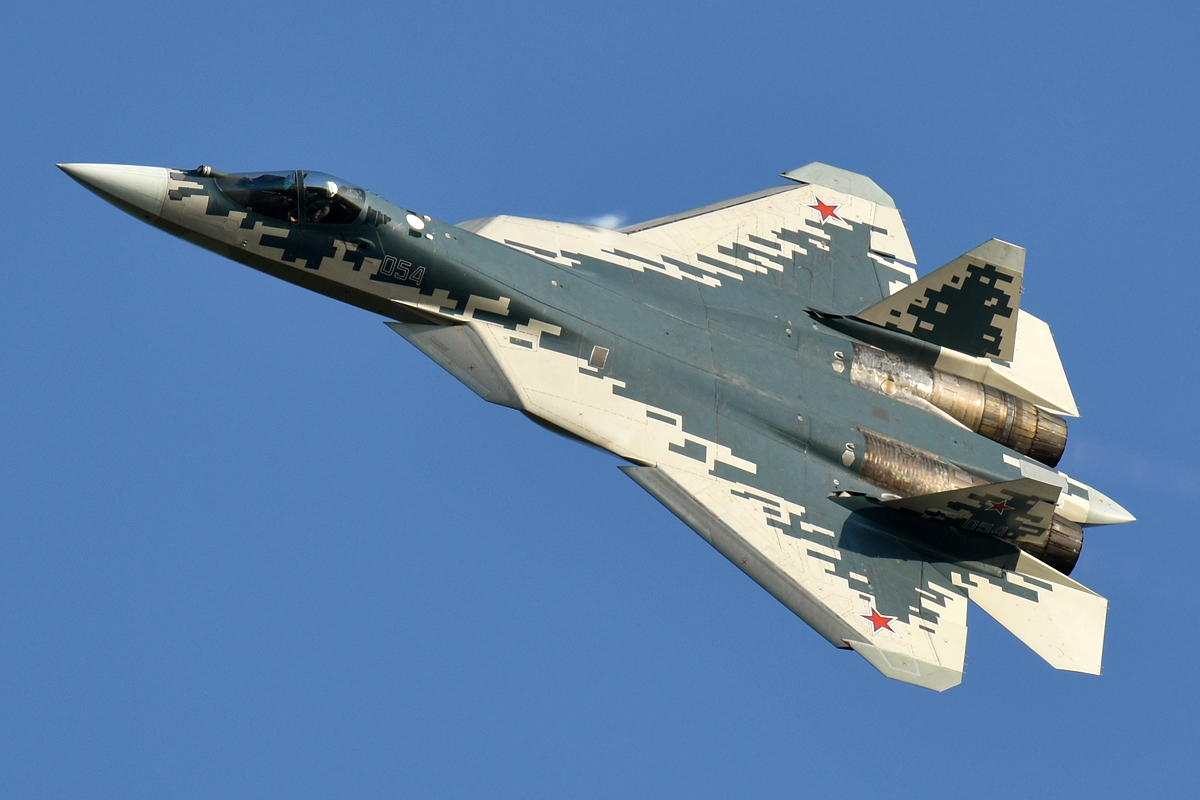
The Sukhoi Su-57 — NATO reporting name Felon, formerly PAK FA / T-50 — is Russia’s first fifth-generation stealth combat aircraft. Developed by the Sukhoi design bureau (a UAC subsidiary), the Su-57 first flew in January 2010 and was officially accepted into Russian Aerospace Forces service in 2020. As of 2026, fewer than 30 airframes are believed to be in operational service — far below the original 220-aircraft target — making the program the slowest fifth-generation deployment of any major power. Despite production delays, the Su-57 has flown combat sorties in Syria (2018) and Ukraine (2022–present), and a major 76-aircraft export contract to Algeria, signed in 2024, has revived the program’s industrial prospects.
Key facts at a glance
| Attribute | Value |
|---|---|
| Type | Fifth-generation multi-role stealth fighter |
| Manufacturer | Sukhoi (UAC) — KnAAPO production line at Komsomolsk-on-Amur |
| First flight | 29 January 2010 |
| Service entry | December 2020 (limited operating capability) |
| Crew | 1 |
| Engines | 2× AL-41F1 (interim) → 2× AL-51F1 / Izdeliye 30 (target) |
| Length | 20.1 m |
| Wingspan | 14.1 m |
| Empty weight | 18,500 kg |
| MTOW | 35,000 kg |
| Max speed | Mach 2.0 |
| Supercruise | Mach 1.3 (claimed) |
| Combat radius | ~1,500 km |
| Service ceiling | 20,000 m |
| Internal weapons bays | 2 main ventral + 2 side-cheek |
| Operators | Russia, Algeria (delivery from 2025) |
| Production rate (2025) | ~12–14 airframes per year |
| Unit cost (estimated) | ~ USD 35–40 million (subsidized Russian Air Force pricing) |
Origins: from PAK FA to Su-57
The PAK FA (Perspektivnyy Aviatsionnyy Kompleks Frontovoy Aviatsii — “Prospective Aviation Complex for Frontal Aviation”) program began in 1999 as the Russian Air Force’s response to the U.S. F-22A. Sukhoi’s T-50 prototype won the requirement in 2002, with development funding shared with India (which planned to acquire 250 examples) until New Delhi withdrew in 2018 citing performance, range and stealth shortfalls. The first T-50 prototype flew in January 2010 at the Komsomolsk-on-Amur production complex; the type was redesignated Su-57 in 2017.
The engine question
The single most-criticized aspect of the Su-57 program is its powerplant. The interim AL-41F1 engine — a derivative of the Su-35S’s AL-41F1S — has been described as a “4.5-generation” engine driving a fifth-generation airframe. The target Izdeliye 30 / AL-51F1 engine, designed from a clean sheet with low-observable nozzles and significantly higher thrust, has been in flight testing since 2017 but has not yet reached series production. Operational Su-57s as of 2026 continue to fly with the interim engine, compromising claimed supercruise performance and IR signature.
Stealth and shaping
The Su-57’s frontal radar cross-section has been the subject of intense Western analysis. Public estimates put the head-on RCS in the range of 0.1–1 m² — significantly larger than the F-22 (estimated ~0.0001 m²) but still smaller than any 4.5-generation fighter. Compromises include: open engine inlets (in the interim configuration), serrated but not fully blended nozzles, externally bolted access panels, and an extensive use of non-stealth-optimized antenna positions. Russian designers prioritized a balance of stealth + supermaneuverability rather than the F-22’s all-aspect low observability.
Sensors
The Su-57 carries an impressive sensor suite by 4.5-generation standards:
- N036 Belka AESA radar — main nose-mounted X-band array.
- N036B-1-01 side-cheek AESA arrays — provide wide-angle coverage without aircraft maneuver.
- N036L L-band AESA arrays in the wing leading edges — primarily for IFF, secondary low-band detection of stealth targets.
- 101KS Atoll DAS — distributed-aperture system inspired by F-35’s EO-DAS, with multiple IR sensors providing 360° missile-warning and tracking coverage.
- L402 Himalayas EW suite — internal jamming and decoy management.
Weapons
In its stealthy internal-carriage configuration, the Su-57 carries up to four large weapons in its two main ventral bays plus two side-cheek bays. Integrated munitions include:
| Role | Weapons |
|---|---|
| BVR air-to-air | R-77-1 / RVV-SD (110 km), R-37M (200+ km) |
| WVR air-to-air | R-74M2 (improved Archer) |
| Air-to-surface | Kh-59MK2, Kh-69 (stealth cruise), Kh-58UShKE anti-radar |
| Anti-ship | Kh-35UE |
| External (non-stealth) | Kh-31 family, Kh-101, KAB-500/1500 family |
Combat record
- February 2018 — Syria. Two T-50/Su-57 prototypes deployed briefly to Khmeimim airbase for “real-world testing.” No operational engagements were publicly confirmed.
- 2022–present — Ukraine. Russian Aerospace Forces operate Su-57s in stand-off strike roles, launching Kh-59MK2 and Kh-69 cruise missiles from outside Ukrainian air-defense engagement range. Ukrainian intelligence claims at least one Su-57 was damaged in a Ukrainian drone strike on Akhtubinsk airbase in June 2024 — the first publicly confirmed loss event for the type.
The Algerian export
In February 2024, Algeria confirmed an order for 76 Su-57 (variant designated Su-57E) with deliveries from 2025 — the largest single Russian fifth-generation export contract. The deal also makes Algeria the first nation outside Russia to operate the type. India’s earlier 2018 withdrawal had left the program with no foreign customers; the Algerian commitment fundamentally changes the economics of the production line and is expected to keep the type in series production through at least 2032.
Su-57 vs. its peers
| Su-57 (current engine) | F-35A | F-22A Raptor | Chengdu J-20 | |
|---|---|---|---|---|
| Class | 5th-gen multi-role | 5th-gen multi-role | 5th-gen air superiority | 5th-gen heavy fighter |
| Engines | 2× AL-41F1 (interim) | 1× F135 | 2× F119 | 2× WS-15 (latest) |
| Max speed | Mach 2.0 | Mach 1.6 | Mach 2.25 | Mach 2.0 |
| Stealth (frontal) | ~0.1–1 m² | Industry-leading | Industry-leading | Near-peer |
| Production rate (current) | ~12/yr | ~150/yr | Out of production | ~50/yr (estimated) |
| In service | ~30 | 1,200+ | 180 | ~200+ |
| Combat record | Syria, Ukraine | Heavy | Limited | None public |
Limitations
- Engines. Series-production Izdeliye 30 has slipped repeatedly.
- Production volume. ~12-14 airframes per year is far below the F-35 (~150/yr) and likely below the J-20.
- Western sanctions. Western avionics suppliers withdrew after 2014 and again in 2022; substitution with Russian and Chinese components has been ongoing.
- Stealth compromises. Externally bolted panels, non-flush antennas and large engine inlets reduce VLO performance.
- Limited combat exposure. Russian operations have kept the type largely in stand-off stand-off-strike roles rather than contested-air missions.
The future: Su-57M and unmanned wingmen
Sukhoi is developing the Su-57M: re-engined with Izdeliye 30, deeper EW upgrades, and integration with the Sukhoi S-70 Okhotnik-B loyal-wingman UCAV. The S-70, a flying-wing stealth drone, made its first flight in 2019 and is intended to operate in manned-unmanned teams with Su-57Ms by 2027. A naval variant for the cancelled Russian aircraft-carrier program is no longer under active development.
Why the Su-57 matters
The Su-57 is not the F-22 of Russia — but it does not need to be. The platform represents the only post-Soviet fifth-generation fighter in active production outside the United States and China, restores Russian standing in the global combat-aviation market through the Algerian contract, and provides the airframe template for an entire generation of Russian sensors, EW and weapons. Whether the Izdeliye 30 engine will eventually materialize at scale remains the program’s most important open question.