US Marines Test Iron Dome-Derived MRIC Air Defense on Guam


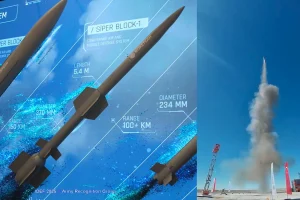
The US Marine Corps has tested MRIC (Medium-Range Intercept Capability), a medium-range air defense system derived from Israel’s Iron Dome, on Guam. The evaluation took place on 24 June 2026 during Valiant Shield 2026 at Guam’s Mason Live Fire Training Range Complex.
How the system works
MRIC uses the Tamir interceptor, marketed by Raytheon as SkyHunter, and engages threats at ranges of 4 to 70 kilometres. It integrates three main components: the proximity-fuzed SkyHunter/Tamir missiles, Northrop Grumman’s 360-degree AN/TPS-80 G/ATOR radar, and the CAC2S command-and-control system. MRIC protects against cruise missiles, drones, rockets, artillery, mortars and aircraft.
Why Guam and the Indo-Pacific
MRIC aims to close a defensive gap for Marine units operating dispersed across small islands. The Marine Corps had lacked medium-range organic air defense since the retirement of the old MIM-23 Hawk. Guam is a critical US base within range of China’s medium-range missiles, and the island’s multi-layered defense sits at the heart of Indo-Pacific strategy.
Programme milestones
The system’s development has moved quickly: live-fire validation at White Sands Missile Range in 2022, a $1.25 billion RTX Tamir production contract in November 2025, delivery of the first interceptor batch to the Marine Corps in May 2026, and operational deployment during Valiant Shield in June 2026. That timeline shows how fast the US can adapt a mature Israeli technology to its own needs and field it.
Compared with Turkey’s ASELSAN and ROKETSAN-developed STEEL DOME layered air defense architecture, militaries worldwide are converging on the same direction: low-cost, multi-layered, rapidly deployable defense against drones and cruise missiles.
Sources: US Marine Corps, RTX (Raytheon), Army Recognition.