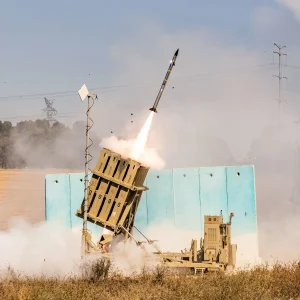
Babcock and Frankenburg to Navalise 60 cm Mark 1 — ‘World’s Smallest Guided Missile’ Heads to Sea

UK-based Babcock and Estonia’s Frankenburg Technologies have agreed to navalise the Mark 1 missile — billed as “the world’s smallest guided missile” at roughly 60 centimetres long — into a containerised maritime counter-drone system designed to flip the cost equation against one-way attack drones.
According to Army Recognition, Babcock International Group and Frankenburg Technologies signed a Memorandum of Understanding to develop a ship-launchable counter-drone air-defence system. At the centre of the package is the Mark 1 missile — solid-fuel propulsion, commercial off-the-shelf components, and a hard-kill kinetic interceptor architecture.
Closing the littoral reaction-time gap
In littoral operations, radar horizon and sea clutter compress reaction time to seconds. Using high-end SAMs (ESSM, Crotale NG, RAM) against low-cost UAVs has become financially untenable — a reality that played out brutally in the Red Sea, where Houthi one-way attack drones forced US and allied vessels into a “half a million dollars per Shahed” equation.
Mark 1 is designed to break that equation, with the partners promising production costs “an order of magnitude cheaper” than conventional alternatives. Estonia’s Defense Industry Park is targeting “triple-digit missiles per day” output.
Target platforms
The partnership is focused on:
- Deployed surface vessels across European fleets
- Patrol vessels and support ships
- Coastal infrastructure — ports, shipyards and ammunition depots
The system was demonstrated at NATO’s Ādaži base in Latvia, positioning Mark 1 as a tangible product of the post-2022 European defence procurement priority shift toward “cost-effective kinetic intercept.”
Turkish industry perspective
Türkiye has been building a layered maritime air-defence stack. GÖKDENİZ, a 35 mm close-in weapon system, anchors point-defence on MILGEM and Istanbul-class frigates. LEVENT GAFM vertical-launch module and Roketsan’s HİSAR-D RF family fill the mid-tier. The asymmetric cost calculus against one-way attack drones now pushes Türkiye toward small-form kinetic mini-missiles and directed-energy concepts.
In this context, Mark 1’s approach mirrors the design intent of ASELSAN’s GÖKER mini guided munition and the ALKAR family. STM’s next-generation USVs (ARMATTA, ULAQ) are also natural integration candidates for a Mark 1-class kinetic interceptor on top of their existing gun-based defences.
Timeline
The concept is advancing toward shipboard integration testing and operational validation. Given Babcock’s tight footprint in UK naval programmes, initial fielding is likely to come aboard Royal Navy platforms.
Sources
- Army Recognition — “UK’s Babcock and Estonia’s Frankenburg partner on new maritime counter-drone air defense system”
- Babcock International Group press release
- Frankenburg Technologies — Mark 1 product brief
- NATO Ādaži base demonstration reports
- Open-source Red Sea operations cost analyses