ASFAT Hands Over TCG Koçhisar and Romania’s CAm. Roman

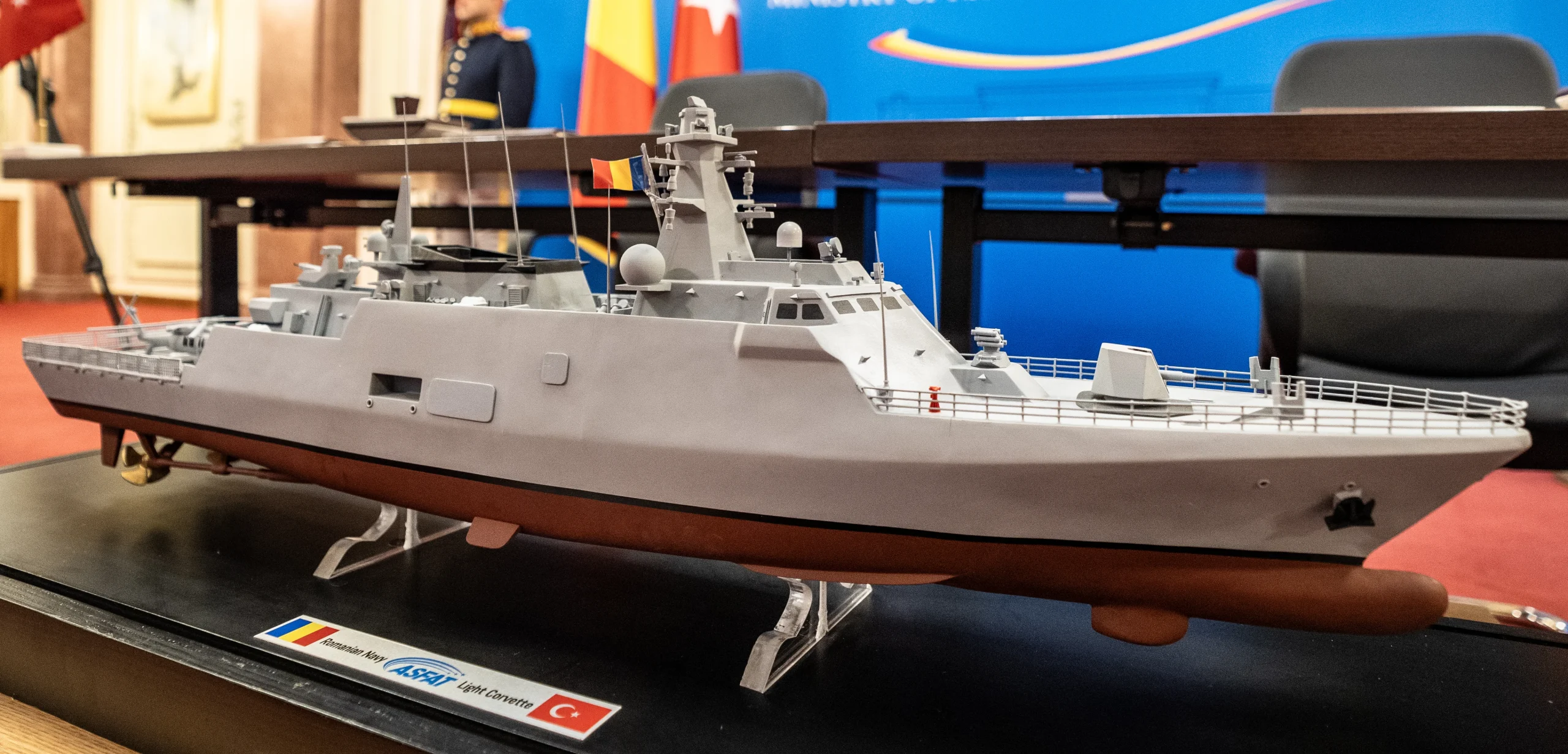
Turkiye’s military shipbuilding sector marked an unusual milestone on 20 June, delivering warships to two different navies in a single ceremony at Istanbul Naval Shipyard Command. Under a programme led by the state procurement agency ASFAT, the Hisar-class offshore patrol vessel TCG Koçhisar (P-1221) entered service with the Turkish Naval Forces, while the corvette CAm. Roman, derived from the same design, was handed over to the Romanian Navy. Turkish President Recep Tayyip Erdoğan and Romanian President Nicusor Dan attended the event together.
The handover carries weight beyond a routine fleet update. The vessel transferred to Romania is recorded as the first Turkish-built naval combatant exported to a country that is both a NATO and a European Union member, a threshold that lifts Turkish yards from aspiring suppliers to proven ones in the allied market.
One design, two flags
The Hisar class was designed under ASFAT to meet an offshore patrol requirement. The Turkish Navy has ordered ten ships across the full programme, with TCG Koçhisar the second hull. It was floated out alongside the lead ship TCG Akhisar (P-1220) in September 2023.
Romania’s CAm. Roman is the corvette configuration of the same platform. The contract was signed on 3 December the previous year for roughly 223 million euros. Bucharest’s choice of a Turkish design reflects a deepening naval relationship between two NATO littoral states on the Black Sea.
What the Hisar class brings
At just under 100 metres, the ships are built for the broad mission set expected of a medium patrol platform: maritime surveillance, intelligence gathering, protection of the exclusive economic zone, maritime security and search and rescue. The design follows a “fitted for but not with” philosophy, leaving room to add heavier weapons and sensors as needs evolve.
The weapons fit is largely indigenous. The main gun is an MKE 76 mm, close-in air defence is handled by Aselsan’s GÖKDENİZ 35 mm system, and the hull is prepared to carry Roketsan’s ATMACA anti-ship missile. That combination turns the Hisar class from a simple patrol boat into a flexible platform capable of contributing to surface warfare when required.
| Specification | Value |
|---|---|
| Length overall | 99.56 m |
| Beam | 14.42 m |
| Draft | 3.77 m |
| Displacement | ~2,300 t |
| Max speed | 24 knots |
| Range | ~4,500 nm at 12 knots |
| Propulsion | CODELOD (diesel-electric / diesel) |
| Crew | ~104 |
| Main armament | MKE 76 mm, Aselsan GÖKDENİZ 35 mm, fitted for ATMACA |
The Black Sea equation
The timing lands in a period when Black Sea security is being reshaped. The maritime dimension of the war in Ukraine has pushed littoral states to strengthen patrol, surveillance and coastal defence capacity, and Romania’s acquisition of a Turkish-built corvette is a concrete response to that need.
At the ceremony Erdoğan said Turkiye is currently building more than 50 naval platforms, including vessels for export customers. The portfolio spans offshore patrol vessels, frigates and destroyers, submarines, unmanned surface vessels and a future national aircraft carrier, underlining that the country’s naval industry is aiming at foreign markets as much as domestic demand.
For Turkiye the outcome is a double gain. The Navy adds a new patrol vessel for EEZ and coastal duties, while exporting the same design to a NATO-EU member serves as international validation that Turkish yards can build to allied standards. As CAm. Roman begins service under the Romanian flag in the Black Sea, it stands as a reference that could open the door to further export deals.
Sources
- Naval News — report on the ASFAT double-delivery ceremony (21 June 2026): ceremony date, ship names, export and Black Sea context.
- Open-source technical data on the Hisar-class OPV: dimensions, displacement, propulsion, weapons and sensor fit.
Image: representative scale model of a Hisar-class platform (Wikimedia Commons), not an operational photo of the delivered ships.