Pentagon’s FY2027 Buy of 24 F-15EX Eagle II Pushes Boeing to Full-Rate Production as F-15C/D Fleet Ages Out
According to Defence Industry Europe’s 23 May 2026 report, the $2.66 billion line item embedded in the Pentagon’s FY2027 package marks the largest single-year order Boeing’s F-15EX line has received to date. The procurement is designed to fill the gap created by the structural fatigue, declining readiness and ballooning sustainment cost of the Cold War-era F-15C/D Eagle fleet. The first batches of Eagle II will be split between active-duty Air Force squadrons and Air National Guard wings.
At a Glance
- Requesting service: U.S. Air Force, FY2027 budget
- Aircraft: 24 × F-15EX Eagle II
- Budget: $2.66 billion
- OEM: Boeing Defense (St. Louis line)
- Production timeline: FY2027 — FY2031
- Expanded ceiling: 268 aircraft total (up from 144)
- Replaces: F-15C/D Eagle (in service since early 1980s)
Background: The C/D Burnout and the Birth of the EX
Army Recognition’s analysis on the same date describes the FY2027 line as the formal acknowledgement of a multi-year strategic shift rather than a one-off appropriation. When Boeing’s F-15EX program was launched in July 2020 with a $1.2 billion seed contract, the original ceiling was 144 jets. Five years later, the Pentagon has nearly doubled that target to 268. The driver is straightforward: the F-15C/D fleet, in service since the early 1980s, can no longer be economically sustained — structural fatigue and obsolete avionics architecture have outpaced depot-level patchwork.
The Eagle II’s airframe derives from the export-only F-15SA (Saudi Arabia) and F-15QA (Qatar) variants. The choice preserved Boeing’s St. Louis production continuity and let the Air Force modernize without scrapping its installed F-15 base infrastructure — basing, spares pipelines, simulator footprint and pilot training pipelines all carry forward.
The Buy and the Production Curve
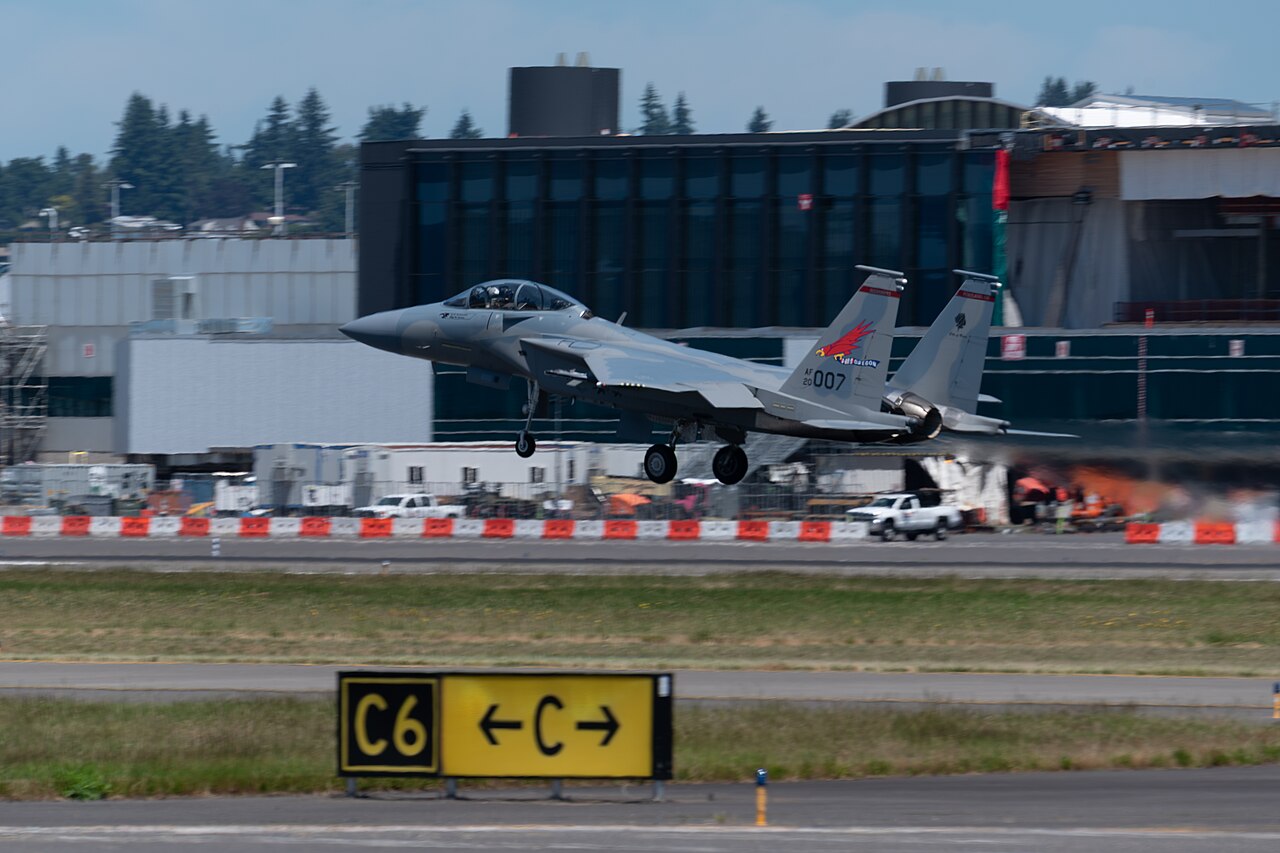
FlightGlobal’s 23 May 2026 analysis underscores that the new procurement profile effectively pushes Boeing to full-rate production. FY2028 calls for another 24 aircraft, FY2029 climbs to 28, and both FY2030 and FY2031 plan 36-aircraft batches. That matches Boeing’s near-term goal of two jets per month off the St. Louis line; the company has previously said it could lift output to 36 aircraft per year if demand materializes.
| Fiscal Year | Planned Aircraft | Notes |
|---|---|---|
| FY2027 | 24 | $2.66 billion — the focus of this report |
| FY2028 | 24 | Full-rate transition batch |
| FY2029 | 28 | Production ramp |
| FY2030 | 36 | 3 jets per month target |
| FY2031 | 36 | Program peak |
| TOTAL | 268 | ~86% above original 144 ceiling |
Technical Profile: What Makes the Eagle II Different
The F-15EX retains the classic two-seat Eagle outer-mold-line but its internals are almost entirely new. Open-source data on the platform confirm:
- Radar: Raytheon AN/APG-82(V)1 AESA — orders of magnitude better detection range and ECM resilience than the legacy APG-63.
- Survivability: EPAWSS (Eagle Passive/Active Warning and Survivability System) — the jet’s electronic warfare and radar warning suite.
- Flight controls: Fully digital fly-by-wire with large-area glass cockpit displays.
- Architecture: Open Mission Systems standard — new weapons can be integrated through software updates rather than full mission-computer refits.
- Weapon load: 13+ air-to-air missiles simultaneously — more than the F-22 Raptor (8) and F-35 (6 internal + external). This is where the “weapons truck” tag originates.
- Max external payload: 14,000 kg.
- Future weapons: Pylon and mission-system integration is being prepared for hypersonic weapons and stand-off cruise missiles.
NATO and Pacific Context
Two distinct threat horizons sit behind the Eagle II expansion. The first is U.S. homeland air and missile defense: the F-15EX’s high dash speed and long persistence fit NORAD’s interceptor profile, particularly in the Arctic approaches against Russian strategic bombers. The second is the Indo-Pacific high-intensity scenario, where the F-15EX’s fuel fraction and large weapons bay make it a viable long-range arsenal platform against the PLA Air Force’s sheer numerical mass.
On the European flank the Eagle II is not slated for forward deployment, but USAF’s rotation of European-based units toward the F-35A frees F-15Cs for retirement on an accelerated curve. Poland’s first F-35A delivery last week carries the fifth-generation burden on NATO’s eastern flank.
Why It Matters for Turkey
The Eagle II ramp-up directly shapes the external context of Türkiye’s fighter recapitalization equation. The fact that the U.S. is reserving the F-15EX for homeland defense and the Pacific raises the theoretical option of legacy F-15C/D “hot transfers” to allies — but that path is misaligned with Türkiye’s strategic priorities. The genuine Turkish answer is the indigenous fifth-generation KAAN programme and a sovereign fleet modernization track.
TUSAŞ-led KAAN is, as of 2026, in active prototype flight testing, with export negotiations advancing — Indonesia in particular. Architecturally KAAN is not a “weapons truck” like the F-15EX; it is built around low observability and an internal weapons bay, targeting an F-35-class doctrine. That is where Turkish defense industry’s edge becomes concrete: digital cockpit (HAVELSAN), AESA radar (ASELSAN MURAD), open-architecture mission system, and the indigenous engine roadmap (TF-6000 / TF-35000) all stay inside national borders end-to-end, without dependency on a foreign supplier veto.
Alongside KAAN, ASELSAN’s EW suite, ROKETSAN’s GÖKDOĞAN / BOZDOĞAN-class air-to-air missiles, and the long-range SİPER air defense layer build Türkiye’s air superiority architecture not around one super-platform but on a distributed, network-centric posture — the right investment balance for a country guarding NATO’s most exposed eastern frontier.
Frequently Asked Questions
Is the F-15EX actually fifth-generation? No. The F-15EX is classified as 4.5-generation; it has no stealth shaping. Its advantages are massive weapon payload, long range and low operating cost — it occupies the “high-payload” slot in the high-low mix alongside the F-22 and F-35.
Is $2.66 billion for 24 aircraft expensive? Unit cost works out to about $110 million, inclusive of engines, sensor suite, EPAWSS, logistics and training infrastructure. For comparison, F-35A unit cost is around $85 million (less engine), but F-35 stealth maintenance and sustainment is materially higher. F-15EX cost-per-flight-hour is roughly half that of the F-35.
Why did Boeing keep the St. Louis line open? Export orders — F-15QA (Qatar), F-15SA (Saudi Arabia) and F-15IA (Israel) — kept the line alive. The FY2027 batch brings it to full capacity; the U.S. domestic customer now sits beside export demand.
When will the F-15C/D be fully retired? With F-15EX deliveries running through FY2031, the last F-15C/D units are expected to retire by 2032-2033. Air National Guard wings sit at the front of that retirement queue.
Bottom Line
The FY2027 24-aircraft batch is the formal stamp on Eagle II’s transition from “experiment” to “full-rate production.” The Pentagon’s 268-jet expansion signals that the U.S. will lean on the classic-airframe-plus-modern-electronics formula for homeland defense and Pacific stand-off for the next decade. For Türkiye the lesson is different: an Eagle II-style weapons truck is not a standalone solution. A sovereign fifth-generation platform, a sovereign weapons ecosystem, and a layered, distributed air defense net must be planned together. KAAN, ASELSAN, ROKETSAN and the SİPER chain remain the only realistic road that frees Türkiye from supplier dependency.
Related Reading
Sources
- Defence Industry Europe — U.S. defense budget plans emergency purchase of F-15EX Eagle II fighters (23 May 2026)
- Army Recognition — U.S. Air Force FY2027 Plans Acquisition of 24 New F-15EX (23 May 2026)
- FlightGlobal — Latest F-15EX acquisition plan would move Boeing to full-rate production
- Wikipedia — Boeing F-15EX Eagle II (technical baseline)
- Breaking Defense — Air Force eyes massive boost for F-15EX fleet (April 2026)