What Is the Eurofighter Typhoon? Specs, Operators and Turkey’s 20-Jet Deal

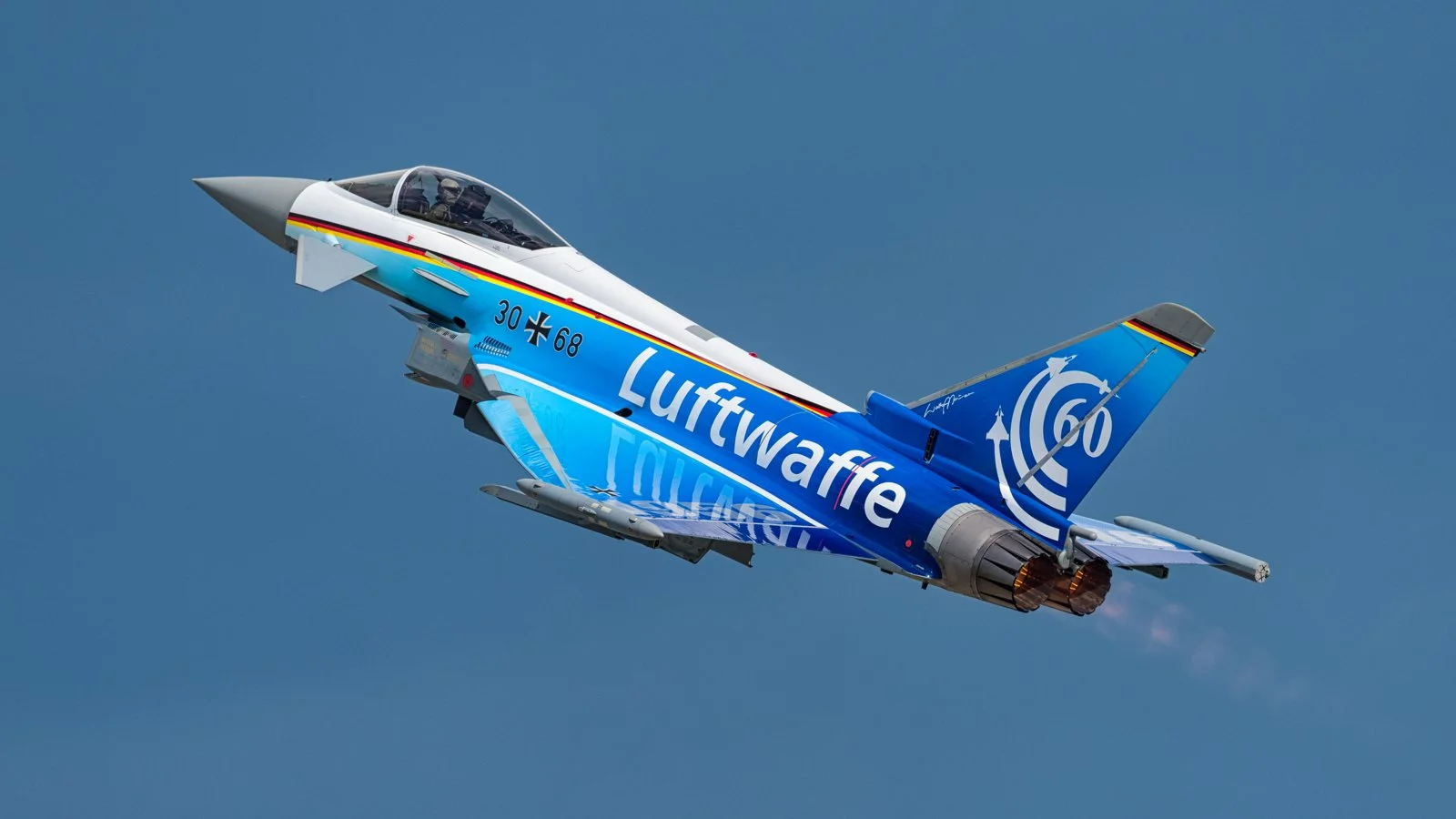
The Eurofighter Typhoon is a 4.5-generation multirole fighter jointly developed by the UK, Germany, Italy and Spain. Conceived for air superiority and matured into a full multirole platform, the Typhoon is Europe’s flagship combat aircraft — and in 2025 it added Turkey to its operator list with a signed deal for 20 jets.
Product Identity
| Manufacturer | Eurofighter GmbH (BAE Systems, Airbus, Leonardo) |
| Type | Multirole fighter (4.5 generation) |
| Origin | UK / Germany / Italy / Spain |
| First flight | 27 March 1994 |
| In service | 2003-2004 |
| Operators | 9 nations |
| Production | Active (Tranche 4/5 on order) |
What the Typhoon Is
The Typhoon was born from a late-Cold-War decision by four European nations to build a common air-superiority fighter against the Soviet air threat. Its canard-delta aerodynamic layout gives it exceptional agility in close combat. Through successive software and hardware upgrades, the jet evolved into a genuine multirole platform, capable of precision air-to-ground strike, anti-shipping and suppression missions alongside its air-to-air core.
Development Story
Launched in the mid-1980s, the programme flew its first prototype in 1994 and entered production in phased “Tranche” blocks — Tranche 1 for early capability, Tranches 2 and 3 for advanced multirole. Today, the Captor-E AESA radar, the ECRS Mk1/Mk2 upgrades and Meteor integration form the spine of a modernisation roadmap intended to keep the jet relevant into the 2060s.
Technical Specifications
| Feature | Value |
|---|---|
| Length | 15.96 m |
| Wingspan | 10.95 m |
| Height | 5.28 m |
| Max take-off weight | ~23,500 kg |
| Engines | 2 × Eurojet EJ200 turbofan (~90 kN with afterburner) |
| Max speed | Mach 2.0 (~2,495 km/h) |
| Combat radius | ~1,390 km (air-defence) |
| Service ceiling | ~19,800 m |
| Hardpoints | 13 + 27 mm Mauser BK-27 cannon |
| Crew | 1 (2 in trainer) |
Weapons and Sensors
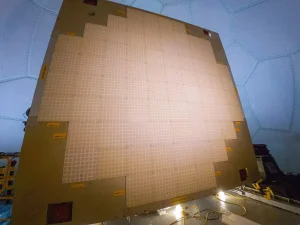
At the heart of the Typhoon’s striking power is the MBDA Meteor beyond-visual-range air-to-air missile, complemented by AIM-120 AMRAAM, IRIS-T and ASRAAM. In the air-to-ground role it carries Storm Shadow, Brimstone, Taurus and Paveway guided weapons. On the sensing side, the Captor radar from the Leonardo-led Euroradar consortium and the EuroDASS Praetorian self-protection suite form the jet’s nervous system.
Leonardo’s Role
Leonardo represents Italy in the consortium with roughly a 21 percent workshare. It builds structural sections including the left wing and rear fuselage, leads development of the Captor radar family (Euroradar), and supplies a major part of the electronic-warfare and self-protection systems — making Leonardo a co-architect of the jet’s brain and senses, not merely a parts supplier.
Operators
| Country | Status |
|---|---|
| UK, Germany, Italy, Spain | Founding operators |
| Austria | Active |
| Saudi Arabia | Active (large fleet) |
| Oman, Kuwait, Qatar | Active / delivery |
| Turkey | 2025 deal — deliveries from 2026 |
Turkey Relationship
Turkey’s path to the Typhoon was shaped by its removal from the F-35 programme and the need to renew an ageing fighter fleet. After years blocked by a German export veto, the process opened in 2025: Germany lifted its objection in June, a memorandum of understanding was signed at the IDEF fair in Istanbul in July, and in October 2025 Turkey and the UK finalised a deal for 20 Typhoons worth roughly $10.66 billion. Per open sources, the package includes an option for 20 more aircraft, with deliveries expected to begin in 2026 and full operational readiness by 2030.
The agreement is widely seen as a bridge capability for the period until Turkey’s indigenous KAAN fighter enters full service. Because the Typhoon also brings access to top-tier air-to-air weapons such as Meteor, the deal directly affects the Turkish Air Force’s beyond-visual-range combat capacity.
Competing Systems
| System | Maker | Country | Difference |
|---|---|---|---|
| Rafale | Dassault | France | Single-nation control, nuclear role; Typhoon is multinational |
| F-35 | Lockheed Martin | USA | True stealth; Typhoon favours agility and speed |
| Gripen E | Saab | Sweden | Low operating cost; Typhoon is heavier and more powerful |
| F-15EX | Boeing | USA | Higher payload; Typhoon more agile |
Strengths and Weaknesses
Strengths: outstanding agility and supersonic performance, best-in-class BVR capability with Meteor, longevity via AESA radar upgrades, and a broad NATO user base. Weaknesses: no true stealth, multinational governance that slows decisions, high acquisition and operating cost, and market pressure from the F-35.
Frequently Asked Questions
Which countries build the Eurofighter Typhoon?
It is jointly developed by the UK, Germany, Italy and Spain, with production led by BAE Systems, Airbus and Leonardo.
How many Eurofighters is Turkey buying?
Turkey signed a deal with the UK in October 2025 for 20 jets (~$10.66 billion), with an option for 20 more. Deliveries are expected to begin in 2026.
Is the Typhoon a stealth aircraft?
No. While it incorporates radar-cross-section reduction measures, it is not a true stealth jet like the F-35; its strengths are agility, speed and sensor/weapon superiority.
Sources
Eurofighter GmbH and Leonardo official statements; UK MoD and Turkish Ministry of National Defence announcements; Breaking Defense, Defense News, Army Recognition, Janes (2025).