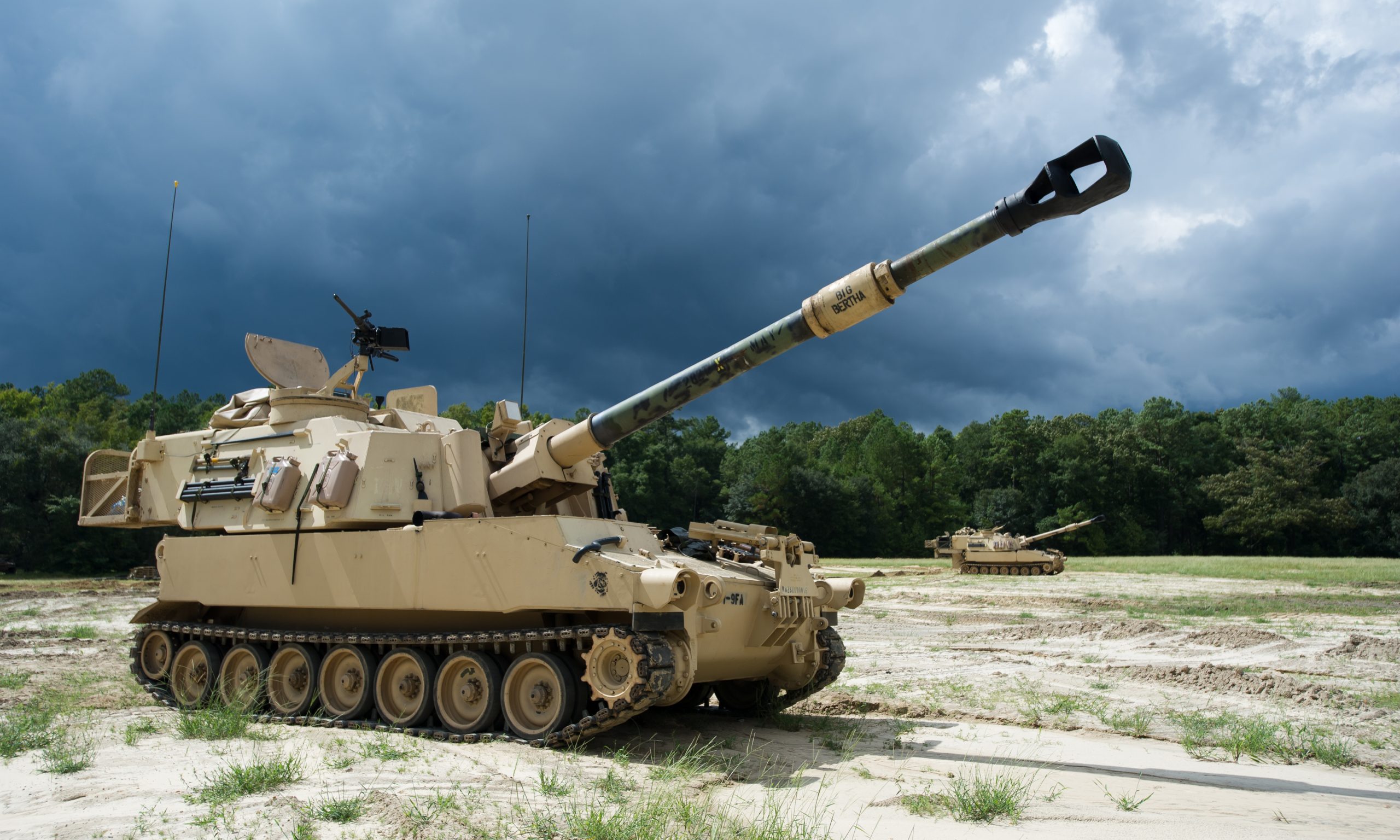
What is the M109A7 Paladin? The standard 155 mm self-propelled howitzer of the U.S.


M109A7 Paladin
155 mm/39 caliber self-propelled howitzer manufactured by BAE Systems. The newest version of the M109 family, which has been the standard artillery platform of the U.S. Army since the 1960s. A version that has completely renewed the engine, electronics, and fire control of the old M109A6 Paladin. Due to the 39 caliber gun, its range is shorter compared to the PzH 2000 / K9 / K9 Thunder, but it maintains its value due to the operational quantity and the U.S. logistics chain.
What is the M109A7 Paladin?
The M109 Paladin is a 155 mm tracked self-propelled howitzer that entered the U.S. Army inventory in 1963. It has continuously maintained the role of the standard artillery platform of the U.S. for over 60 years. The M109A7 is the latest variant of the family; it keeps the production line alive by modernizing previous variants (M109A1, A2, A3, A4, A5, A6).
The innovations that come with the M109A7 (compared to the A6):
- Completely new chassis — reinforced infrastructure taken from parts of the M2 Bradley.
- More powerful engine and electrical system — for modern avionics.
- New fire control computer — digital and faster.
- Integration of precision ammunition “Excalibur” — reaches 50 km guided by GPS.
- More robust armor — high resistance to IEDs and shrapnel.
The biggest weakness of the M109A7 is the length of the L/39 barrel (39 calibers). Modern equivalents like the PzH 2000, K9, and K9 Thunder have L/52 barrels; this difference translates to a range difference of 10 km. Considering this capability, the U.S. Army initiated the ERCA (Extended Range Cannon Artillery) project — the L/58 cannon aimed for a range of over 70 km; the program was canceled in 2024. Currently, the U.S. is turning to the European market for contemporary L/52 SPHs.
U.S. M109A6/A7 howitzers have been provided to Ukraine. Although their range is shorter compared to more modern European SPHs, they have proven their value with the existing ammunition infrastructure and training.