What Is BVR Combat? Beyond Visual Range Air Fighting Explained

# What Is BVR Combat? Beyond Visual Range Air Fighting Explained
Quick answer: Beyond Visual Range (BVR) combat is air-to-air fighting where pilots never see each other with their eyes. Detection happens by radar (often 100+ km away), missiles fire long before visual contact, and most modern kills occur over 20 km. The “dogfight” — close-range maneuvering — is now rare.
The Two Combat Regimes
| Range | Name | Combat Style |
|---|---|---|
| 0–10 km | WVR (Within Visual Range) | Dogfight, IR missiles, guns |
| 10–200 km | BVR (Beyond Visual Range) | Radar tracking, radar-guided missiles |
For decades, most aerial victories shifted from WVR to BVR:
- Korean War (1950s): 100% WVR (guns)
- Vietnam (1960s): mostly WVR (early missiles + guns)
- Gulf War (1991): >50% BVR
- Modern exercises: 80–90%+ BVR
How a BVR Engagement Unfolds
- 1. AWACS detection — A flying radar plane (like E-3 Sentry, A-50, Boeing Wedgetail) sees aircraft 400 km away.
- 2. Fighter alerted — Friendly fighters receive target info via secure datalink (Link-16, MADL).
- 3. Closing — Fighter approaches with own radar still off (silent).
- 4. Identify — IFF and EW signature confirm enemy.
- 5. Lock — Pilot turns on radar briefly to confirm target.
- 6. Launch — Missile (AIM-120, Meteor, PL-15) fires at 70–150 km.
- 7. Mid-course guidance — Missile flies on inertial + radar updates via datalink.
- 8. Terminal phase — At 15–25 km, missile’s own radar activates and homes in.
- 9. Hit or miss — Target either dies or evades with chaff and maneuvering.
The whole sequence: about 90 seconds.
What BVR Pilots Track
Modern fighter HUDs show:
- Range to target (km)
- Closure speed (Mach)
- Altitude difference
- Target’s heading
- “WEZ” — Weapon Engagement Zone (kill area for own missile)
- “NEZ” — No Escape Zone (target can’t outrun missile)
- “MAR” — Maximum Abort Range (when pilot must turn away)
The whole fight becomes a math game played at Mach 1+.
The “First Look, First Shot, First Kill” Principle
In BVR, whoever detects first usually shoots first and wins. So modern air combat is all about:
- Stealth (lower RCS = enemy sees you later)
- Better radar (you see enemy first)
- Better data networks (AWACS, datalinks)
- Better missiles (longer range, NEZ)
- Better situational awareness (sensor fusion, helmet displays)
A 5th-gen fighter typically wins because of this.
Famous BVR Missiles
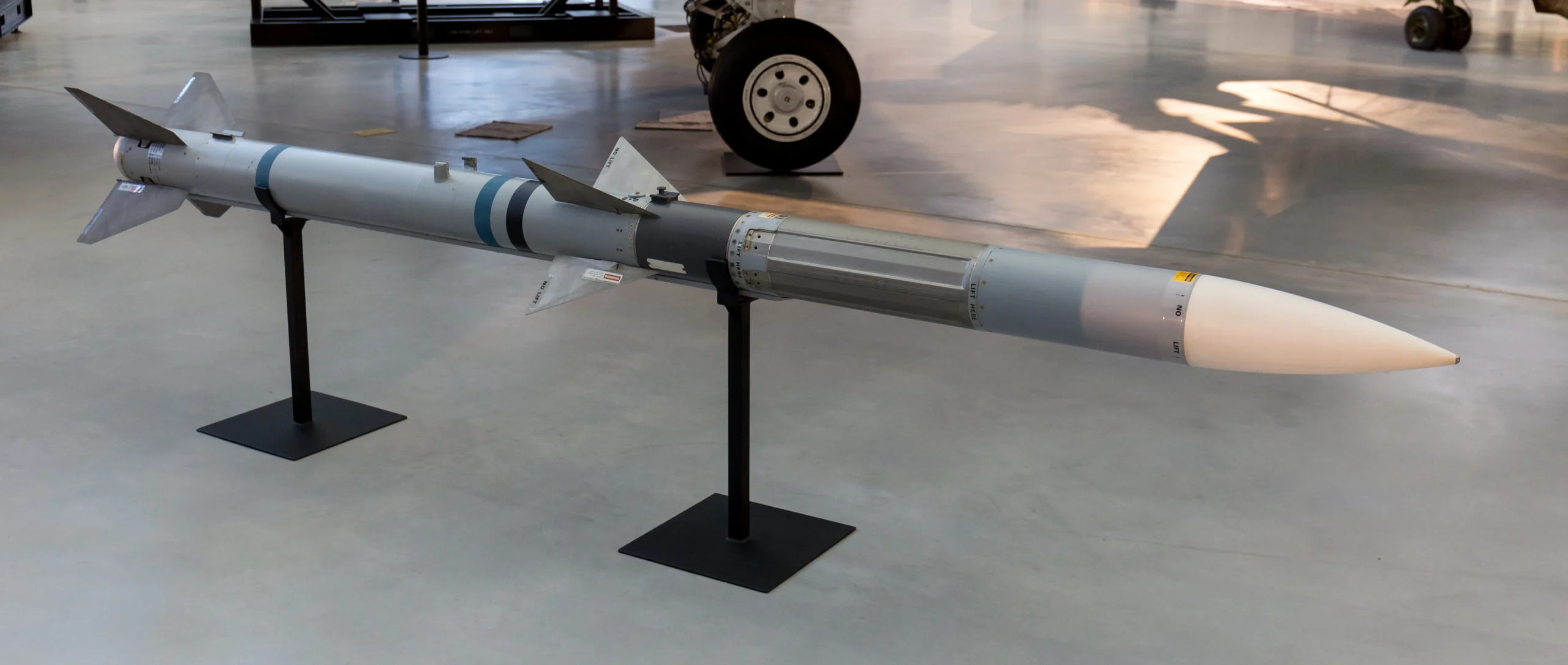
| Missile | Country | Range | NEZ |
|---|---|---|---|
| AIM-120 AMRAAM | USA | 105 km (D-version) | ~50 km |
| AIM-260 JATM | USA | 260+ km | larger |
| Meteor | Europe | 200 km | ~100 km (ramjet) |
| R-77 RVV-AE | Russia | 80–110 km | — |
| R-37M | Russia | 400 km | ~150 km |
| PL-15 | China | 200+ km | large |
| Gökdoğan | Türkiye | 75+ km | — |
| Mica EM | France | 80 km | — |
| Astra Mk1/2 | India | 80–160 km | — |
How BVR Fails Sometimes
BVR isn’t perfect:
- 1. Identification problem — pilots can’t tell enemy from friendly at long range without clear IFF. Past mistakes shot down civilian airliners and friendly fighters.
- 2. Chaff and ECM — modern aircraft can fool radar-guided missiles
- 3. Notching — turning 90° to a Doppler radar makes you “disappear”
- 4. Saturation — limited number of missiles per fighter (F-35 carries 4 internal)
- 5. Stealth-vs-stealth — both fighters invisible, neither knows where the other is
In stealth-vs-stealth, BVR may revert to WVR by surprise.
How BVR Changed Tactics
Old tactics (dogfight era):
- Climb above enemy (“the higher man wins”)
- Use sun to blind enemy
- Maneuver to enemy’s six o’clock
- Use guns at close range
Modern BVR tactics:
- AWACS-based intercept — get target data from radar plane
- Pincer attacks — two fighters from different angles
- Sensor offset — one fighter searches, one shoots
- Crank maneuver — turn 30° away after launch to maintain own missile guidance while reducing exposure
- Notching — defensive maneuver if locked
The Famous “Crank” Maneuver
After launching an AMRAAM, the pilot doesn’t fly straight at the target. Instead, they turn 30–40° away (“crank”). This:
- Reduces own RCS toward enemy radar
- Keeps own missile in guidance datalink range
- Allows quick escape if needed
The opposite — flying straight at the enemy — is called hot aspect and is risky.
BVR Combat in Recent History
- 1991 Gulf War — F-15Cs killed many Iraqi MiGs in BVR
- 1999 Kosovo — F-15s vs MiG-29s, all BVR kills
- 2019 Pakistan-India clash — Pakistani F-16 vs Indian MiG-21; one BVR engagement, both sides claim victory
- 2022+ Russia-Ukraine — R-37M reportedly killed several Ukrainian fighters at extreme BVR distance
- 2025 Iran-Israel exchanges — F-35I reportedly conducted multiple BVR shots
A Kid-Friendly Analogy
Imagine two snipers in a vast field. One has a powerful scope, the other has good eyes only. The sniper with the scope sees and shoots first — the other never even sees what hit them.
That’s BVR combat. Whoever has the longer scope (radar) and longer rifle (missile) usually wins.
The Counter — Stealth + Long Missile = Game-Changer
The F-22 paired with AIM-260 or the F-35 paired with Meteor represents the most lethal BVR combination ever. Combined with low RCS, the enemy may not even know they’re under attack.
This is one reason countries without 5th-gen aircraft worry about modern air wars — BVR favors the technologically advanced side.
Image Suggestions
- 1. Featured: Eurofighter launching Meteor at altitude
- 2. BVR engagement diagram (detect → launch → home)
- 3. F-22 HUD with target box at 80 km
- 4. AWACS aircraft with radar lines to fighters
- 5. Crank maneuver geometry
Related Articles
- What is an air-to-air missile?
- What is a dogfight?
- What is AESA radar?
- What is a fighter jet generation?
- What is AWACS?