U.S. Army Unveils Next-Gen M1E3 Abrams: Unmanned Turret, Hybrid Powertrain and a 60-Ton Drone-Era Tank
According to Defence Industry Europe‘s 25 May coverage, the GDLS-led design has moved noticeably closer to the company’s own AbramsX demonstrator than to the M1E3 test vehicle revealed in January. A new geometric unmanned turret, a turret bustle basket likely housing a reconnaissance UAV, and an unusually wide gap between the first and second road wheels all point to an entirely new hull built around an armored crew capsule.
At a Glance
- Platform: M1E3 Abrams (future M1A3 service designation)
- Combat weight target: ~60 tons (significantly lighter than M1A2 SEPv3)
- Propulsion: Hybrid diesel-electric with high-efficiency transmission
- Turret: Unmanned, autoloader-fed, three-person crew
- Primary armament: 120 mm M256 smoothbore / 30 mm M230LF (Northrop Grumman) secondary
- Active protection: XM251/M251 (Iron Fist-based)
- Contract: Abrams Requirements Contract III ≈ $3.8 billion, FY2026 GDLS award expected
- Service entry: around 2030
Background: Lessons from Ukraine and the Hybrid Pivot
Army Recognition‘s coverage of NDIA MDEX 2026 frames the M1E3 program as a direct response to lessons drawn from Ukraine. U.S. Army officials emphasize that the new hybrid-electric architecture delivers three core gains: materially lower fuel burn, extended range, and reduced thermal and acoustic signatures. Crucially, the architecture also generates surplus electrical power to feed future directed-energy weapons, advanced sensors, and electronic warfare suites.

The Design: Turret, Protection, and Crew Capsule
The most consequential effect of the unmanned turret is the relocation of all three crew members — driver, gunner, commander — into a side-by-side armored capsule, seated in a semi-reclined posture similar to the current Abrams driver position. This addresses one of the starkest data points from Ukraine, where turret strikes have accounted for a substantial share of tank losses.
| System | Supplier | Function |
|---|---|---|
| 120 mm M256 | Watervliet Arsenal | Modernized smoothbore main gun |
| 30 mm M230LF | Northrop Grumman | Secondary turret — anti-UAV, light targets |
| XM251 / M251 | GD-OTS (Elbit Iron Fist core) | Hard-kill APS — unified U.S. standard |
| Hybrid diesel-electric | Supplier undisclosed | Lower thermal/acoustic signature, electrical reserve |
| Autoloader | Integrated in turret | Crew reduced from 4 to 3 |
The M251 selection signals a broader doctrinal shift inside the U.S. Army: by 2028 the same active protection system will reach Strykers and Bradleys, retiring the Rafael Trophy HV that currently equips M1A2 SEPv3 brigades.
Eastern Flank and Pacific Context
The 60-ton target is no accident. Defence Industry Europe sources note that European bridging infrastructure is increasingly intolerant of the M1A2’s 73-ton mass. In the Pacific theater the equation is even more punishing: island-hopping operations, maritime lift capacity, expeditionary bridging, and over-the-shore landings all render a 73-ton tank impractical. The hybrid powertrain’s range advantage also hardens logistics at a time when, in Ukraine, fuel convoys have become priority UAV targets.
Why It Matters for Turkey
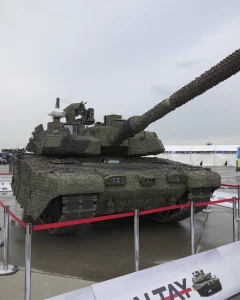
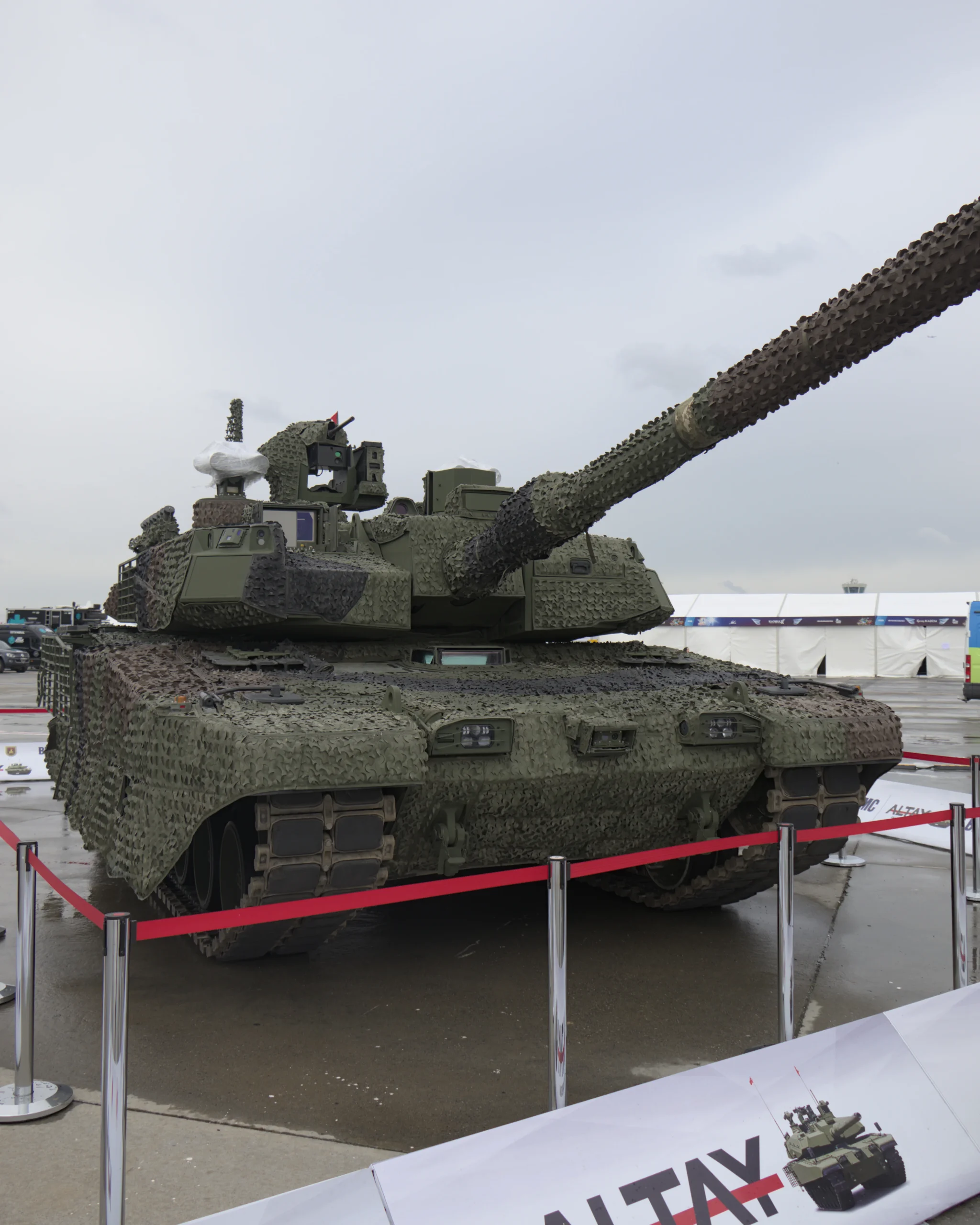
The design philosophy the M1E3 embodies — lower mass, hybrid propulsion, unmanned turret, distributed active protection — bears directly on Türkiye’s main battle tank roadmap. The ALTAY T1, designed by Otokar and now in serial production under BMC, fields the indigenous PULAT (ASELSAN) hard-kill system rather than the Rafael-derived alternative. Just as Washington is rationalizing on a single domestic APS standard, Ankara already operates an entirely sovereign hard-kill solution — a strategic dividend that becomes more valuable the further U.S. and European platforms drift toward proprietary national choices.
Beyond that, Türkiye is integrating the BATU (BMC Power) domestic engine and the ASELSAN VOLKAN fire control system into ALTAY. The KAPLAN MT medium-tank platform already addresses precisely the lightweight bridging and maritime-lift constraints the U.S. Army is now redesigning around. In other words, Türkiye is approaching the “60-ton for the Pacific” equation from a position of established serial production of a 35-ton class platform — an unambiguous payoff of a decade-long commitment to indigenous armor.
Frequently Asked Questions
What’s the difference between M1E3 and M1A3? M1E3 is the engineering development designation. Once mature, the same vehicle will likely enter service as the M1A3 — but the U.S. Army emphasizes this is a clean-sheet tank, not an incremental upgrade of M1A2 SEPv3.
What happens to current M1A2 SEPv3 fleets? They remain in service through the late 2020s, receiving Trophy HV plus Laser Warning Receivers, Driver’s Vision Enhancer-HD upgrades, and counter-UAV packages. M1E3 service entry is targeted around 2030.
Is Türkiye’s ALTAY a peer to the M1E3? ALTAY is a modern 3.5-generation MBT at roughly 65-70 tons with diesel propulsion and PULAT APS. M1E3, by contrast, is a 4th-generation candidate built around hybrid propulsion and an unmanned turret. In present-day terms ALTAY’s advantage is industrial maturity (it is being built); M1E3’s is its more radical design break.
When do the new prototypes enter testing? The U.S. Army will receive three additional vehicles by summer 2026. These prototypes are expected to differ significantly from the January pre-prototype, possibly testing parallel technical solutions before final configuration.
Bottom Line
The Detroit unveil confirms that the U.S. Army’s next decade of armored combat will prioritize maneuver and survivability inside a UAV-saturated battlespace. For Türkiye, this validates the ALTAY-and-KAPLAN-MT axis of its domestic armor strategy: the questions Washington is now asking, Ankara has been answering for years.