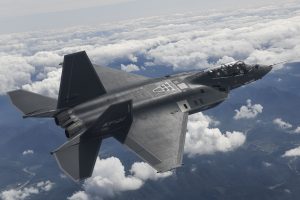
General Atomics YFQ-42A CCA Drone Returns to Flight After Crash — ‘Failing Forward’ US Doctrine

General Atomics’ YFQ-42A — the company’s prototype for the US Air Force’s Collaborative Combat Aircraft (CCA) programme — has resumed flight testing approximately one month after a 6 April 2026 crash in the California desert. Software fixes addressed an autopilot miscalculation that triggered the mishap.
According to Breaking Defense’s 22 May 2026 report, the cause of the crash shortly after takeoff was an autopilot miscalculation involving the aircraft’s weight and centre of gravity. General Atomics implemented software remediation; safety reviews cleared the YFQ-42A to return to the test envelope.
“Failing forward”: the CCA programme’s philosophy
Col. Timothy Helfrich, the Air Force’s Portfolio Acquisition Executive for Fighters and Advanced Aircraft, framed the response in striking terms: “The CCA programme was and is set up to learn, even when the learning comes from ‘failing forward.’ Our response validates our approach to accept acquisition/test risk instead of operational risk, allowing us to accelerate the programme toward fielding.”
The statement signals an Air Force deliberately moving away from the traditional “incident = freeze” reflex on new-class platforms. Because Anduril’s YFQ-44A continued concurrent flight testing during the YFQ-42A’s downtime, the broader CCA programme schedule was not affected.
CCA Increment 1: production decision in Summer 2026
A production decision for CCA Increment 1 is expected in summer 2026. General Atomics and Anduril remain the primary competitors; Northrop Grumman has emerged as a secondary contender with its YFQ-48A prototype. The Air Force’s FY2027 budget request includes $1.4 billion for development and roughly $1 billion for procurement.
Under Increment 2, nine firms received early design contracts in December 2025. The structure cements crewed–uncrewed mixed formations as a central US Air Force doctrine across the operational lives of F-22 and F-35.
Turkish industry perspective
Türkiye has built one of the fastest-moving CCA-parallel ecosystems globally:
- Baykar KIZILELMA (MİUS) — uncrewed combat aircraft designed for mixed formations with KAAN
- TUSAŞ ANKA-3 — blended-wing-body stealth UAV with AESA radar and internal weapons bay
- Baykar AKINCI — HALE combat UAV; the AKINCI-B variant adds true combat capability
- STM TOGAN / KARGU / ALPAGU — tactical loitering and loyal-wingman scale
KIZILELMA is planned with GE F404 (TJ variant) and ultimately TEI TF6000 propulsion to reach supersonic capability. It sits in the same range and mission profile as YFQ-42A — long-range air-to-air and air-to-ground in wide-area combat. The USAF’s “rapid recovery from failure” stance offers a constructive precedent that programme stoppages do not need to follow every accident.
Next steps
The next milestone for YFQ-42A is expanded weapons carriage and data-link integration testing. With a summer 2026 production decision approaching, initial operational squadron structures should follow shortly thereafter.
Sources
- Breaking Defense — “General Atomics CCA drone returns to flight”, 22 May 2026
- US Air Force press releases
- General Atomics ASI — YFQ-42A product page
- Wikipedia — “Collaborative Combat Aircraft” / “Boeing MQ-28 Ghost Bat”
- Baykar — KIZILELMA product page