






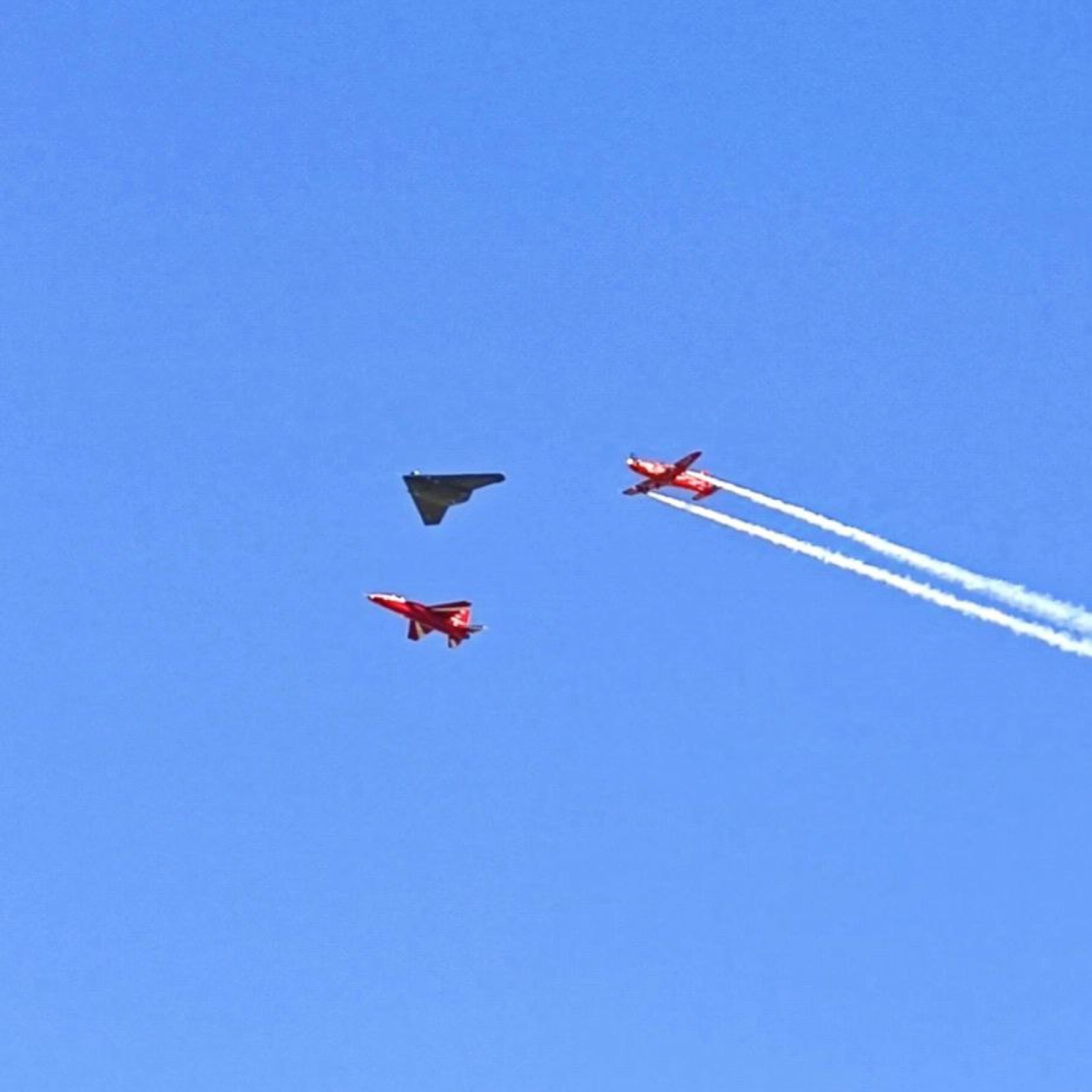
Radar Cross-Section (RCS)
What Is Radar Cross-Section?
Radar Cross-Section (RCS) is a measure of how detectable an object is to radar, expressed as an equivalent area (commonly in square meters) that would reflect the same amount of radar energy back to the receiver as the real object. A lower RCS means the object is harder for a given radar to detect at long range, which is why RCS is central to stealth aircraft and ship design.
How Radar Cross-Section Works
RCS depends on an object’s size, shape, materials and the angle from which it is viewed, so the same aircraft can have very different RCS values depending on whether it is seen from the front, side or below. Designers reduce RCS mainly through shaping (avoiding flat surfaces and sharp corners that reflect radar energy straight back to the transmitter), internal carriage of weapons and fuel instead of external pylons, and radar-absorbent materials (RAM) coatings that convert some radar energy into heat rather than reflecting it. Because RCS varies with aspect angle and radar frequency, published single-number figures for real aircraft are simplifications, and precise values for specific platforms are rarely released by manufacturers or governments. Engineers typically model and measure RCS across many angles and frequencies, producing a full signature pattern rather than a single number, since a design that looks “stealthy” from the front may still be far more visible from the side or from above.
Key Specifications
- Unit: square meters (m²), on a logarithmic scale often expressed in decibels relative to one square meter (dBsm).
- Main reduction techniques: shaped airframe surfaces, internal weapons bays, radar-absorbent coatings, reduced external protrusions.
- Dependence: varies by viewing angle (aspect), radar frequency band, and aircraft configuration (such as open or closed weapons bays).
- Related measure: radar signature, which also accounts for a target’s motion and radar-reflective behavior over time.
Operators and Variants
Low-RCS shaping is a defining feature of fifth-generation fighters such as the U.S. F-22 and F-35, the B-2 and B-21 bombers, Russia’s Su-57, China’s J-20, and Türkiye’s own KAAN, all of which combine faceted or smoothly blended airframes with internal weapons carriage. Exact RCS figures for these aircraft are classified or not independently verified, so public comparisons are generally limited to qualitative design features rather than precise numbers.
History and Development
Radar cross-section became a formal engineering discipline during the Cold War, as radar-guided air defenses made aircraft survivability increasingly dependent on detectability. The U.S. Lockheed Have Blue demonstrator and the resulting F-117 Nighthawk, which first flew in 1981, were the first operational aircraft designed from the outset around minimizing RCS through faceted shaping. Later designs, including the F-22 and F-35, replaced sharp facets with smoothly blended, curved surfaces that are harder to detect across a wider range of angles and radar frequencies.
Frequently Asked Questions
What does RCS stand for?
Radar Cross-Section.
How is RCS measured?
As an equivalent reflecting area, usually in square meters, that would produce the same radar return as the real object.
Does a lower RCS mean an aircraft is invisible to radar?
No. A lower RCS reduces detection range for a given radar but does not make an aircraft undetectable, especially to radars operating at different frequencies or from different angles.
What reduces an aircraft’s RCS?
Shaping that avoids flat surfaces and corners, internal weapons carriage, and radar-absorbent coatings.
Which aircraft are designed around low RCS?
Stealth-focused designs such as the F-22, F-35, B-2, B-21, Su-57, J-20 and KAAN.
Related Glossary Entries
Sources: General radar-engineering and stealth-design references; publicly available design descriptions of stealth aircraft programs. Last reviewed: 20 November 2026.