






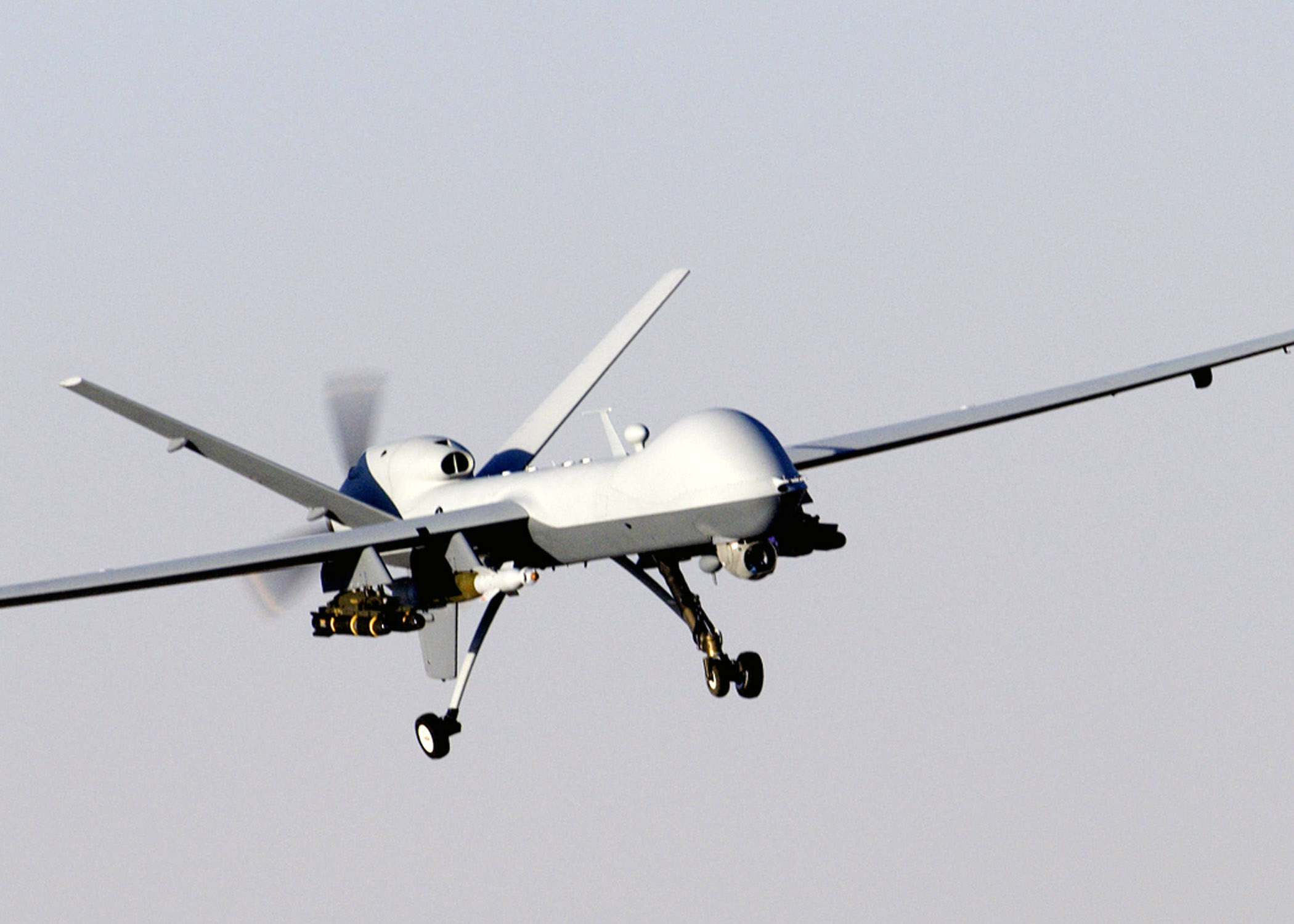
MQ-9 Reaper
The MQ-9 Reaper is a medium-altitude, long-endurance remotely piloted aircraft built by General Atomics Aeronautical Systems, flown by the US Air Force and a growing number of allied air forces. It is a larger, armed successor to the earlier MQ-1 Predator.
A Reaper crew of one pilot and one sensor operator flies the aircraft from a ground control station, using it to watch an area for long periods and then strike a target itself if required, a combination the Air Force describes as a “hunter-killer” role.
Key specifications
- Wingspan: 66 ft (20 m)
- Max takeoff weight: 11,700 lb (5,300 kg)
- Altitude / endurance: operating altitude up to about 50,000 ft; up to roughly 24 hours airborne unarmed, less with a full weapons load
- Payload: up to 3,800 lb (1,700 kg) of sensors and weapons, including AGM-114 Hellfire missiles and GBU-12/GBU-38 guided bombs
How it works / role
The Reaper carries electro-optical/infrared cameras and synthetic aperture radar to find and track targets, then can engage them directly with its own weapons rather than only passing information to another aircraft. Its long endurance lets it loiter over an area for many hours at a time, which is useful for both surveillance missions and for waiting until a time-sensitive target presents itself.
Operators and variants
Besides the US Air Force, the base MQ-9A is also flown by US Customs and Border Protection and used by NASA for research. A newer variant, the MQ-9B SkyGuardian/Protector, is certified for wider use in civil airspace and has been bought by the United Kingdom (as “Protector RG Mk1”), Belgium, Denmark, Italy, France, Spain, Australia, India, Japan and Taiwan, among others.
History and development
The aircraft first flew on 2 February 2001 as the Predator B prototype and entered US Air Force service on 1 May 2007. Since then the program has gradually shifted toward the newer MQ-9B family: the UK received its Military Type Certificate for the Protector in May 2025, and Belgium and Denmark took delivery of their first MQ-9Bs in 2025, reflecting a broader move toward aircraft certified to fly more freely alongside civil air traffic.
That certification matters because older MALE drones like the original Reaper have mostly been restricted to segregated military airspace; an MQ-9B cleared for wider civil-airspace use can be based and flown more like a conventional aircraft, which is part of why several European and Asia-Pacific air forces have chosen it over other options on the market.
For air forces weighing a first armed-drone purchase, the MQ-9 family’s long operational track record is itself a selling point, since it gives a buyer years of documented performance data that a newer, less-proven competitor cannot yet offer.
Frequently Asked Questions
Who makes the MQ-9 Reaper?
General Atomics Aeronautical Systems.
What can the MQ-9 Reaper carry?
Up to 3,800 lb of sensors and weapons, including Hellfire missiles and GBU-series guided bombs.
How long can it stay in the air?
Up to roughly 24 hours unarmed; less with a full weapons load.
Is the Reaper the same as the Predator?
No. It is a larger, faster, armed successor to the MQ-1 Predator.
Which countries besides the US fly it?
Allied operators of the newer MQ-9B variant include the UK, Italy, France, Belgium, Denmark, Australia, India, Japan and Taiwan.
Related Glossary Entries
Sources: U.S. Air Force fact sheets (af.mil); General Atomics Aeronautical Systems official program pages; UK Ministry of Defence and General Atomics delivery announcements. Last reviewed: 18 November 2026.