






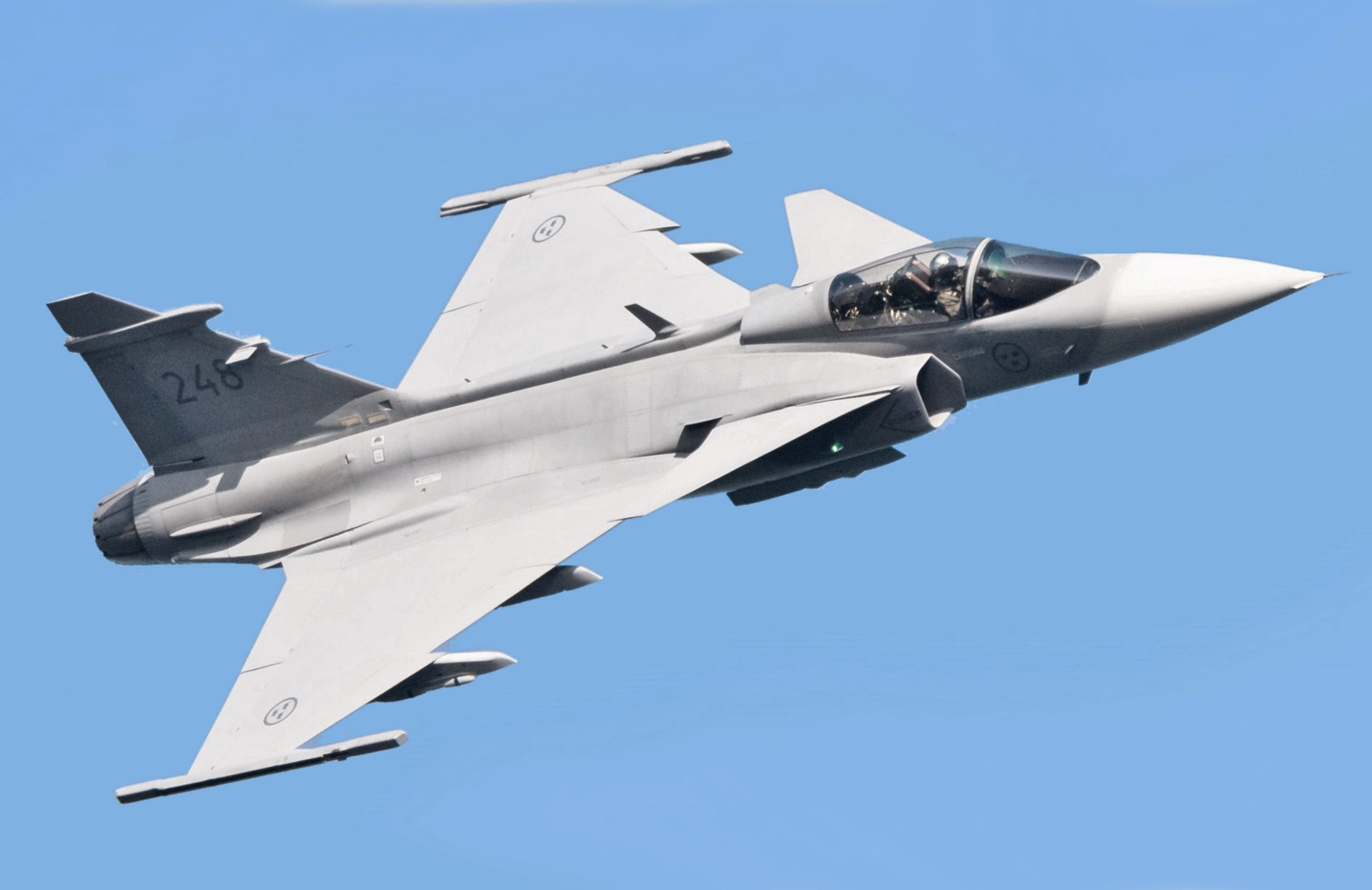
JAS 39 Gripen
What Is the JAS 39 Gripen?
The Gripen is a single-engine, delta-wing multirole fighter built by Sweden’s Saab. Its name, JAS, stands for the Swedish words for fighter, attack and reconnaissance, reflecting the aircraft’s original design goal of combining all three roles in one relatively small, low-cost airframe aimed at a smaller air force like Sweden’s rather than a much larger one.
Key Specifications
| Manufacturer | Saab AB (Sweden) |
| Engine | One GE F404/RM12 (Gripen C/D) or GE F414G (Gripen E/F) |
| Hardpoints | 10 on Gripen E, able to carry up to 7 Meteor beyond-visual-range missiles plus 2 IRIS-T short-range missiles |
| Radar | Raven ES-05 AESA radar on Gripen E/F |
| Turnaround | Saab states an air-to-air mission can be refueled and rearmed in under 15 minutes |
How It Works and Its Role
The Gripen was designed around Sweden’s Cold War-era requirement to keep flying from short, dispersed road strips and small airfields rather than a handful of large, easily targeted air bases, and it can be serviced and re-armed by a small ground crew in that kind of austere setting. The newer Gripen E/F model adds the Raven ES-05 AESA radar, a more powerful F414G engine, extra fuel capacity and additional weapons stations compared with the earlier Gripen C/D, while a 360-degree electronic warfare suite is intended to improve survivability against modern air defenses. Its armament set, including MBDA‘s Meteor missile for beyond-visual-range engagements, is built around NATO-standard weapons rather than Sweden-only systems, which has helped it compete for export sales against larger, more expensive fighters.
Operators and Variants
The Swedish Air Force is the lead operator of both the Gripen C/D and the newer Gripen E, and export customers include the Czech Republic, Hungary and South Africa flying the C/D model. Brazil became a major partner for the Gripen E/F program through a 2014 order for 36 aircraft, with final assembly carried out locally by Embraer in São Paulo, and Brazil announced plans in mid-2026 to order roughly 20 more. Thailand, an existing Gripen C/D operator, selected the Gripen E/F in 2025 to begin replacing its oldest F-16s, while Colombia has become a newer E/F customer and Ukraine has discussed a possible future acquisition, though neither of those deals is fully finalized production for delivery.
History and Development
Saab developed the Gripen from the 1980s as a replacement for Sweden’s earlier Viggen and Draken fighters, with the JAS 39A’s first flight in 1988 and entry into Swedish Air Force service in 1996 (the program suffered a crash of the first prototype in 1989, a setback that led to flight-control software changes). The improved Gripen C/D followed in the late 1990s with NATO-compatible systems that opened the door to export sales, and Saab later launched the larger, more capable Gripen E/F, which first flew in 2017 and entered Swedish service in the following years.
Frequently Asked Questions
What does “Gripen” mean and what does JAS stand for?
Gripen means “griffin” in Swedish; JAS stands for the Swedish words for fighter, attack and reconnaissance, reflecting its multirole design goal.
What radar does the Gripen use?
The newer Gripen E/F carries the Raven ES-05 AESA radar; earlier Gripen C/D aircraft use an older mechanically scanned radar.
Which countries operate the Gripen?
Sweden, the Czech Republic, Hungary, South Africa and Thailand fly the C/D model; Brazil, Thailand and newer customers such as Colombia are adopting the Gripen E/F.
Why was the Gripen designed to operate from road bases?
Sweden built the aircraft to disperse and keep flying from short improvised strips in wartime rather than rely on a small number of vulnerable main air bases.
What missiles can the Gripen E carry?
Saab states it can carry up to 7 MBDA Meteor beyond-visual-range missiles and 2 IRIS-T short-range missiles across its 10 hardpoints.
Related Glossary Entries
Sources: Saab official Gripen E program materials; open-source reporting on Gripen export programs. Last reviewed: 17 November 2026.