






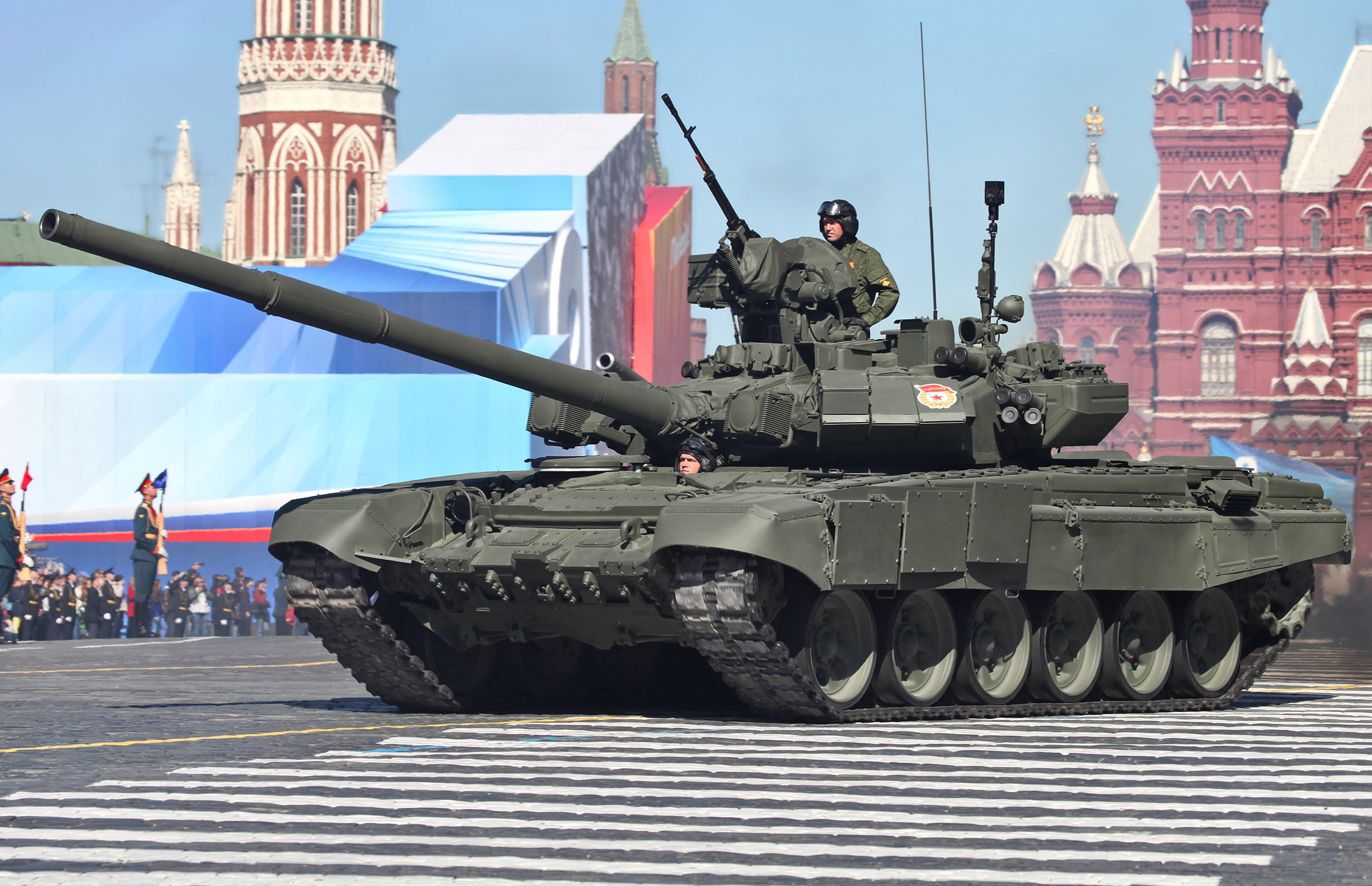
T-90 Main Battle Tank
The T-90 is a Russian third-generation main battle tank, designed and built by Uralvagonzavod as a modernization of the earlier T-72B. It is operated primarily by Russia and, through license production, by India, which is its largest foreign user and the main reason the design has stayed in large-scale production for so long.
Like other modern main battle tanks, the T-90 combines a large-caliber smoothbore gun, composite and reactive armor, and a crew of three, with an autoloader that removes the need for a dedicated loader found on most Western tanks. That smaller crew and lower silhouette, common to Soviet-lineage tank designs, trade some crew redundancy and visibility for a lighter and generally cheaper vehicle to produce at scale.
Key specifications
- Crew: 3
- Main gun: 125mm 2A46M smoothbore cannon with autoloader, able to fire the 9M119 Refleks guided projectile
- Weight / speed: reported around 46.5 tonnes (base model, varies by sub-variant) and a road speed of up to 60 km/h
- Armor: Kontakt-5 explosive reactive armor on the base T-90; the later T-90M “Proryv” uses Relikt reactive armor and an improved fire-control system
How it works / role
As a main battle tank, the T-90 is intended to provide armored, mobile direct-fire support for mechanized forces, able to engage other armored vehicles, fortified positions and infantry while under its own armor protection. Its gun-launched guided projectile gives it an anti-tank missile capability out to several kilometres, in addition to standard tank ammunition. Newer T-90M variants have been reported moving toward active protection systems, such as the Arena-M system, though as of the most recent public reporting these were still in qualification testing rather than fully fielded fleet-wide.
Operators and variants
Besides the base T-90, variants include the T-90A (in service from 2004) and the modernized T-90M “Proryv.” India is the largest foreign operator, building the tank locally as the T-90S/SK “Bhishma” under long-running contracts with Russia dating back to 2006, with later agreements adding further vehicles into the late 2020s. Export T-90S models have also been reported in service with Algeria and a small number of other states, per general international arms-transfer reporting.
History and development
The T-90 entered Russian service in 1992–1993. It has seen combat in Chechnya, in Syria, and in the Russia-Ukraine war since 2022, where the upgraded T-90M has been the most prominent variant in Russian use.
Its long production run and large-scale Indian license manufacturing mean the T-90 family remains in production and active service more than three decades after its initial fielding, which is unusually long for a tank design of its generation.
That longevity, combined with ongoing upgrades like the T-90M, is also why the design continues to appear in comparisons against Western tanks such as the Leopard 2 and M1 Abrams whenever analysts assess the current state of armored warfare.
Frequently Asked Questions
Who makes the T-90?
Uralvagonzavod, in Russia.
What gun does the T-90 carry?
A 125mm 2A46M smoothbore cannon with an autoloader.
Who is the largest foreign operator of the T-90?
India, which license-builds it domestically as the T-90S/SK ‘Bhishma’.
What protects the T-90 from anti-tank weapons?
Kontakt-5 explosive reactive armor on the base model, and Relikt reactive armor on the newer T-90M; an active protection system has been reported in testing.
When did the T-90 enter service?
In 1992–1993, with the Russian Army.
Related Glossary Entries
Sources: FAS.org DOD 101 reference page; Military Balance-style open-source reporting via army-technology.com; publicly reported India-Russia T-90S license-production contracts. Last reviewed: 18 November 2026.