ASELSAN’s DRONEDEF Clears Three-Scenario Test and Makes International Debut at Eurosatory
It was not a single test that cleared ASELSAN’s DRONEDEF for international debut — it was three, each designed to probe a different dimension of the threat that unmanned aerial systems now pose to ground forces. At the Gölbaşı Test and Evaluation Center, the system was put through a single-target engagement, a coordinated swarm attack, and an electronically degraded operating environment. It passed all three. ASELSAN brought the system to Eurosatory 2026 in Paris not as a concept demonstration but as a production-ready capability.
Architecture: Four Layers, One Kill Chain
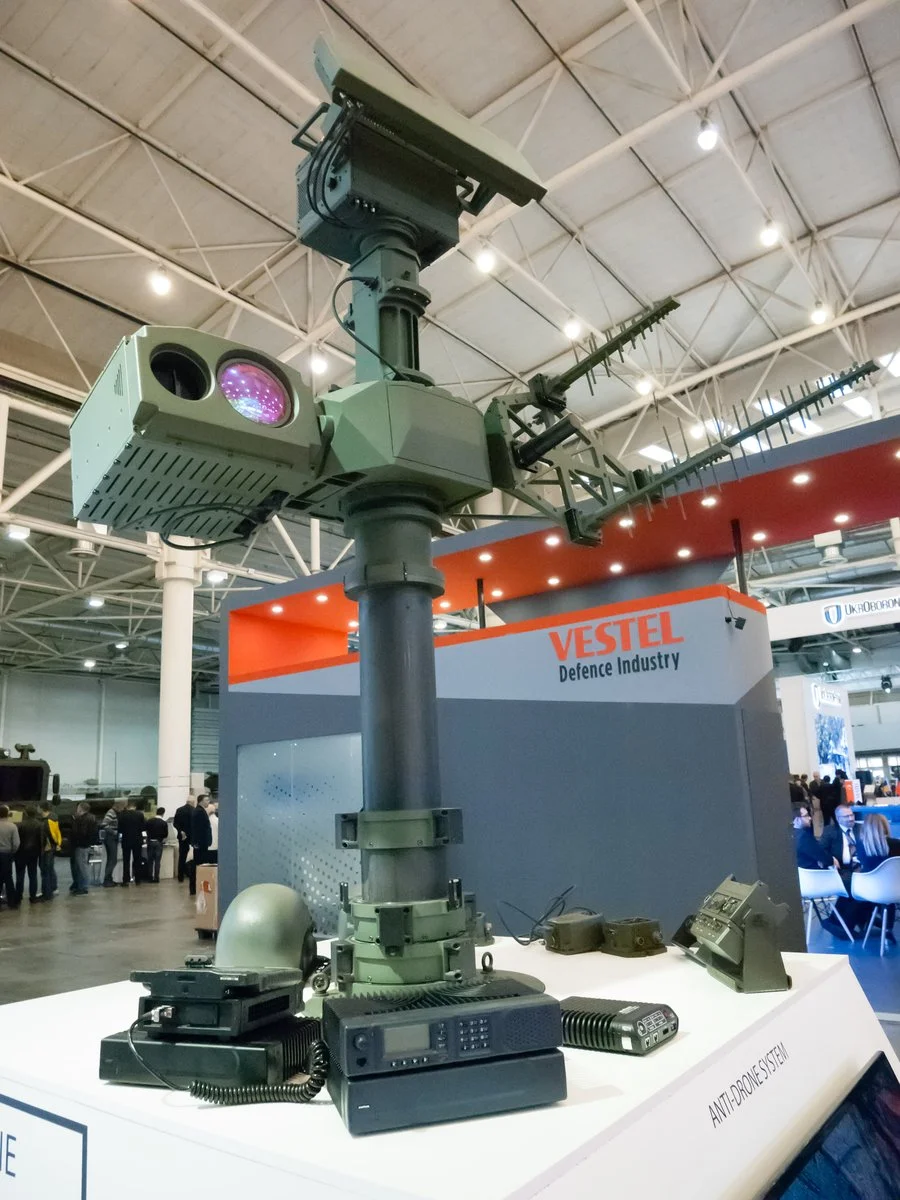
DRONEDEF integrates four distinct capabilities into a unified command-and-control architecture. The IHTAR radar handles detection and classification of mini and micro UAVs. An electronic warfare module severs command links or disrupts GPS navigation. A laser effector provides a silent, magazine-unlimited engagement option. The SARP stabilized remote weapon station serves as the final kinetic layer for targets that survive earlier engagement options.
| Component | Role | Target Class |
|---|---|---|
| IHTAR Radar | Detection and classification | Mini / micro UAVs |
| EW Jammer | Command link disruption / GPS spoofing | RF-controlled and GNSS-guided UAVs |
| Laser Effector | Directed-energy kill | Mini / micro UAVs |
| SARP Kinetic Gun | Kinetic intercept (backup) | Mini UAVs / difficult geometries |
Export Positioning
ASELSAN’s export targeting for DRONEDEF focuses on the Middle East, Gulf Cooperation Council states, and Central Asia — regions that face drone threats from non-state actors or regional rivals and operate at distances from tier-one defense industrial nations that make Western system conditionality a real constraint. The Eurosatory debut gives procurement delegations direct access to the Gölbaşı test results in a competitive context.