


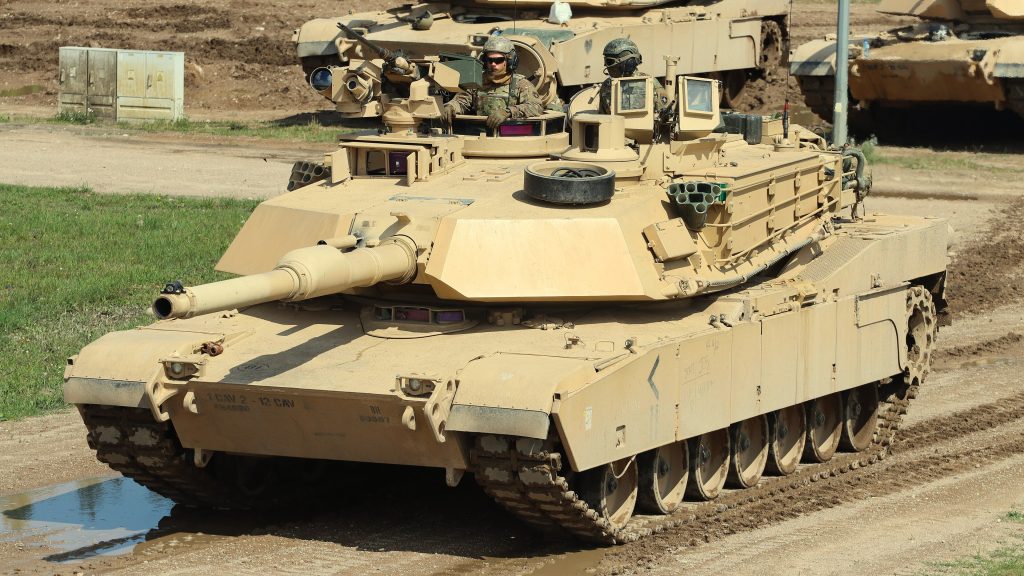
The M1 Abrams is the third-generation main battle tank (MBT) of the United States Army and Marine Corps and the only Western tank in service powered by a gas-turbine engine. Designed in the 1970s by Chrysler Defense (today General Dynamics Land Systems), the Abrams entered service in 1980 and has been continuously upgraded through more than four decades of combat in Iraq, Saudi Arabia, Yemen and now Ukraine. With over 10,000 tanks produced across all variants and active service in nine armies, the M1 remains the global benchmark for Western armored warfare.


Key facts at a glance
| Attribute | Value |
|---|---|
| Type | Third-generation main battle tank |
| Origin | United States |
| Manufacturer | General Dynamics Land Systems (Lima Army Tank Plant) |
| In service | 1980 — present |
| Crew | 4 (commander, gunner, loader, driver) |
| Combat weight | 54 t (M1) — 73 t (M1A2 SEPv3) |
| Length | 9.77 m (gun forward) |
| Main armament | 105 mm M68 rifled (M1/M1IP); 120 mm M256 smoothbore (M1A1 onward) |
| Engine | Honeywell AGT1500 gas turbine, 1,500 hp |
| Transmission | Allison X-1100-3B (hydrokinetic) |
| Power-to-weight | 20.5 hp/t (M1A2 SEPv3) |
| Max speed | 67 km/h (road); 48 km/h (cross-country) |
| Operational range | 426 km (fuel limited) |
| Operators | United States, Egypt, Saudi Arabia, Kuwait, Iraq, Australia, Poland, Morocco, Ukraine, Taiwan (delivery) |
| Unit cost (M1A2 SEPv3) | ~ USD 9–12 million |
The MBT-70 lesson and the road to XM1
The Abrams’ origin mirrors the Leopard 2’s: both were born from the wreckage of the Cold War MBT-70 program, the unrealistic 1960s U.S.-German effort to develop a single common tank. After MBT-70’s cancellation in 1971, the U.S. Army launched its XM1 program in 1972. Chrysler Defense and General Motors built competing prototypes; the Chrysler design — featuring the AGT1500 gas turbine, Chobham composite armor licensed from the United Kingdom, and a four-man crew — was selected on 12 November 1976. Production began at Lima, Ohio in 1979 and the M1 entered service with the 1st Armored Division at Fort Hood in February 1981. The tank was named after General Creighton W. Abrams, Vietnam War commander and former Chief of Staff of the Army.
Variants
| Variant | Year | Key change |
|---|---|---|
| M1 | 1980 | Initial production; 105 mm M68 rifled gun |
| M1IP (Improved Performance) | 1984 | Heavier turret armor, improved ammunition storage |
| M1A1 | 1986 | 120 mm M256 smoothbore, NBC overpressure system |
| M1A1 HA (Heavy Armor) | 1988 | Depleted uranium (DU) mesh inserts in turret armor |
| M1A2 | 1992 | Commander’s Independent Thermal Viewer (CITV), digital fire control |
| M1A2 SEPv1 | 1999 | System Enhancement Package; gen-2 thermal sights |
| M1A2 SEPv2 | 2008 | Color displays, FBCB2 datalink, improved auxiliary power |
| M1A2 SEPv3 (M1A2C) | 2017 | Trophy APS, ammunition data link, AC unit, IVAS connectivity |
| M1A2 SEPv4 (M1A2D, cancelled) | — | Originally planned with new thermal sights; replaced by M1E3 |
| M1E3 / AbramsX | 2025+ | Hybrid-electric drive, unmanned turret concept, 30% lighter |

The gas-turbine question
The Abrams’ most distinctive design choice is the Honeywell AGT1500 gas turbine engine — a 1,500 hp multi-fuel powerplant that gives the tank its remarkable acceleration and acoustic signature. Critics have spent forty years arguing that a 1,500 hp diesel would deliver similar performance at half the fuel burn; defenders point out that the AGT1500 has been almost faultlessly reliable in combat from Desert Storm onward, and that its acceleration in the desert dash from Kuwait to Baghdad has never been matched by a diesel MBT. The M1E3 next-generation Abrams will replace it with a hybrid-electric powertrain to address the fuel-economy criticism while preserving the AGT1500’s burst-power advantage.
Firepower
From the M1A1 onward, the Abrams has carried the Rheinmetall-derived M256 120 mm smoothbore, identical in caliber and ballistics to the Leopard 2’s gun. The standard kinetic round is the M829A4, a long-rod depleted-uranium APFSDS that defeats reactive armor and penetrates the equivalent of 700 mm RHA at 2 km. The newer M829E5 is in low-rate production, with improved penetration against modern Russian Relikt ERA. For soft targets, the Abrams now carries the multipurpose M1147 AMP with selectable airburst, delay and point-detonation modes — replacing four separate older rounds (HEAT, MPAT, OR, OR-T).
Protection
The Abrams’ Chobham composite armor — known officially as “Burlington” in U.S. service — has been progressively augmented with depleted-uranium mesh in the turret front and now with the Israeli Trophy hard-kill APS on the SEPv3 standard. Side armor remains the platform’s most-criticized weakness: the Abrams’ frontal arc is exceptional, but flanks above the side skirts are still vulnerable to modern tandem-warhead ATGMs and top-attack drones. The M1E3 program intends to address this with active-armor sensors and integrated jamming.
Combat record
- 1991 — Operation Desert Storm. First combat. Abrams destroyed an estimated 2,000 Iraqi tanks (mostly T-72M and T-62) with zero Abrams crew losses to enemy tank fire. The U.S. lost nine Abrams: three to friendly fire, six to mine and IED damage.
- 2003 — Operation Iraqi Freedom. The “Thunder Run” into Baghdad was led by M1A1 columns. Two Abrams were destroyed by friendly fire and several more by IEDs; only one was confirmed lost to enemy direct fire (a T-72 round penetrating the engine deck).
- 2004–2011 — Iraq counterinsurgency. Over 80 Abrams were damaged or destroyed by IEDs, EFPs (explosively formed penetrators) and ATGM hits — far more than any conventional tank battle.
- 2014–2017 — Iraq war against Islamic State. Iraqi Army Abrams suffered heavy losses, partly due to crew abandonment and partly to advanced Kornet-EM ATGMs.
- 2015–present — Yemen. Saudi Arabian and UAE Abrams have been destroyed by Houthi-fired Kornet ATGMs and IEDs.
- 2023–present — Ukraine. Thirty-one M1A1 SA tanks transferred by the U.S. in late 2023 saw combat with the 47th Mechanized Brigade. Eight or more have been confirmed destroyed by FPV drones, ATGMs and artillery. Ukrainian crews praise the gunnery and thermal sights but criticize the fuel demand.
Operators
| Operator | Variant | Quantity |
|---|---|---|
| United States | M1A2 SEPv2/v3 | ~2,500 active + ~3,700 reserve |
| Egypt | M1A1 (local production) | 1,360 |
| Saudi Arabia | M1A2 / M1A2S | 442 |
| Kuwait | M1A2K | 218 |
| Iraq | M1A1M | 140 (delivered; combat losses) |
| Australia | M1A2 SEPv3 | 75 (replacing M1A1) |
| Poland | M1A2 SEPv3 | 250 (largest non-U.S. order) |
| Morocco | M1A1 SA | 222 |
| Ukraine | M1A1 SA | 31 (transferred 2023) |
| Taiwan | M1A2T | 108 (delivery 2024–2026) |
Abrams vs. its rivals
| M1A2 SEPv3 | Leopard 2A8 | K2 Black Panther | T-90M Proryv-3 | |
|---|---|---|---|---|
| Combat weight | 73 t | 66.5 t | 55 t | 48 t |
| Main gun | 120 mm M256 | 120 mm L/55A1 | 120 mm L/55 | 125 mm 2A46M-5 |
| Engine | 1,500 hp gas turbine | 1,500 hp diesel | 1,500 hp diesel | 1,130 hp diesel |
| APS | Trophy | Trophy | KAPS hard-kill | Arena-M (limited fielding) |
| Crew | 4 | 4 | 3 (autoloader) | 3 (autoloader) |
| Combat-proven | Gulf, Iraq, Ukraine | Afghanistan, Syria, Ukraine | No | Ukraine |
The future: M1E3 / AbramsX
In September 2023 the U.S. Army cancelled the long-planned M1A2 SEPv4 (M1A2D) upgrade and announced a more ambitious successor, the M1E3. The new tank — being designed jointly by General Dynamics Land Systems and an Army-led integration team — incorporates concepts from GDLS’s AbramsX technology demonstrator: hybrid-electric drive, an unmanned three-man crew cell, a smaller turret with autoloader, and an enlarged sensor suite for drone and ATGM threats. Target combat weight is roughly 55 tonnes — back to the M1A1 era. First M1E3 prototypes are expected in 2030 with operational fielding from the mid-2030s.
Why the Abrams matters
The Abrams turned the Cold War armored debate on its head in 1991 by demonstrating that a Western tank could destroy thousands of Soviet-pattern tanks without losing one crewman to enemy tank fire. Forty-five years later, the platform remains in continuous combat — now under FPV drones and modern ATGMs that were never imagined in 1980. Its evolution into the M1E3 will determine whether the United States can stay competitive against the new generation of Chinese, Russian and Korean MBTs that are entering service through the 2030s.