


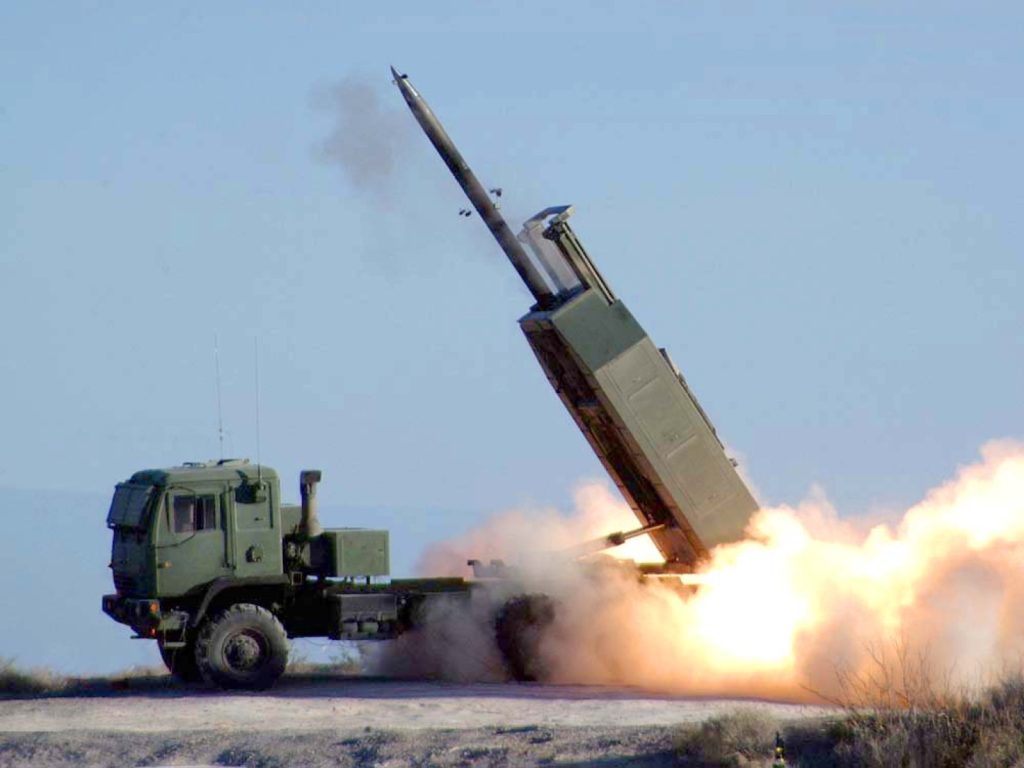
The M142 HIMARS — High Mobility Artillery Rocket System — is a 5-ton, wheeled multiple-launch rocket system manufactured by Lockheed Martin Missiles and Fire Control. Carrying a single six-round pod of GMLRS guided rockets or one ATACMS ballistic missile, HIMARS combines the firepower of the larger tracked M270 MLRS with the C-130-deployable mobility of a 6×6 truck. Since Ukraine received its first HIMARS in June 2022, the system has destroyed an estimated 2,000+ Russian targets — ammunition depots, command posts, air-defense radars and bridges — and become the single most photographed Western weapon of the war.


Key facts at a glance
| Attribute | Value |
|---|---|
| Type | Wheeled multiple-launch rocket system |
| Origin | United States |
| Manufacturer | Lockheed Martin (system); BAE Systems (FMTV chassis) |
| In service | 2010 — present |
| Chassis | FMTV 6×6, 5-ton |
| Combat weight | 16.2 t (loaded) |
| Crew | 3 |
| Munitions | 1 pod = 6 GMLRS / 6 ER-GMLRS / 1 ATACMS / 1 PrSM |
| Max range (GMLRS) | 90 km |
| Max range (ER-GMLRS) | 150 km |
| Max range (ATACMS) | 300 km |
| Max range (PrSM Inc-1) | 500+ km |
| Reload time | 5 minutes |
| Air-deployable | Yes — fits inside a C-130 Hercules |
| Operators | U.S., Singapore, UAE, Jordan, Romania, Poland, Estonia, Latvia, Lithuania, Italy, Australia, Ukraine, Taiwan, Morocco, Netherlands |
| Unit cost | ~ USD 5.6 million (launcher); USD 168,000 per GMLRS rocket |
Origins: half the truck, all the firepower
The U.S. Army’s tracked M270 MLRS entered service in 1983 with twelve rockets per launcher. Effective but heavy (24 tonnes) and limited to C-17 strategic airlift, the M270 could not deploy with the airborne or expeditionary forces the Army was reorganizing around in the late 1990s. Lockheed Martin’s HIMARS concept — a single six-round pod on a 5-ton FMTV — was selected in 1996, first fielded in 2010 with the 18th Field Artillery Brigade, and saw initial combat in 2011 in Afghanistan, where its precision guided rockets were used to strike Taliban command nodes.
Munitions: the family that makes the launcher
HIMARS is a delivery system; the firepower lives in the pods. Six current munitions are integrated:
| Munition | Type | Range | Warhead |
|---|---|---|---|
| GMLRS M30/M31 | 227 mm guided rocket | 15–90 km | Unitary 90 kg HE |
| GMLRS M30A1/A2 | 227 mm AW (alternative warhead) | 15–90 km | 180,000 tungsten fragments |
| ER-GMLRS | 227 mm extended-range rocket | 150 km | Unitary or AW |
| ATACMS (MGM-140) | 610 mm tactical ballistic missile | 300 km | Unitary 230 kg HE |
| PrSM (Precision Strike Missile) | 430 mm tactical ballistic missile | 500+ km | Unitary; multi-mode seeker in Inc-2 |
| Naval Strike Missile (planned) | Subsonic anti-ship cruise missile | 250 km | 120 kg HE |
The signature munition is the GMLRS: a one-meter-CEP guided rocket that has effectively replaced unguided MLRS rockets across NATO. A standard HIMARS salvo of six GMLRS delivers 540 kg of precision HE on six separate target coordinates within 90 seconds.
The Ukraine effect
Ukraine received its first four HIMARS in late June 2022. Within weeks, GMLRS strikes shattered the Russian operational logistics network west of the Dnipro: dozens of ammunition depots and bridges across the Kherson and Zaporizhzhia oblasts were destroyed. The Russian withdrawal from west-bank Kherson in November 2022 is widely credited to the HIMARS-led interdiction campaign.
Subsequent shipments and the late-2023 introduction of ATACMS extended the reach into Crimea: in October 2023, two strikes destroyed nine Russian helicopters at Berdyansk and Luhansk in a single night. By 2025 Ukraine fielded an estimated 40+ HIMARS launchers; total munitions deliveries surpassed 15,000 GMLRS rounds and roughly 500 ATACMS.
Doctrine: shoot, scoot, survive
HIMARS is built around shoot-and-scoot doctrine. From the time the launcher unmasks to the time it begins moving again is typically 30 seconds. The Lockheed Martin fire-control software, integrated with U.S. AFATDS battle-management, allows immediate digital firing commands from forward observers. A Ukrainian HIMARS crew can receive a target, fire six GMLRS, drive 5 km to a new firing position, reload from a covered M1148 carrier, and be ready to fire again — all within 15 minutes.
Operators
| Region | Operators |
|---|---|
| North America | United States Army & Marine Corps (~540 launchers) |
| Europe | Romania, Poland, Estonia, Latvia, Lithuania, Italy, Netherlands, Germany (pending) |
| Middle East | UAE, Jordan, Bahrain (pending) |
| Africa | Morocco |
| Asia-Pacific | Singapore, Australia, Taiwan |
| Ukraine | 40+ launchers (2025) |
Poland’s 2023 order of 486 launchers (Homar-A) — combined with Korean K239 Chunmoo systems — is the largest single rocket-artillery acquisition outside of the United States since the Cold War.
HIMARS vs. its peers
| M142 HIMARS | M270A2 MLRS | K239 Chunmoo | BM-30 Smerch | |
|---|---|---|---|---|
| Chassis | 5-ton 6×6 truck | Tracked | 8×8 truck | 8×8 truck |
| Rockets per launcher | 6 | 12 | 20 (227 mm) / 8 (CTM-290) | 12 |
| Max range | 500 km (PrSM) | 500 km (PrSM) | 290 km (CTM-290) | 90 km (unguided) |
| Air-deployable | Yes (C-130) | No (C-17 required) | No | No |
| Combat use | Afghanistan, Ukraine, Syria | Iraq, Ukraine | UAE, Saudi Arabia | Russia, Syria, Iraq |
Limitations
- Single pod. Six rockets is less than the M270’s twelve; reload becomes critical in sustained engagement.
- Russia adapted. Russian EW (Pole-21, Tirada-2) now jams the GPS receivers in GMLRS, reducing precision; ATACMS uses INS-only guidance and is less affected.
- Visible signature. The launch plume and thermal signature are large; surviving crews depend on quick repositioning.
- Cost per round. GMLRS at USD 168,000 and ATACMS at USD 1.5 million are precision premiums that mass-fire doctrine cannot easily sustain.
The future: PrSM Inc-2 and onward
The Precision Strike Missile PrSM Inc-1 (500 km) reached early operational capability with the U.S. Army in December 2023. PrSM Inc-2 adds a multi-mode anti-ship/anti-radar seeker for maritime targeting from HIMARS; first round delivery is planned for 2026. PrSM Inc-4 will push range past 1,000 km if Congress lifts the legacy INF range cap (the U.S. is no longer party to the treaty after 2019). Lockheed Martin is meanwhile increasing GMLRS production from 9,000 to 14,000 rounds per year by 2026 to cover Ukraine consumption and rebuild U.S. stocks.
Why HIMARS matters
HIMARS proved that precision long-range rocket fire — once a strategic-level capability — could be delivered by a single five-ton truck and crewed by three soldiers. It rewrote the economics of operational fires, gave middle-power armies a way to compete with much larger conventional forces, and became, in Ukraine, the most photographed and most decisive Western weapon of the 21st century’s largest conventional war. Two decades after its first deployment, HIMARS remains the gold standard for wheeled rocket artillery — and the only Western system on which all four U.S. Army artillery missions (rockets, ballistic missiles, anti-ship, suppression) now converge.