


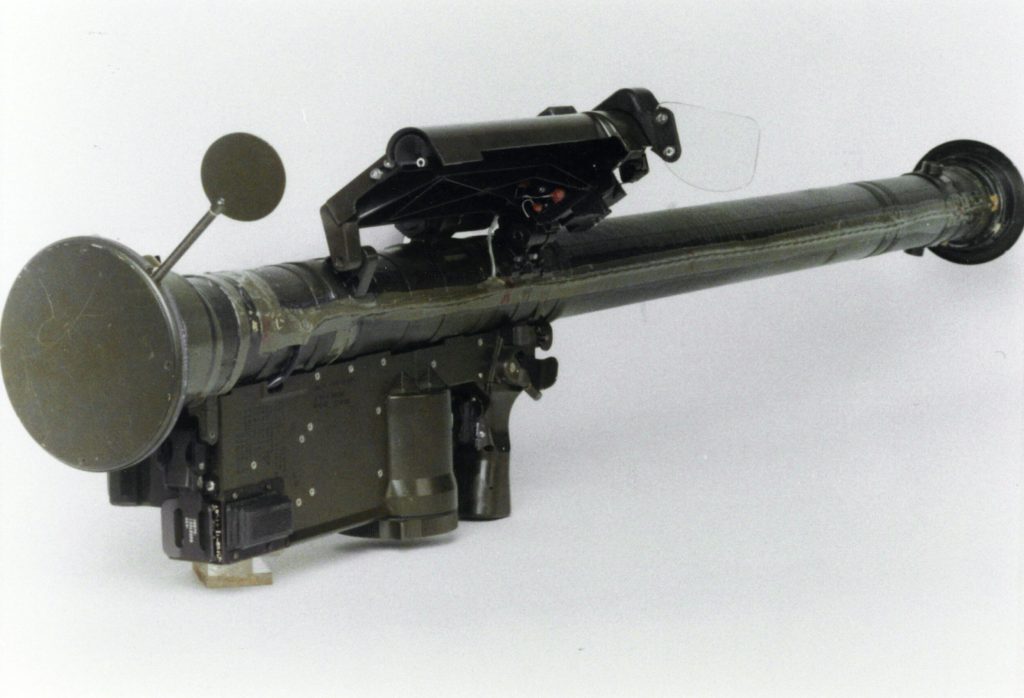
The FIM-92 Stinger is the U.S. man-portable air defense system (MANPADS) that has defined low-altitude tactical air defense for forty years. Manufactured by Raytheon (RTX) since 1981, the Stinger is a shoulder-launched, infrared-homing, fire-and-forget surface-to-air missile carried by infantry teams, vehicle-mounted launchers, helicopters and even small drones. From Soviet helicopters falling over Panjshir in the 1980s to Russian Ka-52s burning over Donbas in the 2020s, the Stinger has become the most-mythologized small SAM in modern history — and its renewed mass production in 2023–2026 marks one of the most aggressive industrial-base resurgences of the post-Cold-War era.


Key facts at a glance
| Attribute | Value |
|---|---|
| Type | Man-portable infrared-homing surface-to-air missile |
| Origin | United States |
| Manufacturer | Raytheon (RTX); license-built in Germany (Diehl/EuroStinger) |
| In service | 1981 — present |
| Length | 1.52 m |
| Diameter | 70 mm |
| Combat weight | 15.2 kg (system with grip stock + IFF + BCU) |
| Missile weight | 10.1 kg |
| Maximum range | 4,800 m (FIM-92F+) |
| Maximum altitude | 3,800 m |
| Maximum speed | Mach 2.2 |
| Guidance | Passive IR + UV (dual-color seeker since FIM-92C/POST) |
| Warhead | 3 kg high-explosive fragmentation |
| Fuse | Impact + delay |
| Operators | 30+ countries; license production in Germany |
| Unit cost | ~ USD 480,000 per round (2024) |
Origins: the Redeye successor
The Stinger program began at General Dynamics Pomona Division (later acquired by Raytheon) in 1972 as the FIM-92 follow-on to the troubled FIM-43 Redeye. Redeye, the first U.S. MANPADS, suffered from a narrow tail-chase-only attack envelope and was easily defeated by flares. The Stinger introduced two breakthrough technologies:
- All-aspect IR seeker. A nitrogen-cooled indium-antimonide detector that could lock onto an aircraft from front, side or rear — not just the hot tailpipe.
- Proportional navigation guidance. Eliminated the “lead-the-target” firing problem of Redeye; the missile computed its own intercept.
First test flights took place in 1973; series production began in 1978; the U.S. Army accepted Stinger for service in 1981.
The Afghanistan moment
The Stinger’s most-told story begins on 25 September 1986, when CIA-supplied mujahideen teams led by Ghaffar (a commander of Jalaluddin Haqqani’s faction) shot down three Soviet Mi-24 Hind helicopters near Jalalabad airport. The CIA’s Operation Cyclone supplied roughly 2,300 Stingers to Afghan resistance groups; subsequent assessments credit Stinger with destroying over 250 Soviet aircraft, mostly Mi-8 and Mi-24 helicopters and Su-25 attack aircraft. The Soviet inability to dominate low-altitude airspace was a major contributor to the December 1988 withdrawal decision. The CIA later spent years trying to recover unused rounds from the region — a project that continued through the 2010s and that, by some accounts, was never fully completed.
Variants
| Variant | Year | Key change |
|---|---|---|
| FIM-92A | 1981 | Initial production; IR only |
| FIM-92B (POST) | 1983 | Passive Optical Seeker Technique — dual-color IR/UV seeker, much harder to defeat with flares |
| FIM-92C | 1987 | Reprogrammable microprocessor allowing rapid IR-counter-countermeasure updates |
| FIM-92D | 1991 | Increased IRCCM (IR Counter-Counter-Measures) |
| FIM-92E (RMP Block I) | 1995 | Improved against UAVs and cruise missiles |
| FIM-92F | 2001 | Further IRCCM upgrade |
| FIM-92G/H/I | 2005–2010 | Vehicle-mounted variants for Avenger, helicopter-launched (ATAS) |
| FIM-92J (Block II) | 2018 | New imaging IR seeker, target-discrimination logic; range 6 km+ |
| NGSRI (Next-Gen Short-Range Interceptor) | 2027+ | Stinger replacement — open competition won by RTX in 2023 |
Combat record
- 1982 — Falklands War. British SAS teams scored at least one confirmed kill of an Argentine Pucara light-attack aircraft.
- 1986–1989 — Afghanistan. 250+ Soviet aircraft destroyed by mujahideen Stinger teams.
- 1989–1990 — Chad/Libya war. Chadian forces using French- and U.S.-supplied Stingers downed Libyan Su-22s.
- 1991 — Gulf War. U.S. Marine Stinger teams shot down at least one Iraqi Mi-25 Hind during the Battle of Khafji.
- 2008 — Russo-Georgian war. Georgian forces downed several Russian Su-25s with French-supplied Mistrals and reportedly with some surviving Afghan-era Stingers.
- 2014–2023 — Syria. Reported but unverified Stinger use by anti-Assad factions; the U.S. resisted supplying additional Stingers due to concerns about post-war recovery.
- 2022–present — Ukraine. 2,000+ Stingers transferred. Verified kills include Russian Ka-52, Mi-28N, Su-25 and Orlan-10 UAVs. Stingers (combined with British Starstreak, Polish Piorun and Russian-pattern Igla-S) are credited with breaking Russian rotary-wing air dominance in the early-war phase.
How Stinger works
A Stinger team typically operates two-person: gunner and team chief. The firing sequence is straightforward:
- Battery Coolant Unit (BCU) is screwed into the grip stock — provides 30 seconds of seeker cooling and 45 seconds of electrical power.
- The IFF (Identification Friend-or-Foe) antenna is unfolded; the gunner interrogates the inbound target.
- The gunner tracks the target through the open sight; the seeker provides an audible tone confirming lock.
- The gunner depresses the trigger; the missile is ejected by a small launch motor before the main rocket ignites at safe distance.
- The missile uses passive IR + UV homing and proportional navigation to close. Flight time at maximum range is approximately 12 seconds.
The shooter does not need to track or guide after launch — the “fire-and-forget” principle that made Stinger so revolutionary in 1981.
Operators
| Region | Operators (selection) |
|---|---|
| North America | United States, Canada |
| Europe | Germany (license), Italy, Greece, Netherlands, Poland, Czech Republic, Lithuania, Latvia, Estonia, Finland, Sweden, UK, Ukraine |
| Middle East | Israel, Saudi Arabia, Jordan, Bahrain, Kuwait, Qatar, UAE |
| Asia-Pacific | Japan, South Korea, Taiwan, Australia, India, Pakistan |
| Africa | Egypt, Morocco |
| Latin America | Chile, Colombia |
Stinger vs. its peers
| FIM-92J Stinger | Mistral 3 (MBDA) | Starstreak (Thales) | Igla-S (Russia) | |
|---|---|---|---|---|
| Origin | USA | France | UK | Russia |
| Guidance | IR/UV imaging | Imaging IR | Laser-beam riding (3 darts) | IR/UV dual-color |
| Range | 4,800–6,000 m | 7,000 m | 7,000 m | 6,000 m |
| Speed | Mach 2.2 | Mach 2.6 | Mach 3.5 | Mach 2.3 |
| Weight (system) | 15.2 kg | 20 kg (tripod) | 20 kg (tripod) | 18 kg |
| Combat record | Afghanistan, Ukraine | Yugoslavia, Chad, Ukraine | Ukraine | Many conflicts |
The production resurgence
By 2018 Stinger production had nearly stopped — only Foreign Military Sales kept Raytheon’s Tucson line warm. The Ukraine war reversed that: in 2022 the U.S. drew down ~1,400 Stingers from operational stocks, faster than Raytheon could replace them. Subsequent appropriations expanded the production line:
- FY2022 supplemental funding: USD 600 million for 1,468 rounds.
- FY2023: contract for 1,700 more rounds.
- FY2024: USD 700 million expansion of Tucson assembly.
- By 2026, Raytheon expects to produce 2,000 Stingers per year, the highest annual rate in the program’s history.
The U.S. Army has also funded the Next-Generation Short-Range Interceptor (NGSRI) program to replace Stinger; Raytheon won the development contract in 2023, with first deliveries targeted for 2027.
Limitations
- Short range. 4.8 km is limited against modern stand-off rockets and helicopters firing ATGMs at 8 km+.
- Visual target tracking. The gunner needs eyes-on; effective night use requires the optional AN/PAS-13G thermal sight.
- Flare susceptibility. Despite IRCCM upgrades, modern decoys (MAW-cued, kinematic flares) can still defeat older variants.
- Cost. USD 480,000 per round is high for engaging low-cost drones and quadcopters.
Why the Stinger matters
The Stinger redefined the rules of air dominance. After 1981, no helicopter or low-altitude attack aircraft could operate over contested ground without considering MANPADS. Soviet helicopters fell over Afghan valleys; Russian Ka-52s and Mi-28s have fallen over Ukrainian forests. The program’s industrial revival in 2023–2026 — driven by Ukraine — has assured that Stinger or its NGSRI successor will keep shaping ground-based air defense for another two decades.