


The Cold War left America with exactly one stealth bomber — the B-2 Spirit — and only 19 of them, each carrying a multi-billion-dollar price tag and decades on the airframe. Its replacement is the B-21 Raider, Northrop Grumman’s sixth-generation stealth bomber. The U.S. Air Force plans for at least 100 of them, the production line was accelerated 25% in 2025 under a USD 4.5 billion contract, and the first operational base is on schedule for 2027. This explainer covers what the B-21 actually is, what it does, what it costs, and why Türkiye chose a fundamentally different way to project long-range firepower.
What Is the B-21 Raider?
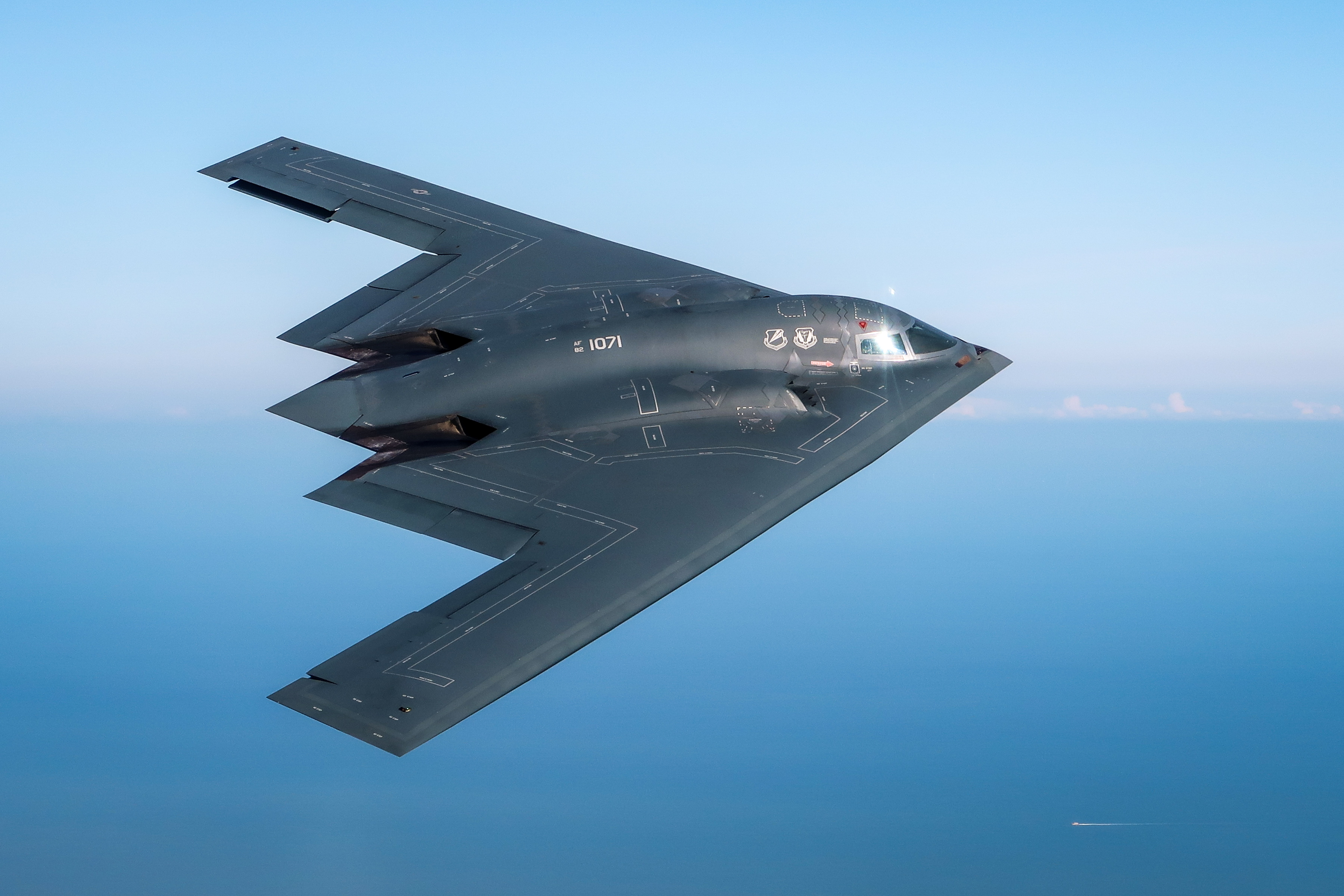
The B-21 Raider is the U.S. Air Force’s Long Range Strike Bomber (LRS-B), a twin-engine, flying-wing strategic bomber built around an open-architecture mission system. The program began in 2014, the contract went to Northrop Grumman in 2015, the aircraft was rolled out to the public on 2 December 2022 at Palmdale-Plant 42, and made its first flight on 10 November 2023 at Edwards Air Force Base.
Its name “Raider” honors the Doolittle Raiders, the World War II crews who hit Tokyo. The B-21 shares the flying-wing aerodynamics of the B-2 Spirit, but differs in four important ways:
- Open Mission Systems (OMS): Software and hardware are modular — future weapons and sensors plug in rather than requiring a redesign.
- Optionally manned: First production blocks are crewed, but the airframe was designed from the start for unmanned operation.
- Digital stealth: Shaping is only one layer. Skin coatings (RAM — radar-absorbent materials) and integrated electronic warfare give multi-spectral invisibility.
- Lower sustainment burden: B-2 spends roughly half of its flight hours in the hangar. B-21’s modular maintenance concept is built for forward-operating bases.
What Does It Do?
- Strategic nuclear deterrence. When B-1B and B-52 retire, the B-21 will carry the air leg of the U.S. nuclear triad with the B61-12 gravity bomb and the forthcoming LRSO cruise missile.
- Conventional long-range strike. Hypersonic munitions (AGM-183A ARRW), JASSM-ER cruise missiles and the GBU-57 MOP bunker-buster all integrate with the B-21’s internal bays — designed for penetration of anti-access/area-denial (A2/AD) environments.
- Intelligence-surveillance-reconnaissance (ISR). The aircraft can stay inside denied airspace, find targets, jam, and feed sensor data back to the rest of the joint force. Penetrating counter-air is a central doctrine role.
- Battle network node. Open architecture means B-21 acts as a central hub linking NGAD fighters, Collaborative Combat Aircraft (CCA) drones, and space-based sensors.
Technical Specifications
| Spec | Value (disclosed) |
|---|---|
| Crew | 2 (optionally unmanned) |
| Layout | Flying-wing (tailless) |
| Engines | 2 × Pratt & Whitney PW9000-family (classified, B-2 F118 derivative) |
| Size | Smaller than B-2; estimated ~40 m wingspan |
| Range | 9,300+ km (unrefueled) |
| Internal payload | ~14,000 kg (less than B-2’s ~18,000 kg; efficiency-first) |
| Stealth generation | Sixth-gen — “sub-insect RCS” claim |
| Avionics | Open Mission Systems (OMS), distributed sensor fusion |
| EW suite | Wideband adaptive electronic warfare, internal |
| Nuclear capability | B61-12 gravity bomb + LRSO cruise missile (under development) |
| Conventional weapons | JASSM-ER, JDAM, GBU-57 MOP, ARRW (hypersonic) |
| Air-to-air refueling | KC-46 / KC-135 compatible |

Operators and Contracts: Who Bought, How Much
The B-21 program is currently single-customer. The structure:
| Operator | Qty | Value / Year |
|---|---|---|
| U.S. Air Force (USAF) | At least 100 (LRIP in progress) | ~USD 692M per unit (FY2022) — ~USD 200B total program |
| USA (production acceleration) | +25% rate | USD 4.5B addendum (2025) |
| Australia (in negotiation) | Export authorization granted (2024) | Undisclosed, AUKUS Pillar 2 scope |
Export of the B-21 is restricted under ITAR; the program is reportedly limited to Five Eyes allies. Australia formally requested information in 2024 and the decision is still pending.
Why It Matters for Turkey — A Different Philosophy
There is no direct Turkish counterpart to the B-21, because neither the requirement nor the doctrine overlaps. Türkiye solves the same long-range strike problem with three different platforms at far higher cost-effectiveness:
| Criterion | B-21 Raider | Turkish Doctrine |
|---|---|---|
| Philosophy | Crewed stealth platform | Hybrid: unmanned + ballistic + cruise missile |
| Long-range strike | B-21 + JASSM-ER (~1,000 km) | TAYFUN (>500 km) + GEZGİN cruise missile (>800 km) |
| Stealth platform | B-21 (~USD 692M / aircraft) | KAAN (fifth-gen fighter) + KIZILELMA jet UCAV |
| Unmanned strike | B-21 (optionally unmanned) | AKINCI + AKSUNGUR + KIZILELMA |
| Nuclear deterrence | B61-12, LRSO | NATO nuclear sharing (Incirlik) + conventional deterrence |
| Unit cost | USD 692M | TAYFUN: USD 3-5M/missile, KIZILELMA: ~USD 30M |
| Export sovereignty | ITAR-restricted, Five Eyes only | 100% indigenous, export-ready |
The Turkish path is asymmetric advantage: ballistic missiles arrive seconds before impact; jet-UCAVs are produced for a fraction of a manned aircraft’s cost; low-observable platforms like KIZILELMA reach the target before enemy radar can react. This doctrine fits NATO’s European flank — it does not need to match the geographical demands of U.S. operations in the Pacific.
Global Counterparts
- Xian H-20 (China): Reportedly flying-wing, still pre-flight. AVIC’s strategic bomber program — the closest direct rival on paper.
- PAK-DA (Russia): Tupolev’s stealth bomber project, in development since 2018, first flight targeted 2027.
- B-2 Spirit (predecessor): 19 aircraft active since 1989. Inflation-adjusted unit cost ~USD 2.1B.
- B-52H Stratofortress: In service since 1955, complements rather than competes with the B-21. Non-stealth but unmatched range and payload.
- B-1B Lancer: Variable-geometry supersonic bomber retiring as B-21 enters service.
Frequently Asked Questions
Northrop claims a “sub-insect” radar cross-section. The B-2’s RCS is comparable to a small bird; the B-21 is said to be significantly lower.
Yes. AGM-183A ARRW and other Mach-5+ munitions integrate with the B-21’s internal bays, alongside JASSM-ER and the future LRSO cruise missile.
No. ITAR restrictions and nuclear architecture limit the B-21 to Five Eyes allies. Türkiye’s roadmap centers on KAAN + TAYFUN + KIZILELMA.
Ellsworth Air Force Base receives the first operational squadron in 2027. Production was accelerated by 25% in 2025 under a USD 4.5B addendum.
Yes — gradually. The 19 B-2s phase out through the 2030s as 100+ B-21s come online.
The airframe was designed to be optionally unmanned. First production blocks are crewed; future software updates enable autonomous missions.
Bottom Line
The B-21 Raider is an instrument designed for U.S. global power projection — the long-range stealth strike platform of the Asia-Pacific century. It is not a direct benchmark for Türkiye. The Turkish industry solves the same mission with a ballistic missile + unmanned aircraft + jet-UCAV triad that preserves export sovereignty and undercuts unit costs by orders of magnitude. KAAN’s stealth profile, KIZILELMA’s unmanned jet configuration, TAYFUN’s reach, AKINCI’s payload — instead of compressing all of it into one airframe, Türkiye networks them. The B-21 is a remarkable engineering achievement; the Turkish path is a remarkable engineering achievement in a different dimension.
Related Reading
Northrop Grumman — Company Profile
Maker’s file: history, product family, global export footprint.
F-35 Lightning II Explained
The fifth-gen stealth fighter that would escort the B-21.
THAAD Explained
The U.S. high-altitude missile shield that complements the strategic strike triad.
Türkçe sürümü — B-21 Raider Nedir?
Turkish-language explainer with the same Türkiye comparison.
Sources
- Northrop Grumman — B-21 Raider press page (northropgrumman.com)
- U.S. Air Force — B-21 Raider official fact sheet (af.mil)
- Wikipedia — “Northrop Grumman B-21 Raider”
- Air Force Magazine — B-21 LRIP reporting (2023-2025)
- The Aviationist — B-21 first flight and rollout analysis
- Defense News — B-21 production acceleration contract (2025)